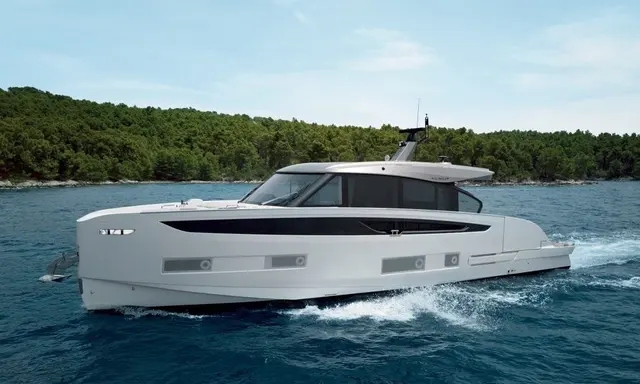
Australian builder ILIAD Catamarans has arrived in Europe with the ILIAD 53F OffGrid Hybrid, using Cannes for both its first major European show and the global premiere of the new propulsion package. The 16.37-metre power catamaran is based on the established 53F platform but integrates a parallel hybrid system developed with e-Motion Hybrid Systems.
The project is intended to reduce generator use and allow periods of silent low-emission operation without asking owners to rely on batteries alone for every passage. Twin Volvo Penta D6 diesels remain part of the system, supported by high-capacity lithium storage, electric propulsion capability and a large solar array integrated into the roof structure.
Parallel hybrid rather than battery-only
The OffGrid system is designed to move between diesel and electric modes according to operating conditions. ILIAD says the parallel architecture allows the conventional engines to drive the yacht directly when required, while electric operation can be used for quieter manoeuvring and low-speed cruising.
That approach is deliberately conservative compared with a fully electric yacht. Long-range owners retain the energy density and refuelling convenience of diesel for demanding passages, but they can reduce engine and generator running during the many hours spent at low load, at anchor or moving slowly around a destination.
Nearly eight kilowatts of solar
A carbon-fibre roof extension carries a 5 kW solar array, while another 2.96 kW of flexible panels are integrated into the coachroof. Together, the panels are intended to support hotel loads and recharge the battery system when the yacht is operating away from shore power.
ILIAD says the battery bank can support onboard systems, including air-conditioning, for as long as 24 hours under suitable conditions and can be recharged rapidly when the engines are running. Those are builder estimates that will vary with climate and hotel demand, but they show the level of autonomy the engineering team is targeting.
A proven 53F platform underneath
The hybrid package sits within the same 53F architecture that has already been used for conventional diesel-powered yachts. Official specifications give the catamaran an overall length of 16.37 metres and a beam of 7.63 metres, with the builder promoting a range of more than 3,000 nautical miles depending on configuration and operating speed.
Using an established hull reduces the number of variables introduced at once. Owners can assess accommodation and seakeeping from the existing model while the new yacht focuses attention on how effectively the revised energy system changes fuel use, noise and daily generator hours.
Lower engine hours are part of the ownership case
ILIAD estimates that engine operating hours could fall by as much as 75 percent during a typical cruising season when the hybrid system is used as intended. The yard links that reduction not only to fuel consumption but also to maintenance intervals and the quieter environment created when combustion machinery can remain stopped.
The exact saving will depend heavily on owner behaviour. A yacht running air-conditioning continuously in tropical conditions will have a different energy balance from one cruising temperate waters, but the design gives owners more ways to match machinery use to actual demand rather than running a large diesel generator for small electrical loads.
Cannes is a European market test
ILIAD has grown primarily in Asia-Pacific and North America since launching in 2019, so Cannes represents a major step in its geographic expansion. Europe has become an important market for power catamarans, particularly as owners look for large living areas and lower-speed efficiency within manageable overall lengths.
The OffGrid Hybrid gives the builder a technology-led introduction rather than simply bringing an existing model across the world. If European buyers respond to the combination of long-range diesel security and quieter battery-supported operation, the 53F platform could become an important bridge between conventional and fully electric multihull cruising.
Hybrid value will be measured in ordinary cruising days
The most persuasive test of the OffGrid package will not be a short demonstration run in electric mode. Owners need to know how often engines and generators can remain stopped through a normal cycle of anchoring, cooking, air-conditioning, manoeuvring and passage making, because those everyday hours determine whether the investment produces a quieter and less fuel-intensive ownership experience.
ILIAD has an advantage in using an established 53F platform because conventional examples already provide a reference for space, range and machinery access. The hybrid yacht can therefore be judged on what the new energy system changes rather than on an entirely unfamiliar hull. That should make owner feedback from the first European boats particularly useful as the technology is refined.