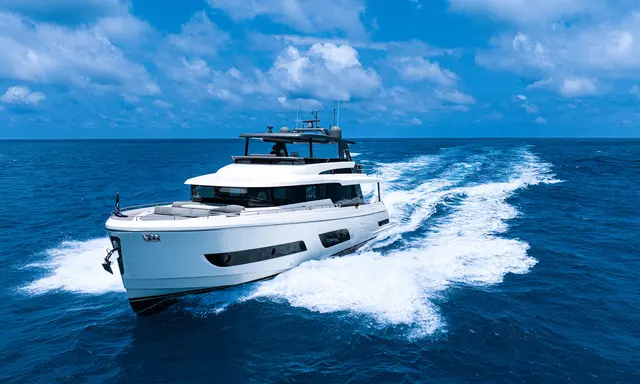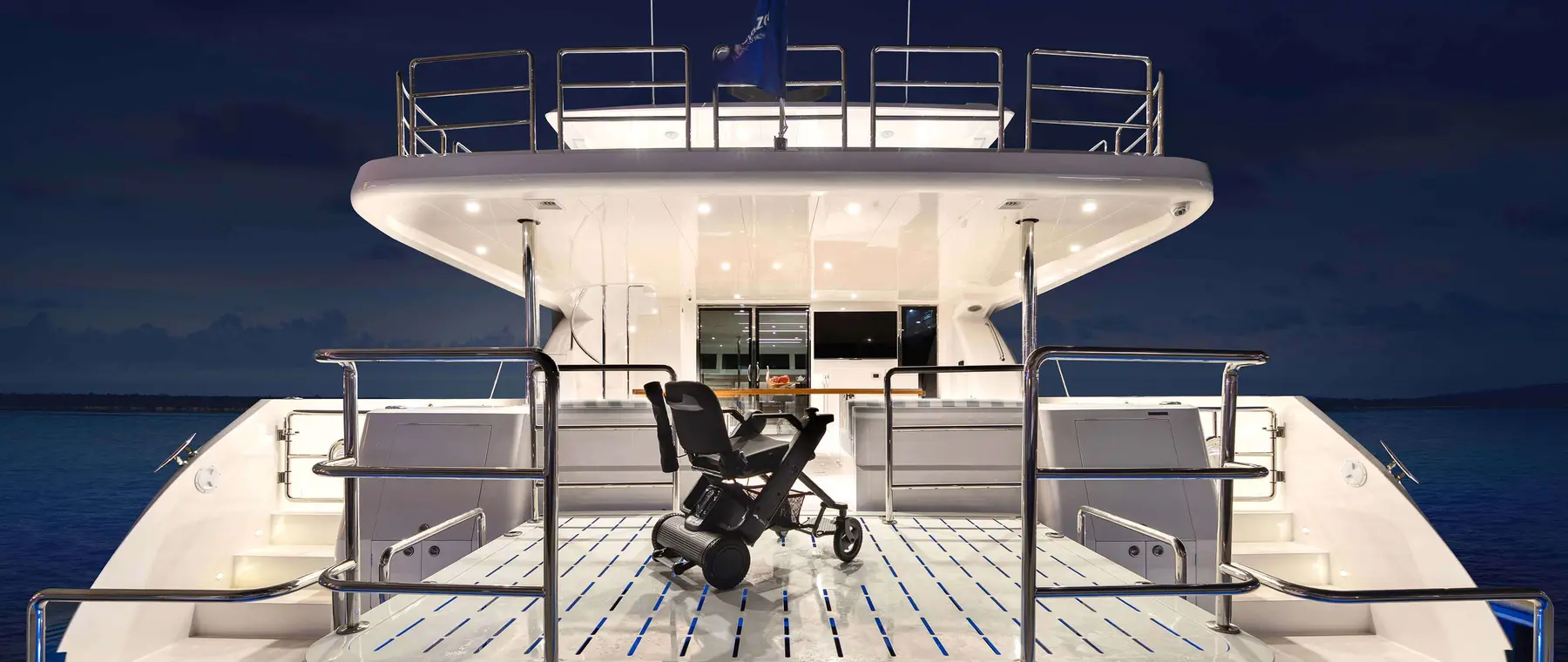
Horizon Power Catamarans has used the established PC68 platform to address a part of yacht design that is often treated as a retrofit rather than a starting point. Announced on 10 September 2026, the PC68A has been developed around independent mobility from dockside boarding through to the flybridge, with Horizon describing it as the first power catamaran in its size range to integrate an interior elevator as part of the yacht's core architecture.
The project was developed with Horizon Group's Vision Shipyard in Taiwan and The Powercat Company, with Vision Shipyard president Austin Lin and Powercat founder and chief executive Richard Ford involved in re-engineering the platform. The result keeps the broad lifestyle proposition of the PC68 while changing circulation routes, access points and interior arrangements so an owner using a wheelchair can move through the boat with fewer physical barriers.
Accessibility designed into the yacht
The changes begin before anyone steps aboard. Horizon says the PC68A provides five wheelchair-friendly boarding options through a combination of a retractable boarding ramp, widened side gates and a hydraulic hi-lo platform, while the tender crane has been repositioned to make transfers between yacht, dock and tender more practical.
Inside, automatic saloon doors, level flooring and wider passageways are intended to preserve that continuity. The centrepiece is a purpose-built elevator linking the starboard-hull owner's suite, the main deck, and the flybridge and Portuguese deck level; frameless glass doors and a rotating platform are designed to align a wheelchair for entry and exit without awkward reversing manoeuvres.
Living spaces reworked around independent movement
Horizon has also reconfigured the owner's suite, galley and associated accommodation rather than stopping at circulation. Appliances have been repositioned in the galley and the master stateroom includes a purpose-built transfer platform, illustrating how accessibility can affect seemingly ordinary design decisions such as reach heights, clearances and the relationship between furniture and passageways.
That matters in a luxury-yacht context because the most successful accessible design tends to disappear into the general quality of the boat. Wide circulation, level thresholds and intuitive deck connections can improve life on board for every guest, while avoiding the institutional appearance that can result when specialist equipment is bolted onto a finished interior.
Silent living and conventional cruising performance
The PC68A is not being presented only as an accessibility exercise. Horizon's Silent Living Package combines a 1,600 amp-hour Victron battery bank with a Termodinamica air-conditioning system, with the builder saying the arrangement can support generator-free operation for as much as 20 hours a day depending on use and conditions.
Propulsion comes from twin MAN i6 engines rated at 850 horsepower apiece. Horizon quotes a cruising speed of about 20 knots and a top speed of approximately 25 knots, while high-output alternators are intended to recharge the battery system underway; that combination keeps the yacht within the familiar performance envelope expected from this class of cruising power catamaran.
Why the PC68A matters
Accessible yacht design has traditionally depended heavily on custom projects, which can make it expensive and difficult for owners to compare solutions before construction begins. By integrating these features into a repeatable production-derived platform, Horizon is testing whether accessibility can become a defined configuration rather than a one-off engineering problem solved separately for each owner.
The first PC68A is scheduled to make its global debut at the 2026 Fort Lauderdale International Boat Show. That public debut should provide a clearer view of how successfully the lift, boarding systems and reworked accommodation have been integrated into the finished yacht, but the engineering brief already makes the PC68A one of the more distinctive developments in the sub-24-metre luxury power-catamaran market this year.
Questions the first boat will answer
The Fort Lauderdale debut will make it possible to judge details that cannot be settled from a specification sheet, including the speed of movement between levels, the clear space around furniture and the way accessible routes interact with guests using the yacht conventionally. Those practical observations will matter because a successful solution must feel natural during everyday cruising, not merely demonstrate that a wheelchair can physically reach each deck.
The production context is also worth watching. If the PC68A is repeatable without turning every build into a fresh custom-engineering exercise, Horizon will have created a model that can give more owners a defined starting point for accessibility discussions. That could influence expectations elsewhere in the market, particularly among buyers who need mobility support but still want the finish, performance and resale logic of an established series yacht.