A new offering at the upper end of the 20m category
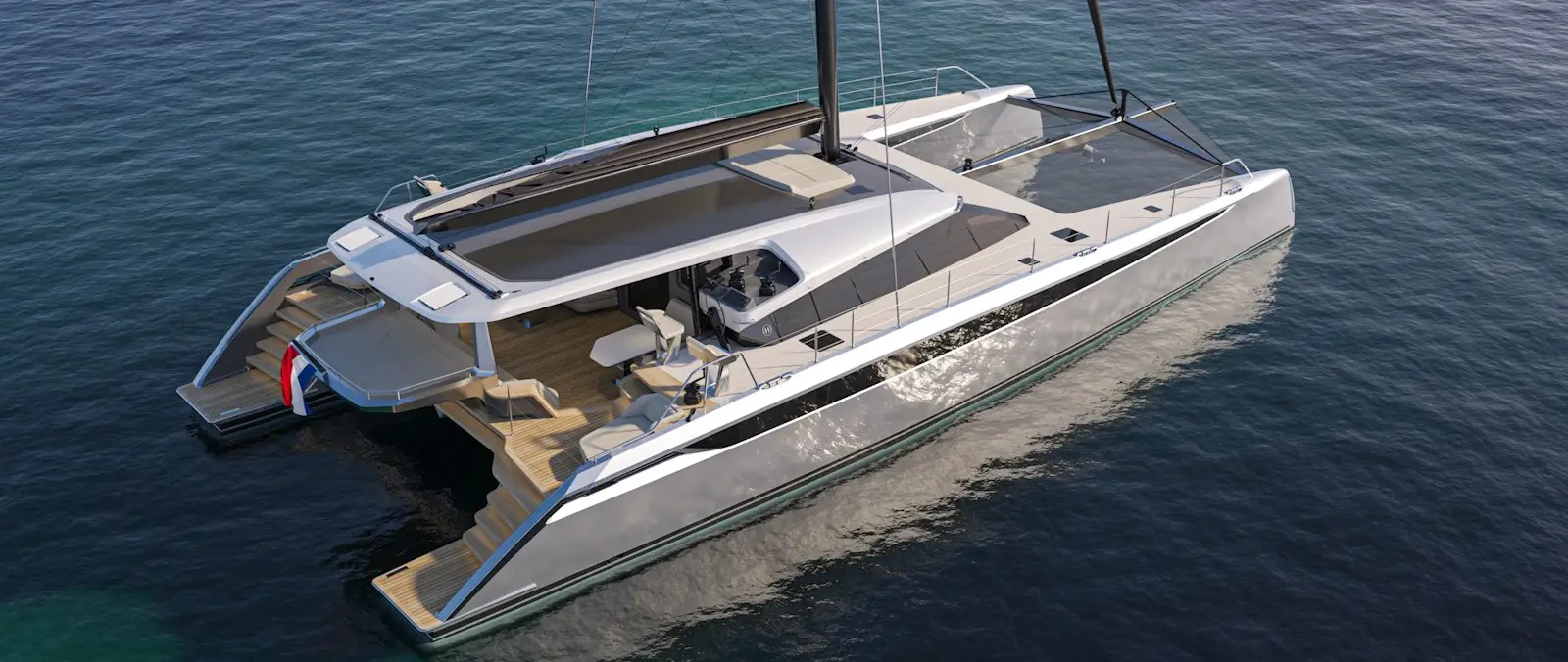
Northrop & Johnson has announced a brokerage appointment for the HOLLD 76, a 23.3-metre sailing catamaran currently under construction in the Netherlands. The semi-custom project is offered at €15 million through broker Sean McCarter, with delivery anticipated in spring 2027. The announcement on 3 November places a high-performance, shallow-draft multihull in a market where many owners compare space, sailing autonomy and the possibility of changing a new-build specification. The vessel should be described as an advanced construction project, not a delivered or sea-trialled yacht.
HOLLD Yachts says its team brings more than 25 years of experience in composite construction for large yachts. That experience is relevant because lightweight structures underpin the model's ambitious performance aims. A prospective buyer will still need detailed build specifications, survey opportunities and an agreed delivery programme. A published asking price and design rendering provide a useful starting point, but cannot establish the final equipment standard or performance of a particular boat until her construction and commissioning are completed.
Vacuum-infused structure and the sailing brief
The builder describes hulls, deck, keels and furniture produced through a one-shot vacuum-infusion process. Composite techniques are used to manage weight and stiffness, factors that matter on a wide-beam performance catamaran. Naval architecture comes from Thorne Design, while Dijksman Design is responsible for exterior styling. These separate roles are important because the form of a fast catamaran must reconcile resistance, structural loads and the accommodation demanded by an owner. The result is being positioned as a long-range family cruiser with a strong interest in speed.
Northrop & Johnson says speeds above 25 knots are envisaged in suitable sailing conditions. That is a design claim rather than a recorded result from sea trials. Buyers should ask for target displacement, sail plan assumptions and the conditions under which such a figure might be possible. The yacht's 10.2-metre beam offers significant interior potential, but creates practical questions about marina berths, harbour manoeuvring and lifting facilities. A cruising programme should account for those everyday constraints as seriously as it considers speed offshore.
Shallow draft and control from three helms
A quoted draft of 1.45 metres is one of the project's distinctive features, offering an opportunity to approach anchorages inaccessible to deeper-draft sailing yachts of comparable length. The brokerage specifically mentions cruising areas such as the Bahamas. Sailing equipment is planned to include an Axxon carbon mast and boom, composite rigging and Harken deck hardware. Three helm stations are specified, including a protected interior station, supported by a B&G navigation installation. These choices suggest an emphasis on flexible watchkeeping and operation by a relatively small crew.
The practical usefulness of shallow draft depends on more than a number. Rudder configuration, machinery protection and the conditions of a particular anchorage need consideration, especially where bottom type or tides are difficult. Equally, an interior helm can improve shelter but must provide appropriate visibility and access to sailing controls. An owner considering short-handed operation should ask how sail handling, anchoring and tender deployment are managed during a normal voyage, not assume that an additional helm alone reduces workload.
Interior flexibility is a central selling point
Linda Chevallera is credited with the interior design, which the sales announcement describes using Tabu Oak veneers, leather and carbon-composite furniture. Full-height glass doors and large windows are intended to connect the main deck's salon, dining area and galley with the aft cockpit. This is the type of arrangement that attracts multihull buyers: living space can remain close to the water without sacrificing wide circulation routes. The advertised standard plan accommodates six to eight guests in three main cabins, with a forward starboard owner suite and a port-side VIP.
Alternative plans of as many as six cabins are proposed, with flexible spaces for family or crew. The actual suitability of any version depends on the client's intended use, the number of people aboard and the storage needed for extended cruises. A larger cabin count may reduce room sizes or change service access, while retaining fewer suites may make longer stays more comfortable. An owner should examine detailed deck plans and technical compartment access before treating any advertised layout as final.
Outdoor living and autonomy features
The exterior programme includes a teak-decked aft cockpit, a sun lounge above the deckhouse, a bow trampoline and transom sunbeds. A sculptural carbon davit arrangement incorporates a suspended netted lounge looking out toward the sea. Such features are part of the lifestyle case for a broad multihull, but their design must also consider safe movement, line handling and the management of equipment in rough weather. A visually striking piece of deck furniture is useful only if it sits comfortably within the practical priorities of the yacht.
The design also advertises substantial solar capacity, lithium battery storage, hybrid-ready propulsion and redundant systems for longer passages. No independently measured energy budget is presented in the broker's announcement. Owners should therefore request the electrical load assumptions, the intended propulsion package and the way hotel services operate when sailing or at anchor. Equipment that promises autonomy can impose additional maintenance and monitoring requirements; crew training and support arrangements remain central to making such systems dependable.
What buyers should establish before committing
The HOLLD 76's combination of size, shallow draft, flexible accommodation and an ambitious performance brief distinguishes it from a conventional monohull in the 20-metre class. The Northrop & Johnson listing creates an opportunity for buyers to discuss the build specification while important decisions may still be open. It does not establish how much freedom remains to change structure or equipment, nor whether the published delivery estimate can be guaranteed. Those questions belong in formal discussions with the shipyard and the selling broker.
A prudent purchase process will look beyond renderings to the current state of construction, materials, classification or certification arrangements, warranty terms and sea-trial acceptance criteria. Potential owners should also check the commercial consequences of any customization. The fresh announcement is significant because it brings a clearly priced, near-delivery performance catamaran into view. Whether it suits a given owner depends on the balance between sailing ambition, comfortable family use and the day-to-day realities of maintaining a sophisticated multihull.