Moving AI from analysis into yacht design
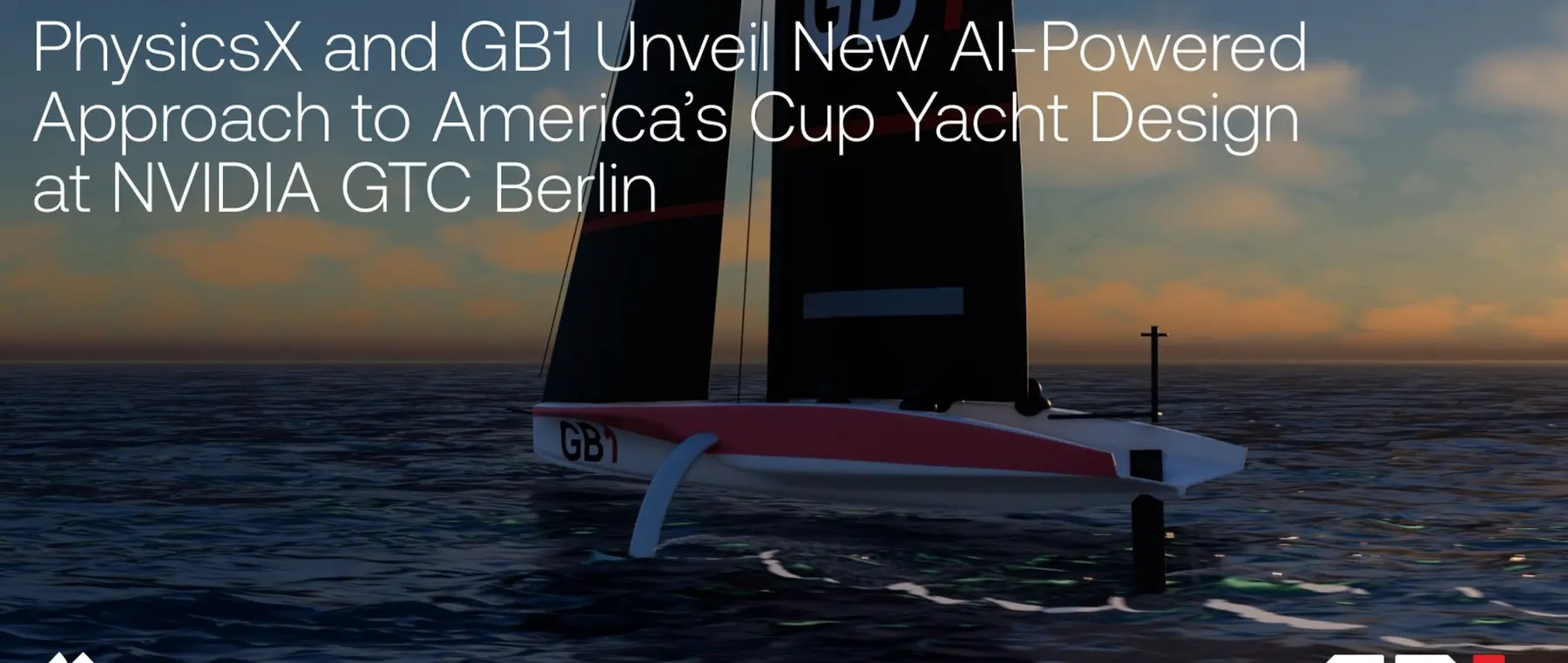
GB1 has expanded its technology partnership with PhysicsX to develop an artificial-intelligence-led approach to high-performance yacht design. Announced on 21 October 2026 at NVIDIA GTC Berlin, the work aims to let engineers examine many more potential hull forms than could be considered through conventional design-and-test cycles.
The programme is being developed with an eye to future America's Cup rules and the design possibilities of the 2029 cycle. It is distinct from the immediate 2027 campaign in Naples, where returning teams are required to use their existing AC75 hulls.
The difference between shape and performance
GB1 describes two types of foundation model at the centre of the workflow. Large Geometry Models create candidate hull shapes within the team's defined design space, while Large Physics Models estimate their physical performance without having to run a full traditional simulation for every alternative.
The distinction matters because creating an unusual hull is easy compared with determining whether it will be quick, controllable and legal. A design team must consider not only a theoretical reduction in resistance, but also how shape interacts with stability, foil configuration, structural requirements and changing conditions on the water.
The reported speed of simulation
According to the team's announcement, early results have delivered a five-fold reduction in the need for high-fidelity Reynolds-averaged Navier–Stokes simulation work. GB1 also reports accuracy gains of around one hundred times compared with previous panel-method approximations, along with design evaluations that can be performed up to one hundred times faster.
These are project-reported engineering results, not an independently verified prediction of race speed. A faster analytical system may improve the number of concepts engineers can examine, but it does not automatically make the finished yacht proportionally faster on the water.
A different workflow for naval architects
Traditional yacht development proceeds through repeated geometry creation, numerical analysis, selection and refinement. The PhysicsX collaboration seeks to make those loops more continuous, using AI to propose shapes and produce rapid performance estimates before the most promising candidates receive expensive high-fidelity checking.
GB1 refers to this as an AI-native workflow, but the term should not obscure the role of experienced naval architects and designers. Engineers still need to define valid parameters, impose class-rule limits, recognise physically implausible outputs and decide when computer predictions are reliable enough to guide a costly manufacturing choice.
The system uses NVIDIA accelerated computing infrastructure, reflecting the substantial computational resources required to train models and deploy them at speed. The announcement does not give a total project cost or identify a particular commercial graphics processor as the sole driver of the reported gains.
Why class rules change the design problem
For the next America's Cup in Naples, the existing-hull requirement directs innovation towards systems, appendages and modifications permitted by the 2027 regulations. GB1 says the partnership's latest phase considers a broader future design space associated with the subsequent 2029 competition.
That longer view is significant because hull generation becomes more valuable when designers have genuine freedom to choose new geometry. The work can also inform how a team structures its design knowledge, even if particular shapes eventually fall outside class measurements or practical construction limits.
What the technology could mean for yacht building
High-end yacht builders also rely on computational fluid dynamics and detailed numerical modelling to understand efficiency, seakeeping and comfort. There is a plausible future in which related AI methods reduce the time required to evaluate a range of displacement and planing hull options, although GB1's claims specifically concern its own racing programme.
Commercial and leisure vessels have different requirements from an AC75: payload, interior volume, long-term durability, quietness and realistic operating cost all matter. Any technology transfer would therefore require fresh validation rather than a direct application of racing results to a cruising yacht.
PhysicsX and GB1 have presented the collaboration as a faster way to test ideas and support decisions under racing deadlines. The test of its longer-term value will be whether engineers can consistently turn those predictions into measured improvements once the next class of boats is built and sailed.
Related event: Louis Vuitton 38th America's Cup, Naples 2027.