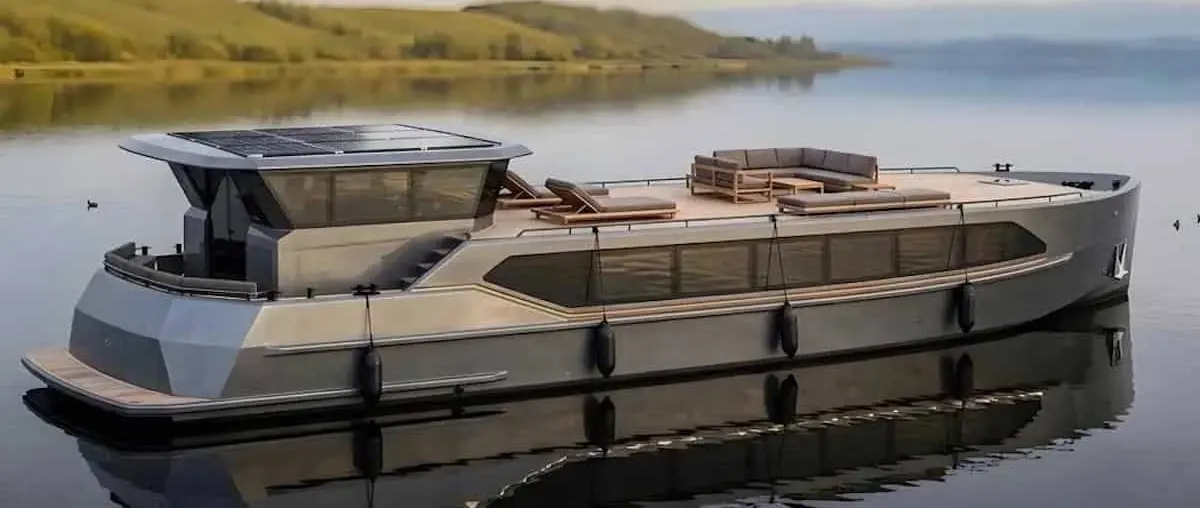
A different answer to the 20-metre yacht
Italian designer Gian Paolo Nari and marine consultant Lorenzo Cappugi are developing a 19.9-metre contemporary barge concept intended to combine European canal cruising with carefully planned coastal passages. A fresh industry report published on 15 October examines the idea, which was first presented in September. The project is a design proposal, not a launched production yacht; neither delivery dates nor completed sea trials have been announced.
Its appeal is the possibility of bringing the interior volume and styling of a modern motor yacht to waterways where conventional deep-draught craft may struggle. The developers envisage an owner who can move between a city-centre waterfront and sheltered coastal destinations. That proposition is subject to the design being engineered, built and approved, as well as to local passage restrictions on any intended route.
Dimensions chosen around European canals
The concept measures 19.90 metres overall with a beam of 4.85 metres, a proposed full-load draught of 1.20 metres and an indicative air draught of 3.40 metres. The designers say those figures were developed with the Freycinet gauge in mind. That approach makes route access a central design requirement instead of an afterthought, although real operating limits depend on bridge heights, lock dimensions, seasonal water levels and local authorities.
A broad hull can provide extensive living area at a length under 20 metres, but dimensions are not sufficient proof of unrestricted canal access. Waterways vary and so do available moorings, lock approaches and bridge clearances. Prospective customers would need the final certified dimensions and an itinerary checked against current navigation notices before treating inland compatibility as an accomplished fact.
Four proposed versions, not four deliveries
Four styling and layout versions have been outlined under the names Vega, Aura, Obsidian and Lumina. Vega, Aura and Lumina are described with full-beam main-deck interiors, while Obsidian retains external side decks. This distinction shows a deliberate trade-off between internal space and ease of movement along the outside of the craft. The versions remain design alternatives rather than completed hulls.
All four concepts include an aft bathing platform intended to connect the accommodation to the water. Buyers would still need to study practical access from locks and quay walls, tender arrangements and how guests move between inside and outside areas. A wide main deck maximises space but may not suit every operating preference, particularly where the owner expects to handle lines directly at a succession of short canal stops.
Hybrid propulsion is being studied
An indicative propulsion arrangement combines two electric motors rated at 80 kW each and a 45 kW generator or range extender. The proposed series-hybrid architecture would also incorporate a battery bank, rooftop photovoltaic panels and shore-power charging. Published design information describes a target cruising speed of roughly 7.5 to 8.5 knots and a possible maximum near 10.5 knots, but these are estimates associated with the current proposal.
Battery capacity, measured range and fuel-consumption figures have not been released, and there is no evidence of a completed installation undergoing trials. Electric drive could reduce noise and eliminate local exhaust emissions in suitable operating modes, but the benefit would depend on battery energy, power demand and charging infrastructure. The boat should therefore be judged as an interesting engineering plan rather than a proven zero-emission vessel.
Steel and aluminium meet residential design
Cantieri Navali di Termoli, also associated with the Italian Vessels name, has become an engineering and potential construction partner. The platform is envisaged with a steel hull and aluminium superstructure, drawing on methods familiar in robust commercial and custom vessel construction. Designers have referred to future CE Category C or B certification targets that would support use beyond the most sheltered inland conditions if achieved.
Certification is a defined process, not a marketing description. The completed vessel would need an appropriate final design, stability assessment and relevant conformity checks before any operating-category claim could be confirmed. Its full-load mass, safety systems and machinery design remain significant open questions. The involvement of a shipyard adds technical experience, but it does not yet establish a build contract or production schedule.
A lower deck arranged around living space
One published general arrangement concentrates the principal saloon, dining area and galley on the lower deck, with a forward owner’s cabin and an additional guest cabin that could double as a study. Machinery and service spaces are proposed aft. A raised pilothouse is intended to give good all-round visibility, important when approaching locks or manoeuvring close to quays in constrained inland waterways.
The concept devotes the upper level largely to an outdoor terrace with lounge and dining areas. This allows the barge to be imagined as both cruising craft and occasional urban residence, without copying the traditional divisions of a planing motor yacht. The details remain subject to development, however: storage, mechanical access, noise isolation, escape routes and visibility all require careful validation during engineering.
The eVTOL illustration remains futuristic
One version of the proposal explores space on the upper deck for a passenger electric vertical take-off and landing aircraft. The designers present that idea as a possible longer-term link between waterways and urban aviation, not as an operational helicopter or aircraft landing facility offered on the barge today. Nothing in the released material shows an aviation-certified deck or an approved passenger service.
The distinction matters because innovative images can easily be mistaken for available equipment. Adding aircraft operations would introduce demanding questions about structure, fire protection, flight clearances and local permission. For now the far more tangible design ambition is canal-and-coastal mobility within a vessel less than 20 metres long. The aviation element remains a visual exploration rather than a specification.
What this means for the sub-24m market
The Contemporary Barge sits outside the familiar categories of sports cruiser, trawler yacht and pure houseboat. It is an attempt to use modest cruising speeds and high interior volume to connect city berths, rural canal networks and short coastal journeys. That makes it relevant to the 12–24m owner considering longer stays aboard rather than the highest possible speed. Whether the formula becomes viable will depend on engineering, access and build costs.
Nari brings an established custom-yacht design background, while Cappugi contributes marine-consultancy and survey experience. Cantieri Navali di Termoli offers a possible path towards construction, but a production order, final certification and sea-trial results have not been announced. The accompanying image is a project rendering supplied by designer Gian Paolo Nari and shows the Vega version; it is not a photograph of a completed boat.