Fountaine Pajot reports a softer year for boat sales
Fountaine Pajot Group has reported consolidated revenue of €291.3 million for its 2025/26 financial year, down 9.9% from €323.2 million a year earlier. The French catamaran and sailing-yacht manufacturer published the figures on 26 October, covering the twelve months ended 31 August 2026. The announcement describes a leisure-marine market still adjusting after stronger periods of demand, while drawing attention to a slower decline during the second half of the year.
The difference between the two annual revenue figures is approximately €31.9 million. This is a reduction in turnover, not a disclosed net loss, and the market should not confuse lower sales with the company's full profitability position. Fountaine Pajot expects to release its annual financial results later in December, so the October statement does not yet provide the complete picture of margins, net earnings or cash flow for the year.
For owners, dealers and the wider luxury-yacht industry, the figures illustrate a changing commercial environment. Boatbuilders must balance production schedules, working capital and investment in new designs while demand becomes less predictable. A lower turnover figure can reflect several factors, including the timing of deliveries and differences in the size and price of boats sold, so the headline percentage should not be treated as a standalone explanation of the market.
A slower decline in the second half
The company said revenue declined 7.1% in the second half of its financial year, a less severe contraction than in the preceding six months. Management regards this as an early indication of stabilising demand, although it does not represent a return to growth. The distinction is important because the boating industry can show improving comparisons before the underlying market has fully recovered.
Demand for new cruising catamarans is influenced by financing conditions, exchange rates, consumer confidence and the availability of existing inventory. These factors can move differently in Europe and North America, creating uneven conditions for a builder selling across several regions. A period of lower deliveries may also affect dealers whose businesses depend on a predictable flow of new models and their associated after-sales work.
The company has not presented the latest release as a detailed forecast for 2026/27. Buyers and industry observers should therefore avoid assuming that the smaller second-half decline guarantees a return to expansion next year. The more meaningful evidence will come from new-order activity, forthcoming production schedules and the complete annual financial results when they are available.
North America grows despite global weakness
International business accounted for 85% of group sales, demonstrating the importance of Fountaine Pajot's export network. Europe excluding France remained the single largest region at 38% of revenue, while North America contributed 27%. Major export markets represented about 12%, the Caribbean 7%, and the French domestic market the remaining 15%, according to the company's published breakdown.
North American revenue increased by 43% during the year, a striking contrast with the contraction across the group as a whole. That increase helped offset weaker activity in other areas, though the company has not supplied enough detail in this statement to attribute it entirely to higher unit sales, pricing or changes in product mix. The distribution of revenue is a useful indicator of regional opportunity, not a substitute for more detailed market data.
For owners contemplating a new boat, the international nature of the company also matters after delivery. A yacht purchased in one region may be operated and serviced elsewhere, and consistent warranty arrangements and technical support can influence the ownership experience. A robust dealer network is therefore part of the commercial proposition, especially for cruising catamarans whose owners may travel well beyond the country where they originally signed an order.
New catamarans and monohulls underpin the strategy
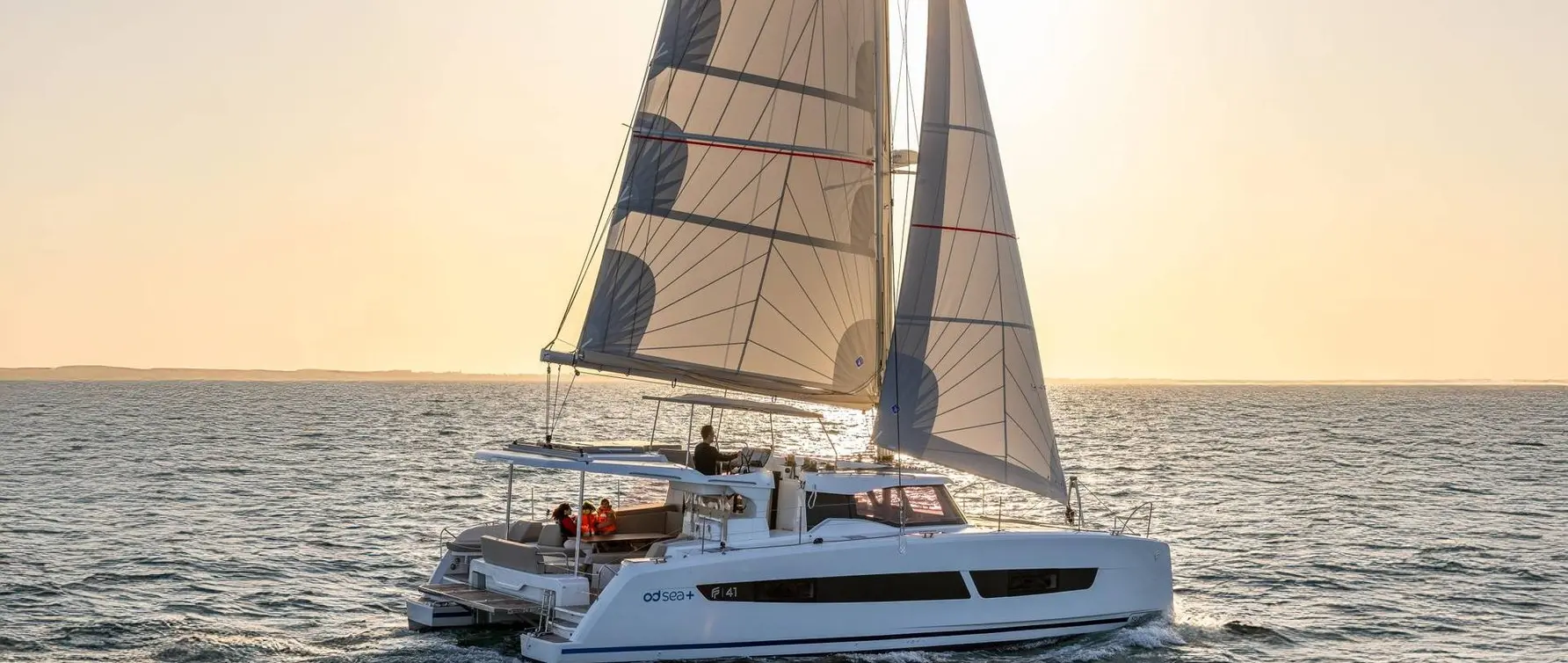
Fountaine Pajot attributes some of its resilience to continued renewal of its model ranges. Recent launches include the FP41 and FP44 sailing catamarans, together with the Dufour 41 and Dufour 44 monohulls and the newer Dufour 54. New designs can help a builder compete when customers become more selective, but launching a model is only the beginning. Production quality, commissioning and the experience of first owners determine whether demand is sustained.
During the autumn 2026 boat shows the company has also presented newer catamaran projects including the FP48, FP55 and FP70, alongside the D39 in the Dufour line. These introductions demonstrate that the business is continuing to invest in products across several size categories rather than responding to the softer market by abandoning its development programme. Prospective buyers should nevertheless distinguish between an announced design, a completed show yacht and a model already available for delivery.
The group is also preparing a larger project in the approximately 120-foot superyacht category, with a planned 2028 launch. That represents a different ownership proposition from its production cruising boats and would require appropriate attention to crew arrangements, technical complexity and long-range support. A development plan should not be interpreted as evidence that an order book or finished yacht has already been secured at the published future date.
What the results mean for the wider market
The company is developing its commercial activities as well as its boat range, including the Velite international brokerage operation and a distribution venture in Greece. These initiatives can provide new ways of reaching owners and supporting transactions, but each needs a sustainable operating model of its own. Brokerage and new-boat production are related businesses with different inventory risks and customer expectations.
A manufacturer's revenue statement is particularly valuable when it provides geographical information and a consistent comparison with the previous year. In this case, it shows that the international leisure-yacht market is not moving uniformly: North American sales rose strongly while the overall group contracted. That pattern challenges the idea that every region and every class of cruising boat responds to changing economic conditions in the same way.
Fountaine Pajot enters the next financial year with a wider portfolio of catamarans and monohulls but also the task of adapting to a more measured market. The €291.3 million revenue figure establishes the scale of the slowdown, while the second-half trend offers a tentative sign of improvement. The full annual results and evidence from forthcoming orders will be needed to judge whether the company's product and distribution strategy is producing a durable recovery.