How an international family office changes its travel needs
A newly released Airbus Corporate Jets study suggests that private aviation is becoming an increasingly important tool for internationally dispersed family offices. The report, published on 1 October 2026, describes organisations trying to coordinate investment meetings, family travel and professional staff across several countries. Its value lies less in presenting private flying as a luxury symbol than in showing how the geography of wealth management can change the daily work of running a family enterprise. When owners, beneficiaries and advisers reside on different continents, time zones and airport connections quickly become operational questions.
Airbus commissioned the independent research company Pureprofile to interview 73 senior family-office executives whose organisations collectively managed $303 billion in assets. Importantly, the interviews were conducted in May 2025, even though the announcement appeared in October 2026. The combined asset figure describes the group represented by the interviewees, not the value of aircraft they operate or a measure of overall family-office wealth. This is a specific commissioned survey and should not be read as representative of every family office, every private-aircraft operator or the entire global luxury travel market.
A greater spread of residences and investment activity
Nearly 70% of respondents said their organisations had established offices in additional jurisdictions during the previous five years. The leading reported driver was family members living in different countries, cited by 90% of those surveyed, while 72% pointed to more diversified investment portfolios. Twenty-eight percent included geopolitical risk among their motivations. These responses can overlap: a family can be geographically dispersed while also expanding its commercial interests. The resulting itinerary is likely to be shaped by meetings, governance and investment oversight as much as by traditional leisure destinations.
That pattern helps explain why a family office may seek more direct control over departures, stopovers and cabin arrangements. A group may need to convene advisers for a meeting, inspect a property or respond to an unexpected business development without spending days navigating scheduled connections. An aircraft can make such a journey possible, but it also introduces its own constraints: airport slot availability, landing permissions, security checks, crew duty limitations and the range of the selected platform. A useful travel policy therefore begins with actual journeys and people rather than with the prestige of a particular aircraft.
What the respondents said about private jet use
Airbus says 96% of the family-office executives surveyed reported increasing their use of private aircraft over the preceding two years. Every respondent expected their organisation's use to rise further in the next two years, and 85% anticipated an increase of fifty to one hundred percent. That final range reflects individual expectations about future use; it is not an independently calculated forecast for the number of business-jet flights worldwide. The survey also says private aircraft accounted for around 70% of respondents' business-aviation travel, a measure that should not be generalised without the study's sampling limitations.
A related finding concerns the destinations themselves. Sixty-seven percent of the executives said that a quarter to a half of their private-aircraft trips were to destinations without a direct commercial-airline connection. This is a particularly useful operational detail, because access can be more important than aircraft luxury or even absolute flight time. Nonetheless, it does not mean every such destination has an airport suitable for all private jets. Runway performance, weather, customs, parking, local transfers and handling support remain central when drawing up a genuine itinerary. The difference between theoretical range and practical accessibility can be substantial.
Privacy, productive hours and the real cost of convenience
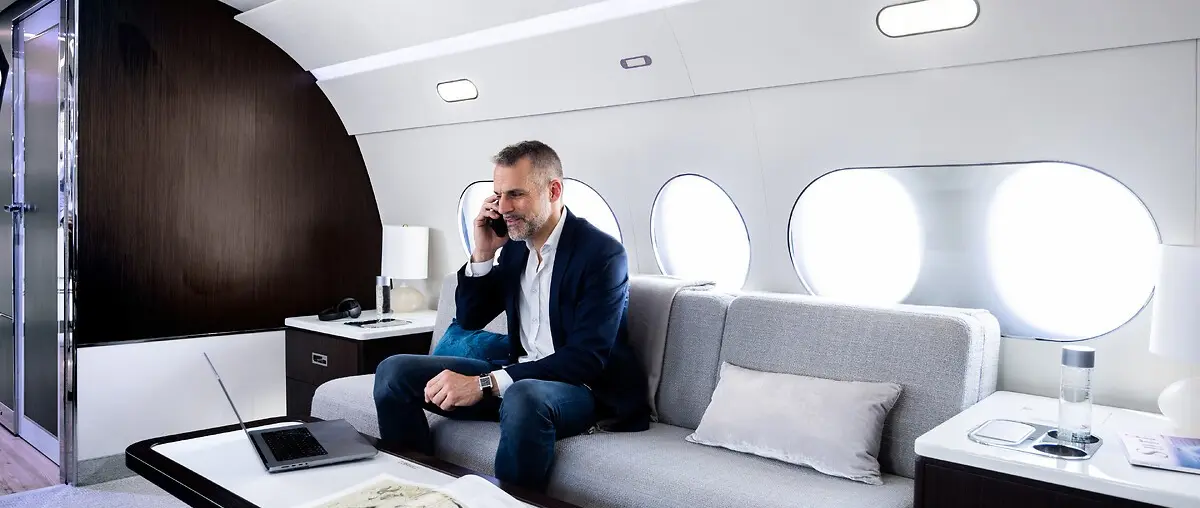
Respondents ranked the ability to work during a flight on confidential matters as their most important perceived benefit, followed by schedule control, privacy and faster travel. Airbus further reports that 89% of the executives believed they saved two to three hours per trip compared with using commercial services. Ninety-two percent described themselves as at least a quarter more productive on private flights. Both sets of numbers are survey responses about perceived gains, not time-and-motion experiments or audited productivity measures. The commercial case for an aircraft should be built on a family's own travel records.
The practical calculus must include far more than flight duration. Pre-departure planning, ground transfer times, crew positioning, weather delays, parking constraints, insurance and maintenance can all affect the total journey. Depending on frequency and range, charter, fractional arrangements and outright aircraft ownership may produce very different costs and degrees of control. A family office that flies irregularly may prefer the flexibility of charter, while an organisation with recurring missions and consistent passenger requirements could justify a dedicated solution. Either way, advisers should test the full annual programme, not only the most memorable long-range trip.
Professional staff and aircraft selection
The study suggests access to private aircraft is becoming broader inside family-office organisations. Airbus says 92% of those interviewed already allowed additional staff to use business aviation, with 97% expecting access to expand further over the next three years. An aircraft used by professional managers and advisers needs a different operating philosophy from one arranged only for occasional family holidays. Passenger manifests, confidential documents, business continuity, data connectivity and predictable booking rules require written policies and clear responsibility. These can be as important as the layout of the onboard meeting area.
Respondents also expected increased use across several aircraft categories. Forty-three percent predicted a fifty-to-seventy-five-percent rise in large-jet use, and 55% gave that same range for midsize aircraft, while around one third indicated similar expectations for light jets. Those answers are not proof that one size will dominate. Large-cabin aircraft provide flexibility for longer missions and group travel, but smaller jets may be more economical or suitable for shorter regional trips. Equipment choices should follow payload, runway constraints, operational range, passenger numbers and annual flight hours, supported by professional flight operations advice.
What this means for the premium aviation market
Airbus Corporate Jets naturally frames the results within its own portfolio, including the ACJ TwoTwenty and larger aircraft derived from commercial airline platforms. Such aircraft can offer expansive cabins configured for work, private accommodation and long journeys, yet no family office should infer from the survey that owning a large aircraft is automatically the most efficient choice. A realistic comparison includes charter-market availability, operating permissions, aircraft utilisation and the ability to obtain maintenance and crew support across the intended network. The best option may be a combination of scheduled travel, private charter and company-owned equipment.
The strongest editorial conclusion is about the management of time and confidentiality in increasingly international family structures. Airbus has identified a group of executives who say the dispersion of family members and businesses makes controlled travel more attractive. The finding deserves attention, especially from aircraft designers, operators and advisers who serve demanding international clients. But the survey was conducted in 2025, released in 2026 and reflects 73 executives. Future evidence about actual aircraft utilisation, deliveries and operator performance will be needed before stronger global market claims can be made.