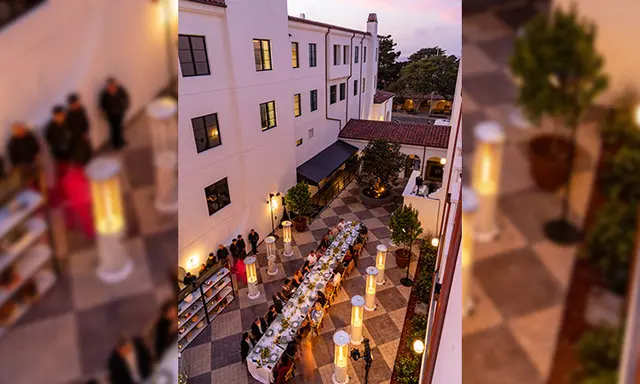
An operating superyacht berth inside a marina still being developed
D-Marin says superyachts can now be received at a dedicated pontoon in Livorno's historic Porto Mediceo, with vessels up to 80 metres within the announced berthing capability. The operator described the milestone at the beginning of October, but it is important to distinguish a usable berth today from the wider marina project that is still being built in stages. For owners approaching the Tuscan coast, the practical development is a new large-yacht option at a port with existing maritime services rather than a claim that every promised amenity has already opened.
The announcement is situated in one of the western Mediterranean's most useful cruising corridors. Livorno offers access to the Tuscan coast and the island of Elba, while the port also functions as an industrial and ferry gateway with a long-established working waterfront. It is precisely that mixed maritime character that makes accurate arrival planning important: superyacht crews should obtain current berthing instructions directly from the marina, and a project's promotional masterplan should never replace official harbour or traffic directions.
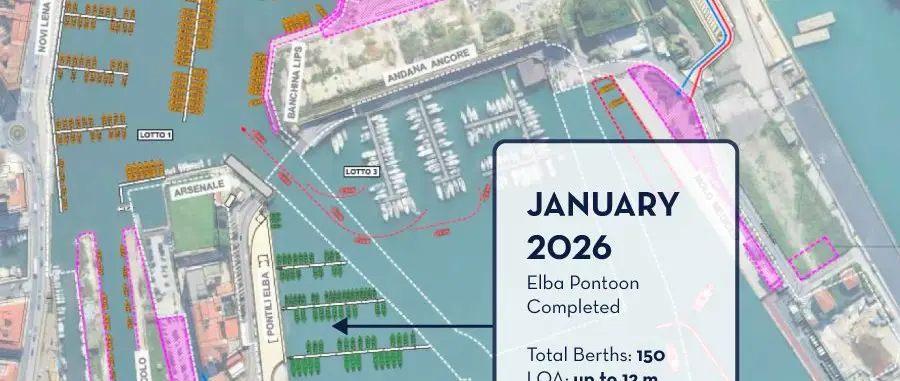
According to D-Marin, the present superyacht operation centres on the Mediceo Pontoon, close to the historic Fortezza Vecchia. Separately, the first phase provides smaller-vessel infrastructure and the operator is targeting further delivery before the end of 2026, followed by the wider project's completion in 2027. These dates are the developer's programme at the time of publication, not independently verified completion certificates or a promise that every future berth can be occupied now.
What the staged opening means for captains
A captain considering Livorno for a seasonal stop should begin with dimensions, draft, actual availability and the intended berth, rather than reading an advertised maximum length as an automatic acceptance of any vessel below it. The stated 80-metre figure is a design and operator capability for a particular pontoon, not a guarantee about tidal, manoeuvring or service conditions for every yacht. Arrival instructions, pilotage requirements and any temporary works restrictions must be confirmed through the relevant harbour authorities and the marina before committing an itinerary.
The operator also describes a completed first stage with 150 berths for boats up to 14 metres and more than 400 spaces in the inner basin. Those figures explain why a phased opening matters: the site serves multiple types of boating while the superyacht area evolves separately. A large yacht arriving for a refit consultation may have very different berthing and shore-power needs from a family cruiser using a small-boat pontoon. Availability should therefore be requested by actual vessel specification, not by a general headline about total marina capacity.
Where a development has an active construction programme, the location of temporary barriers, guest routes, contractor traffic and access to shore services can change. Experienced captains should ask for a current berth plan, an explicit arrival contact and confirmation of which facilities are functioning on the proposed dates. This is sensible normal practice, not a suggestion that D-Marin has reported a specific problem at Livorno.
A Tuscan base with strong shore-side connections
The attraction of Livorno extends beyond the pontoons. Tuscany's principal maritime hub sits within reach of cities and cultural destinations that can turn a technical stop into a shore visit, although transfer times depend on traffic and the chosen itinerary. The municipality of Livorno identifies Porto Mediceo as a historic harbour district, with the northern Tuscan port network administered through the regional port-authority structure. These official geographic sources independently establish the setting described by the marina operator.
For an owner, the choice may be whether to stay aboard while travelling inland or use Livorno as a brief staging point before a coastal passage. For a charter planner or concierge, guests may value access to Tuscan food, art and countryside, but it is important to specify which experiences actually require a journey from the waterfront. Port proximity and cultural proximity are not the same as walkable access to every famous destination promoted under a broad Tuscany label.
The harbour's commercial and industrial functions are also part of its strength. Large yachts often rely on chandlery, maintenance contractors, deliveries and crew logistics that are more readily coordinated around an established port than at an isolated leisure anchorage. D-Marin highlights the nearby shipyard and yacht-service ecosystem; clients should nevertheless contract directly with relevant suppliers and verify access arrangements rather than assume every service is included in a marina berth fee.
The marine network from mainland Italy to Sardinia
D-Marin presents Livorno alongside additions on the Sardinian side of the Tyrrhenian Sea, particularly Marina di Olbia and Molo Brin. Its statement places these facilities in a connected operating network, but each location has its own berth-size limits, programme and stage of readiness. The company says Molo Brin has already received some large yachts ahead of its planned full opening in June 2027. Those are site-specific development statements, not evidence that the whole network has identical current operating capability.
Connections between mainland Tuscany, northern Sardinia, Corsica and the French Riviera may appeal to yachts balancing seasonal use with maintenance and owner travel. A planner can use more than one shore base while cruising the western Mediterranean, but weather, geography, clearance requirements and crew rest still determine whether a route is sensible. A regional operator's portfolio should be treated as a menu of possible stops to verify individually, not a single continuous reservation guaranteeing passage or berthing.
At its broader level, D-Marin says Italy has become its largest regional market following expansion over recent years. Corporate portfolio counts are management-reported figures that can change with acquisitions and operating contracts. For owners, the more actionable question is whether berth agreements, payment procedures, service support and preferences can be coordinated across the destinations they actually intend to use.
Technology and support: useful only when the berth is confirmed
The marina operator highlights digital services including app-based berth management, smart pedestals and monitoring features. For a captain, the advantage of a connected marina system is not the slogan but the quality of the specific task it simplifies: pre-arrival documentation, confirmed service requests, billing details or awareness of a vessel's shore-side systems. Crews should establish exactly which functions are live at Livorno and what local fallback procedures apply when connectivity is unavailable.
D-Marin also promotes security, concierge assistance and hospitality features across the project. Some belong to the broader development plan, so the distinction between available now and scheduled for later should be made during the booking conversation. The most useful marina response is a precise written confirmation of the chosen berth, electricity and water provision, arrival arrangements, responsible contacts, security access and any works that might affect guests.
Annual berth holders may be eligible for the group's Happy Berth Days arrangement at participating marinas, subject to its terms and conditions. It would be misleading to interpret that as automatically free berthing at any destination or for any yacht size. A yacht manager should request the programme conditions, participating locations and any blackout or availability rules before comparing an annual contract with separate transient bookings.
What the official reporting confirms—and what remains provisional
The operator's 30 September announcement explicitly says superyachts are already being welcomed at the Mediceo Pontoon and states the 80-metre upper vessel length for that facility. Its live marina information supplies an office address in Livorno, a local contact number and VHF channel information. Those are useful starting points for direct enquiry, though captains must check they remain current for the intended voyage and comply with official port communications.
The first phase and later construction stages are separately dated in the developer's statement. As of 26 October 2026, an editor can accurately report the opening of a dedicated large-yacht receiving point without claiming that the complete proposed marina has been delivered. Project imagery should likewise be understood as official visual material: a marina illustration or gallery image is not independent proof that every depicted structure is available for use.
The location can be checked against the City of Livorno's description of Porto Mediceo and the Tuscany region's port information. Industry reporting has also recorded the operator's phased-opening statement, but figures originating with D-Marin are attributed to D-Marin here rather than presented as measurements made by an outside auditor. The distinction matters most with large capital projects, where opening dates and capacity descriptions can mean different things at successive stages.
The decision for owners considering Livorno this winter
For owners and captains evaluating the western Mediterranean after the summer peak, D-Marin Livorno is now a candidate worth contacting, especially for a large yacht that values both a sheltered shore connection and proximity to Tuscany's service businesses. The most honest assessment is qualified: the announcement establishes a real large-yacht offering while the finished marina remains a developing project. A potential berth should be judged on a confirmed allocation and service list rather than future landscaping or total proposed slip numbers.
Before setting course, request a written quotation and the latest berth diagram, then verify dimensions, draft, security, provisioning, guest movements and practical access with the marina and harbour authorities. Those steps make it possible to compare Livorno with other bases on requirements that matter aboard. They also avoid a common confusion in new-marina coverage, where an operational first berth is mistakenly described either as a fully finished resort or merely an unbuilt concept.
The primary source for this report is D-Marin's official September announcement, supplemented by the operator's current Livorno marina page and publicly available local-government information about the historic port. The accompanying image is an official D-Marin Livorno project image. This is independently written editorial analysis of an announced operating milestone, not a copied media statement, a charter offer or a guarantee of berth availability.