Two Falcons on the Henderson apron
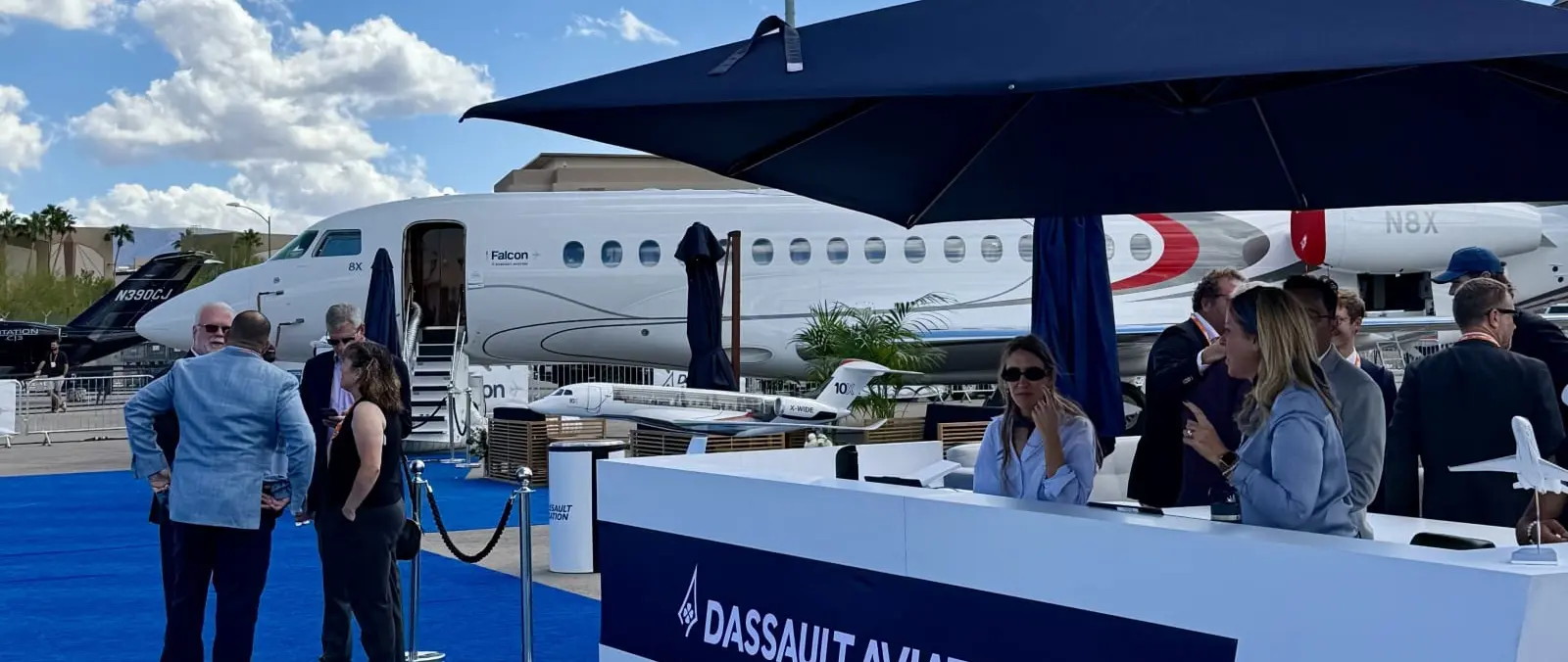
Dassault Aviation used NBAA-BACE 2026 to place the Falcon 6X and Falcon 8X before business-aviation operators and prospective customers at Henderson Executive Airport near Las Vegas. The manufacturer's account, dated 22 October, identifies both aircraft as part of its display while also pointing ahead to the still-developing Falcon 10X.
The business aviation convention took place from 20 to 22 October in Las Vegas, according to organiser NBAA, with the static-aircraft programme at Henderson on 20 and 21 October. That timeline is worth distinguishing from a new aircraft launch: Dassault was showing two established Falcon types, not announcing that the 10X had joined them on the apron.
For a luxury traveller, the pairing offered an unusually direct way to ask what 'long range' and 'spacious cabin' actually mean in different aircraft. Both are designed around business-jet missions, but their cabin proportions, range capability and operating flexibility lead to different conversations with a flight department or charter adviser.
Falcon 6X: cabin room is the headline
The twin-engine Falcon 6X is the wider and taller of the two cabins in Dassault's published specifications, with a height of 1.98 metres and width of 2.58 metres. Those measurements make it particularly relevant to travellers assessing how comfortably a group can move around, dine, work or rest during an intercontinental sector.
Dassault quotes a cabin length of 12.30 metres excluding the flight deck and baggage space, with a volume of 52.2 cubic metres. That figure does not prescribe an interior layout: actual seating and room arrangements depend on the particular aircraft's configuration, so prospective charterers should study photographs and cabin plans of the specific jet they will use.
The manufacturer gives the Falcon 6X a range of 5,500 nautical miles at Mach 0.80 under an eight-passenger, three-crew test assumption with NBAA IFR reserves. A published maximum-range number is not a guaranteed distance for every real-world mission, since winds, payload, weather, routing and alternate-airport planning may reduce what can be flown without stopping.
Falcon 8X: longer reach with flexible layouts
The Falcon 8X offers a published range of 6,450 nautical miles under the same eight-passenger, three-crew reserve basis at Mach 0.80, according to Dassault's technical information. That extra nominal reach may be useful when a traveller values nonstop flexibility between distant regions, although a representative must still check the actual route against conditions on the day.
The 8X's cabin dimensions are different rather than simply larger in every direction: the published interior measures 1.88 metres high, 2.34 metres wide and 13 metres long, excluding the cockpit and baggage. Its approximately 48 cubic metres of cabin volume contrasts with the 6X's wider cross-section, helping explain why the right aircraft cannot be selected by one headline measurement alone.
Dassault also emphasises the 8X's runway and airport flexibility, naming destinations including London City and La Môle–Saint-Tropez among locations it can access in appropriate circumstances. Such statements still require route-specific performance calculations, crew approvals, airport restrictions and local conditions, rather than a blanket assumption that any specific departure or arrival is possible.
The Falcon 10X was the forward-looking story
Dassault used its October show presence to build interest in the Falcon 10X, its next-generation ultra-long-range business jet, but the company did not list the 10X as one of the two aircraft on static display. It is important not to confuse an aircraft-development programme with a model currently available for ordinary commercial or private operation.
The company's Falcon 10X information describes a planned 7,500-nautical-mile range and a spacious cabin measuring 2.03 metres high and 2.77 metres wide. These are design targets from the manufacturer, and should be treated as projected performance and configuration data until final certification and operating specifications are established.
The programme reached a significant stage with a first flight during 2026, giving Dassault a credible development story to discuss alongside the in-service 6X and 8X. Yet the practical purchasing distinction remains: the two aircraft in Henderson illustrate current Falcon capability, while the 10X points to the cabin and route ambitions of a future member of the family.
What a discerning traveller should compare
A private aircraft is often selected around a particular journey rather than an abstract ranking. If a family is moving between a superyacht in the Mediterranean and a residence across the Atlantic, departure-airport suitability, customs arrangements, baggage space and cabin use during the flight may matter just as much as the nominal range.
Cabin height and width can change how spacious a seating area feels, but sleeping arrangements, noise levels, connectivity and service standards differ between individual aircraft. Owners and charter clients should ask for a cabin diagram, certified seating capacity, luggage limits, recent photographs and a realistic mission quote rather than assume every Falcon of the same type has an identical interior.
Operational efficiency also depends on more than engine count or published fuel figures. The distance to a suitable alternate, airport curfews, ground handling, positioning flights and any intermediate fuel stop affect schedule reliability and total journey time, particularly when a complex itinerary must fit around an onward tender or yacht embarkation.
A measured message from NBAA-BACE 2026
The Las Vegas presentation brought Dassault's current widebody and ultra-long-range strengths into a single public setting while keeping the Falcon 10X's development horizon in view. It was a useful comparison for serious buyers, operators and passengers because the 6X and 8X reward different priorities rather than supplying one universal answer.
For travellers accustomed to planning high-value itineraries, the most persuasive point is not the show photograph but the discipline behind aircraft selection. A good flight plan begins with a real passenger list, baggage requirement and airport pair, then matches those needs to the properly equipped and authorised aircraft.
Dassault's display closed with NBAA-BACE on 22 October, but its contrast between cabin space, route flexibility and future development remains relevant. The 6X, 8X and prospective 10X together show how luxury aviation is moving towards a more considered blend of personal comfort, sophisticated flight systems and mission-specific capability.