CMC Marine has introduced a package of updates to its electric stabilisation and manoeuvring systems, led by a new Low Aspect Ratio fin range for Stabilis Electra. The Cannes presentation also included five-blade propellers for Dualis Electra thrusters, a new capacitive touchscreen and an expanded Waveless stabiliser range.
The individual products span several yacht sizes, including equipment aimed at vessels larger than Luxury Yacht Guide's 24-metre upper limit. The most relevant development for LYG readers is the underlying engineering direction: lower hydrodynamic drag, quieter electric actuation and tighter integration with the yacht's NMEA 2000 network.
New LA fins target up to 30% less drag
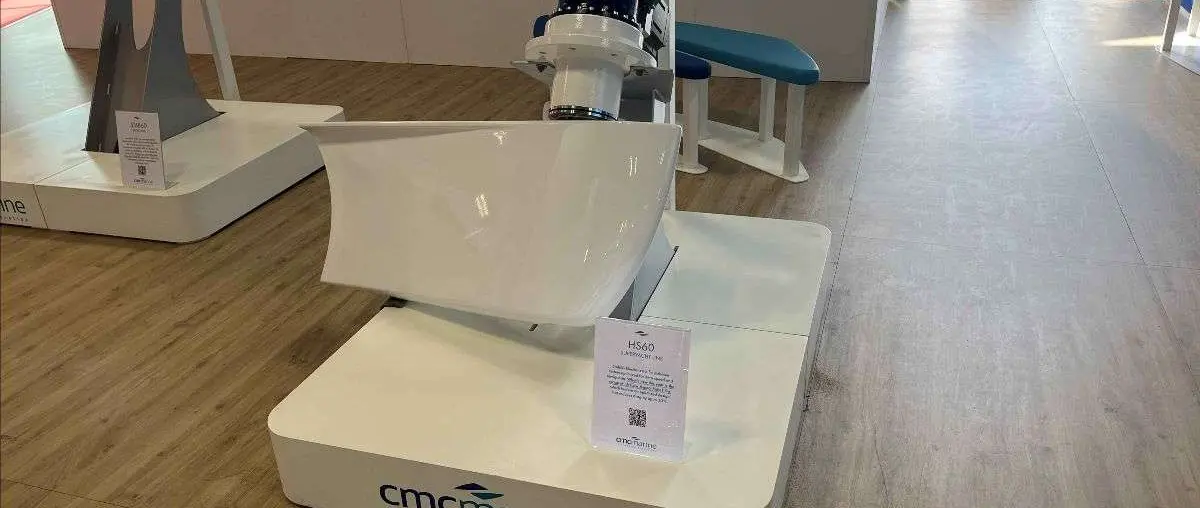
CMC Marine says the new Stabilis Electra LA fins use a rounded leading edge developed to reduce turbulence and lower resistance through the water by as much as 30 per cent. The available fin areas run from 2.10 to 7 square metres, extending the design across a broad range of Stabilis Electra installations.
The project is also an industrial milestone for the company because CMC says the fins were designed and developed entirely in-house. Its R&D work included computational-fluid-dynamics simulation, structural engineering and technical validation before moving into production at the company's Salerno facility.
Five-blade thruster propellers focus on noise and smoothness
Dualis Electra electric thrusters gain a new five-blade propeller family designed and manufactured internally by CMC Marine. The company says the revised geometry can reduce thrust fluctuations by up to 30 per cent, which should translate into smoother manoeuvres and lower vibration and noise.
CMC notes that these propellers are particularly relevant to its larger thruster sizes, including installations from around 30 metres upward. That puts the biggest applications outside LYG's yacht-size scope, but the design illustrates how electric manoeuvring systems are being refined beyond simple thrust output toward acoustic comfort and smoother control.
New touchscreen connects directly to NMEA 2000
The new capacitive display brings a brighter screen, higher resolution and improved responsiveness for operation in strong sunlight. CMC has also added CAN NMEA 2000 connections so the display can receive vessel-network information including gear status and GPS-related data.
For owners of increasingly integrated yachts, that network connection can reduce the number of isolated control interfaces at the helm. The benefit will depend on installation and software configuration, but direct use of a standard marine network should make it easier for stabilisation and manoeuvring information to coexist with other onboard systems.
Energy recovery remains part of the efficiency strategy
CMC also demonstrated its Energy Recovery System, which recovers electrical energy generated when stabiliser fins decelerate and feeds that energy back into the stabilisation process. The company says the system eliminates power peaks and can reduce stabilisation energy consumption by up to 50 per cent under the conditions represented in its product testing and demonstrations.
The wider Cannes launch therefore shows CMC Marine working on efficiency at several levels: fin drag, thruster vibration, control integration and electrical-energy recovery. For LYG-sized yachts, the important question is which elements become available on the smaller compatible Stabilis Electra and control-system packages rather than assuming every newly announced component is intended for yachts below 24 metres.