An owner's brief reshapes an expedition concept
The first XPD95 is not a generic demonstrator or a model being built speculatively for an unnamed buyer. Antonini Navi announced the sale of the first unit, and the owner's preferences have shaped the project's arrangement. Camper & Nicholsons says the client was drawn immediately to the tough, purposeful outline of the original expedition concept, but wanted a boat suited principally to Mediterranean cruising. Keeping those two priorities together became the central design challenge. The workboat influence is therefore an aesthetic and functional starting point, not a promise that this yacht is being outfitted for a particular polar programme.
The vessel is intended to measure almost 30 metres and remain below 200 gross tons. Its hull will be steel, with an aluminium superstructure, following construction practices familiar from larger long-range motor yachts. That combination is an important statement of intent in a length band also occupied by lighter, faster production yachts. The precise operational performance, including fuel consumption, cruising range and speed, should not be assumed from the expedition appearance. Neither of the official announcements used here supplies independently verified sea-trial results, and none can exist for a yacht whose construction is still being prepared.
Camper & Nicholsons takes the owner's representative role
Camper & Nicholsons' involvement covers project oversight rather than merely presenting the original sale. The brokerage and yachting-services business identifies Daniela Duck as the owner's representative. Having worked with Antonini Navi for many years, she is expected to serve as the main link between the shipyard and the client as decisions move from drawings into construction. An owner's representative typically helps turn an owner's instructions into practical reviews of design, specification, programme and delivery matters; the precise contractual authority in this case has not been made public.
That role matters because an individualised yacht is a sequence of interconnected decisions. Moving a bulkhead can change cabin services, structural details, access for maintenance and sightlines. A new choice of finish can affect weight, durability, lead time and cost. Building a near-30-metre boat under a 199 GT target adds further constraints to the design. Close communication between client and yard does not eliminate those trade-offs, but it gives the project a dedicated channel through which they can be evaluated before physical work makes changes more expensive.
Sculli & Covini and the language of an offshore vessel
The exterior is the work of Sculli & Covini, which has retained a strong visual connection with professional working craft. A high, protective bow and assertive forward profile give way to more open volumes as the eye travels aft, finishing at a broad platform close to the water. Even the helm station draws inspiration from the wheelhouse of an ocean-going tug. Those references are deliberate, but the intention is not to make the owner live inside an industrial environment. The working-boat vocabulary has been adapted to a bespoke yacht for comfortable coastal exploration and longer Mediterranean passages.
There is an architectural discipline to this approach. Rather than build upward into a conventional stack of decks, the XPD95's designers have kept the profile relatively low and horizontal. This is partly a consequence of the gross-tonnage envelope, but it also protects the distinctive silhouette that initially attracted the owner. It places particular importance on usable outdoor areas and the paths that connect them. The final result will depend on how well the sheltered zones, views over the water and practical movement around the yacht perform once the design is realised.
A private owner's deck and a versatile stern
The published arrangement makes unusually specific allocations for outdoor living. The owner is to have a private zone of approximately 60 square metres, comprising around 25 square metres inside and a 35-square-metre terrace. Access is designed from within the yacht or by a protected port-side staircase, allowing the space to function with a degree of independence from the shared decks. It is a striking use of area on a vessel just under 30 metres, and it suggests privacy has been treated as a core design requirement rather than something added after the social spaces were fixed.
At the stern, roughly 35 square metres perform two roles. While underway, the area carries a five-metre tender; after launching, it can be converted into an open terrace beside the sea. That dual use is more substantial than a simple fold-down swimming step, although the practicality of handling the tender will depend on the final equipment specification. Elsewhere, a main-deck cockpit of around 44 square metres and an upper foredeck lounge of approximately 33 square metres carry most of the shared outdoor programme. The design deliberately omits a traditional sundeck, preserving its lower profile.
Hot Lab's materials bring warmth inside
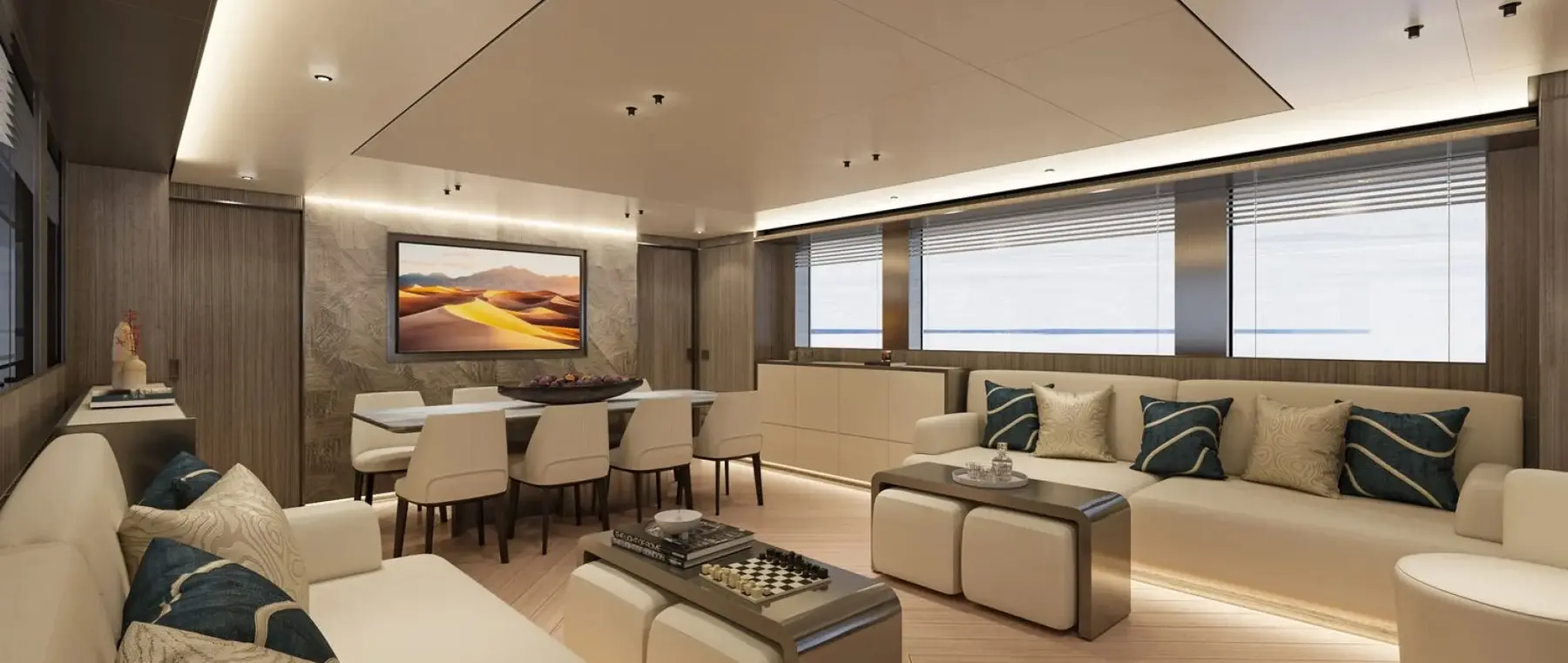
For the interior, Hot Lab has chosen a softer material language than the robust exterior might lead one to expect. The design team specifies eucalyptus as the principal timber, complemented by lacquered surfaces, leather, upholstery fabrics, metal details and natural stone. This mixture could bring a residential sense of texture and depth, while allowing heavier-use circulation areas to be finished for practicality. The official renderings should be understood as the project's design intent: the final grain, tones, fittings and installation quality will need to be judged on the completed yacht.
Connections between inside and outside are an explicit part of the brief. The team has worked on lines of sight and ways of reaching the exterior spaces without interrupting the rooms' calm character. Crew movement has also received its own planning: about 23 square metres of lower-deck accommodation are placed amidships, away from the engine room, with two three-berth cabins. A further forward main-deck cabin can accommodate another crew member or serve as storage. The flexible choice will influence both operational staffing and the amount of space available for stores on extended trips.
The next milestones remain ahead
Antonini Navi's announcement places construction in autumn 2026 and a planned launch or handover in summer 2028. Those dates describe the disclosed programme, not an independently verified achievement. No keel-laying, completion or sea-trial milestone for this first XPD95 is asserted here. That distinction is especially important with bespoke construction, where design approvals, suppliers, equipment choices and yard scheduling can all influence the eventual completion date. Camper & Nicholsons' published appointment gives the project a clear oversight structure as it approaches that phase.
For the wider market, the XPD95 is an example of how owner preferences can transform the original purpose of an explorer concept. The yacht retains a steel-and-aluminium build, protected working-boat stance and tender-handling capacity, while prioritising private terraces, carefully composed interiors and accessible outdoor living in the Mediterranean. It will be judged ultimately by the clarity of its execution, not by renderings or marketing descriptions alone. The disclosed design nevertheless sets out a coherent direction for a distinctive, individually commissioned yacht.
Original sources: Camper & Nicholsons and Antonini Navi. Project imagery supplied by Camper & Nicholsons.