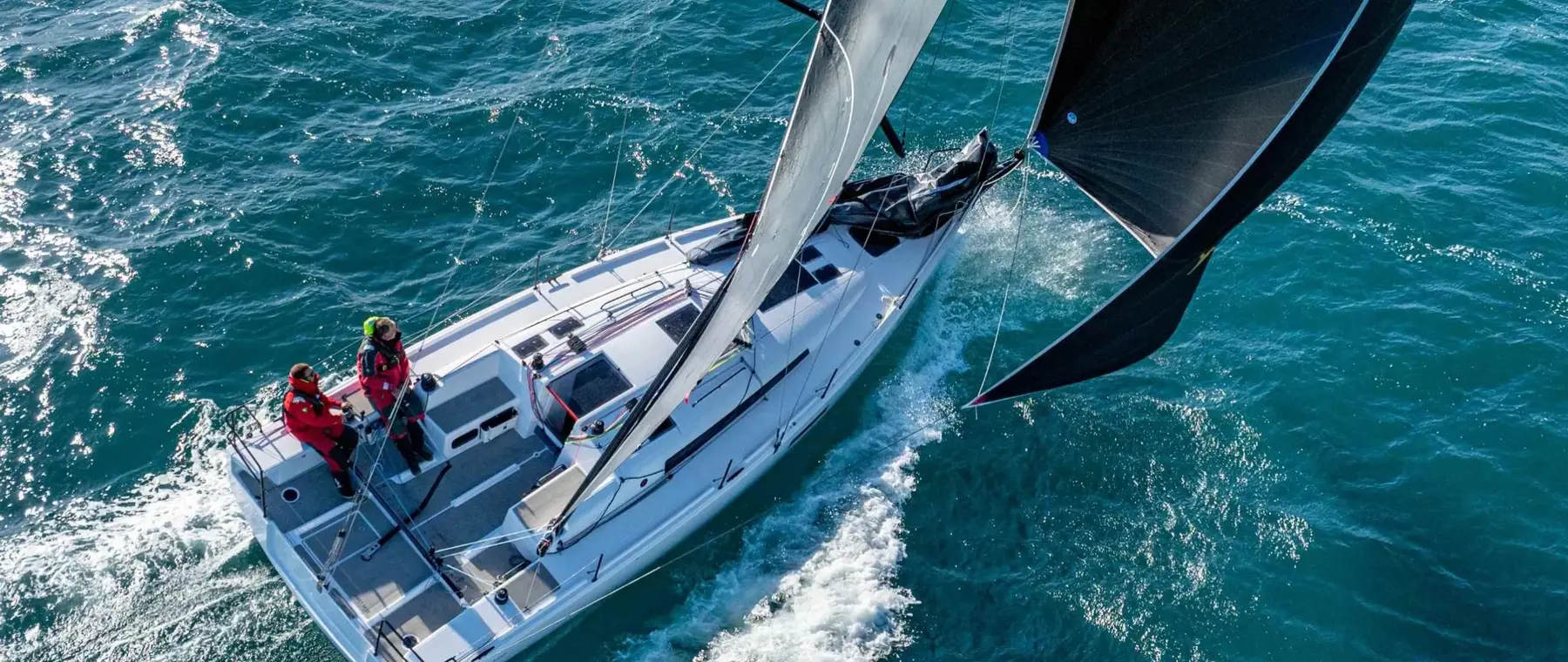
Beneteau has turned a successful 2026 Pacific Cup campaign into a wider discussion about how performance sailing is changing. In a SailFaster podcast featured by the builder, First-range creative lead Andraz Mihelin joined Naos Yachts owner and racer Charles Etienne Devanneaux to discuss doublehanded racing, simpler sail plans and the gap between modern boat design and traditional race formats.
The conversation is grounded in the experience of Rahan, Devanneaux's First 36, which produced one of the notable results of the 2026 Pacific Cup. Racing doublehanded with Fred Courouble, the boat was first to finish, won its ORR doublehanded category and achieved a podium result in the overall ORR standings.
Doublehanded racing solves a practical crew problem
Both guests linked the growth of doublehanded sailing to practical realities as much as sporting fashion. Finding two committed sailors is easier than assembling and transporting a full crew, and the cost of sending two people to an offshore finish such as Hawaii is materially lower than moving a large team.
Time also matters. Modern owners often have less leisure time available, yet still want a demanding competitive experience, and doublehanded racing can deliver that intensity without the logistics of a conventional crewed campaign. That combination has helped the format grow first in Europe and increasingly in the United States.
Rahan became a development platform
Devanneaux described how Rahan evolved over several seasons rather than being transformed in one step. Changes included a custom carbon mast, lighter rigging, and modifications to the keel and rudder, with each season providing another chance to identify where performance could be improved.
The project is relevant to production-yacht buyers because Beneteau says some lessons from Rahan have fed into the First 36 SE. That creates a useful link between owner-led racing development and a factory model, allowing ideas proven in competition to influence a boat available to customers without requiring the same level of custom campaign work.
Performance without unnecessary complexity
A recurring theme in the discussion was simplicity. Mihelin described the First philosophy around making planing performance accessible rather than designing only for a rating rule, while Devanneaux explained that his own baseline sail inventory remains deliberately manageable and complexity is added only when there is a clear performance reason.
That approach has implications beyond racing. Owners who want fast cruising increasingly expect boats that are rewarding to sail with small crews, and systems that reduce manpower requirements can make a performance yacht more usable in ordinary weekends as well as organised events.
Race formats may need to catch up with the boats
The podcast also questioned whether racing formats have evolved as quickly as yacht design. Mihelin noted that many club-racing routines still resemble those of decades ago, while contemporary boats, owner demographics and available crew time have changed substantially.
Devanneaux linked that issue to ageing club membership and the difficulty of assembling full crews. Offshore and coastal doublehanded formats can be easier to organise and may better suit owners who want meaningful competition without committing to the structure of a large race team.
Rahan's Pacific Cup result gives the discussion credibility because it shows the concept working over a serious offshore course rather than only in theory. The larger lesson for the production market is that performance, simplicity and small-crew usability do not have to be opposing goals. Beneteau's decision to highlight the conversation suggests the First range is being positioned not simply as a collection of faster sailboats, but as part of a broader attempt to keep performance sailing relevant to how owners actually have time to sail today.
Production boats benefit when racing lessons remain usable
The most useful transfer from a campaign such as Rahan is not a specialised component that only works for expert racers; it is knowledge that can make a production boat faster or easier for ordinary owners without adding excessive complication. Beneteau's reference to ideas moving into the First 36 SE suggests the builder sees the campaign as a development environment rather than simply a marketing exercise.
That distinction will matter as performance cruisers compete for owners who want speed but do not want a professional crew. A yacht that rewards good sailing while remaining manageable by two people can serve club racing, offshore events and fast cruising with the same underlying platform. The growth of doublehanded competition gives manufacturers a demanding test case for exactly that balance, making the format relevant well beyond the race results themselves.