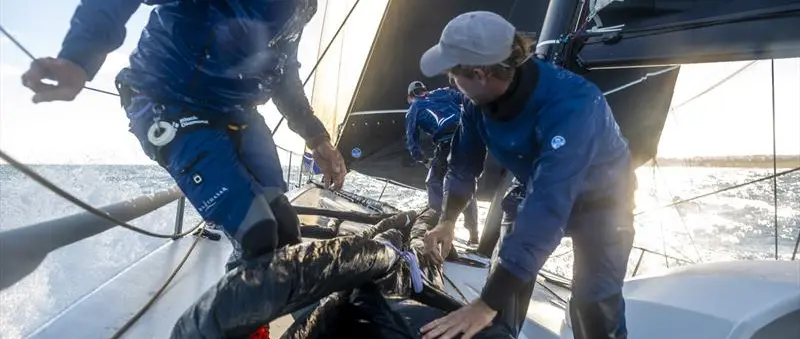
Balthasar dominates the coastal warm-up
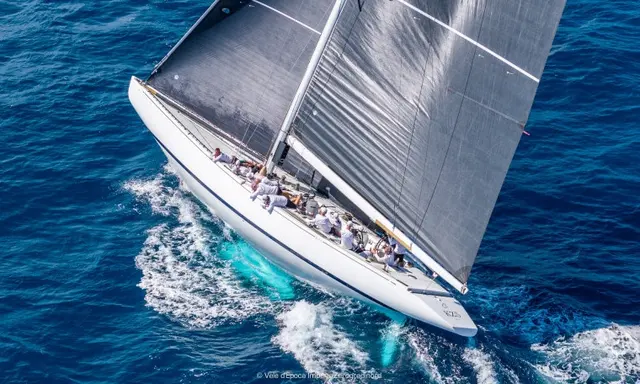
Filip Balcaen's Mills 72 Balthasar won both line honours and the overall IRC result in the Yachting Malta Coastal Race on Wednesday 14 October 2026, giving the crew a strong competitive rehearsal before the Rolex Middle Sea Race starts on Saturday. The result comes as the defending overall winners prepare for another major offshore challenge.
The 30-nautical-mile contest started in Marsamxett Harbour, rounded Comino and returned to Marsamxett. Conditions were demanding enough to be informative rather than a leisurely test sail, with reported wind speeds reaching 25 knots during the day's racing.
For the roughly 22-metre Balthasar, the outcome was significant because the team beat competitors not only across the line but also after corrected-time calculations. That combination strengthens confidence in preparation, though it offers no guarantee of how the much longer offshore race will unfold.
A tactician with major offshore experience
Bouwe Bekking served as tactician aboard Balthasar during the coastal contest. With a long background in international ocean racing, he is familiar with the interaction between yacht performance, changing conditions and the importance of retaining speed through manoeuvres.
The crew reportedly achieved speeds exceeding 10 knots upwind and around 20 knots off the breeze. These are event-specific observations rather than a general speed specification, and they should not be treated as numbers that a cruising yacht of similar length could necessarily reproduce.
The short coastal race provides an opportunity to test sail-handling sequences under pressure and review any weaknesses in instruments or crew coordination. Even a successful outing can produce a list of improvements to complete before the larger 606-nautical-mile challenge.
Artemis Bleu and Arkas Blue Moon complete the podium
James Neville's Botin 65 Artemis Bleu finished second overall, 8 minutes and 55 seconds behind Balthasar on IRC corrected time. The Arkas Blue Moon campaign, skippered by Serhat Altay, took third place in the coastal race's overall results.
These boats illustrate a particularly competitive segment of the offshore fleet, where modest differences in wind angle, manoeuvre execution and time spent in lighter patches can move a yacht up or down the standings. Finishing order is only one element of the story when different hull designs carry different handicap ratings.
Owners considering racing a privately operated yacht should look closely at crew experience and the cost of sail inventories, professional maintenance and training. Successful campaigns depend as much on dependable systems and continuous preparation as on high-profile design.
The defence of last year's Middle Sea crown
Balthasar enters Saturday's main event as the reigning overall winner of the 2025 Rolex Middle Sea Race. Last year's 606-mile course rewarded the Mills 72 on corrected time, establishing the crew as one of the benchmark campaigns for the 2026 edition.
The full race presents a very different sequence of challenges from a 30-mile warm-up. Competitors must work through the Strait of Messina, the Aeolian and Aegadian islands, and the waters around Pantelleria and Lampedusa before making their return to Malta.
Forecast uncertainty adds another complication. A faster yacht may be slowed by an adverse transition while a competitor on another part of the course finds fresh breeze, so tactical decisions and consistent sailing can matter as much as outright hull speed.
What the result tells owners and race followers
The coastal victory demonstrates that Balthasar and its crew were competitive in the conditions encountered on 14 October. It is a useful practical signal after months of boat preparation, but it is not an early result for the Rolex Middle Sea Race itself.
Even for sailors who do not race at this level, the performance underlines the benefit of rehearsing manoeuvres and checking critical equipment before a demanding passage. Owners of 15-to-24-metre sailing yachts can apply those lessons without adopting a professional racing programme.
As the fleet prepares to leave Grand Harbour on Saturday 17 October, the central question is whether Balthasar can sustain its strong performance through shifting Mediterranean conditions. The coastal win sets the scene; the offshore contest will decide the next result.