An urban hotel with a connection to Vermont’s waterways
Sugar House Hotel has opened in Winooski, near Burlington in Vermont, as a member of Marriott's Tribute Portfolio. Marriott's 9 November 2026 announcement identifies the 115-room property as its first hotel worldwide designed with the combined objectives of all-electric, net-zero energy operation and LEED Platinum certification. The developer's approach joins energy infrastructure with an interior conceived around Vermont's maple sugarhouses, local craft and the historic industrial community beside the Winooski River.
The property offers an interesting shore-based subject for owners whose cruising plans take them around Lake Champlain and the northeastern United States. It is not a marina hotel and the announcement does not establish the availability of yacht berthing at the property. However, its location in the Burlington region provides a different way to explore an inland waterfront community and its heritage. Its combination of a substantial commercial kitchen, rooftop dining, a public nature connection and a distinctive energy strategy is also relevant to clients considering the materials and engineering of their own residential or yacht interiors.
A design built around the maple sugarhouse
The characteristic sugaring buildings of Vermont provide the conceptual starting point for the hotel. Marriott describes the lobby as a contemporary interpretation of those structures. Timber surfaces, locally sourced detail and a large stone hearth contribute to the identity of the space. A twenty-foot indoor maple tree is incorporated into the central area, with a spiral stair leading towards a library on the mezzanine. The hotel also describes a maple creemee station as part of the arrival experience.
These details matter because the design has taken its reference from a local activity rather than applied a broadly defined rustic aesthetic without explanation. A maple sugarhouse has a particular association with seasonal work, materials and the preparation of a product closely connected to the region. The hotel's interpretation does not reproduce a working sugarhouse, but instead incorporates references to the practice within a setting adapted to hospitality.
For a yacht owner commissioning bespoke joinery, there is a parallel in establishing the reason for a particular visual language. An interior developed with a meaningful connection to a place or collection can have a distinctive character without relying on a large number of conspicuous decorative objects. The precise material, construction and safety requirements remain different for a marine installation.
One hundred and fifteen rooms and an emphasis on local manufacture
The rooms take their names from Vermont sugarhouses, according to the operator. Their design incorporates timber panelling, bespoke glass sconces and artworks made by local craftspeople. The hotel therefore intends its references to the region to extend beyond the public lobby and into the individual accommodation.
For travellers interested in craftsmanship, the appeal of such a scheme is the opportunity to encounter objects in relation to the place in which they are made. Rather than treat the entire interior as a uniform display, the guest can consider the character of the timber, lighting and other features separately. The differences between the work of individual makers become part of the experience.
A yacht interior is often designed through the coordination of several specialists. A lighting fixture or piece of furniture may be commissioned from one workshop while the surrounding joinery is made elsewhere. Understanding the relationship between those pieces can help the client establish an overall composition that does not obscure the individual craft. The hotel is an example of a residential-scale design objective applied to a hospitality project. It is not evidence that the individual materials employed would be appropriate for installation aboard a vessel without further assessment.
What an all-electric commercial hotel means
Marriott's description states that the entire hotel operates on electricity, including its commercial cooking facilities, with no gas connection or fuel tank serving the hotel. Rooftop photovoltaic panels are intended to supply approximately one-third of the building's energy needs, while a geothermal well system provides heating and cooling and assists with hot-water production.
The three characteristics should be distinguished from one another. Using electricity as the building's direct energy source removes the need for the particular on-site fuel installations described by the operator. Solar panels provide a source of electricity whose actual annual output depends on operating circumstances. Geothermal systems can support building heating and cooling through a different relationship with the surrounding ground. Net-zero energy operation is a performance objective requiring the energy consumed and generated to be evaluated over an appropriate period and within defined accounting boundaries.
The company's opening announcement describes the hotel's design objectives. It does not include a year's measured energy-production and consumption data showing that net-zero performance has been achieved in operation. Similarly, the certification objective should be distinguished from a confirmed award of certification based on independently examined documentation. That distinction is valuable when evaluating any building or vessel marketed on the basis of its environmental performance.
Local materials and the reuse of existing timber
The hotel reports a particularly direct connection to regional infrastructure through the reuse of timbers recovered from Vermont's historic North Hero drawbridge. The reclaimed material has been incorporated into the rooftop bar and elevator lobby tables. The native Green Mountain Schist hearth in the lobby is described as weighing 20,000 pounds. Together, these features illustrate the relationship between the history of particular materials and the character of a newly built interior.
Reused timber can be especially compelling when its origin is understood. Tool marks, wear and variation may provide a connection to its earlier purpose. Incorporating the material into a new object does not mean that every property of the old construction is necessarily retained. The designer and maker must establish the condition of the timber and the suitability of its proposed use.
An owner considering reclaimed materials aboard a yacht faces additional technical questions. Mass, moisture characteristics, attachment and the applicable material requirements need to be assessed for the intended location. A large stone hearth illustrates the difference especially clearly. A feature that can be supported within a purpose-designed building may be entirely inappropriate for a relatively small vessel. The useful idea is the development of a coherent story through selected materials, not the literal duplication of the hotel's most substantial elements.
A rooftop restaurant and a neighbourhood café
Treetops Restaurant occupies the rooftop, offering a seasonal dining programme with views through extensive glazing and from its outdoor terrace. Marriott describes it as the only rooftop restaurant and bar in the Greater Burlington area. The hotel's MOSS Café and Bar provides a more informal setting within the central public spaces, offering coffee, bakery items, deli-style dishes and other refreshments throughout the day.
The distinction between these spaces allows guests and people living in the vicinity to encounter the hotel according to several different rhythms. A rooftop meal may be the focus of a particular visit, while a shorter stop in a café can fit into a walk through Winooski. The existence of a public-facing hospitality programme is an important aspect of the property's relationship with its neighbourhood.
Travellers planning a shore excursion should confirm the restaurants' actual operating hours and any applicable reservation requirements. Published descriptions identify their intended character, but cannot establish the availability of a particular table. Menus and prices may also change as the seasons develop.
A connection to the Winooski landscape
The property is situated beside a 104-acre nature preserve and the Winooski River, close to the town's downtown circle. The announced facilities include a 180-foot wooden bridge connecting the hotel to a 1.2-mile loop through the Winooski Gorge Natural Area and near the Salmon Hole fishing waters. Guided walks and artisan activities are among the experiences planned with local partners.
This is a notable aspect of the hotel for visitors who wish to spend time outside their accommodation. A relatively short journey from an urban setting to a natural landscape can reveal the particular character of an inland waterfront town. The transition between streets, industrial history and riverside paths can offer an experience different from that of a remote resort where access to everyday local life may be less direct.
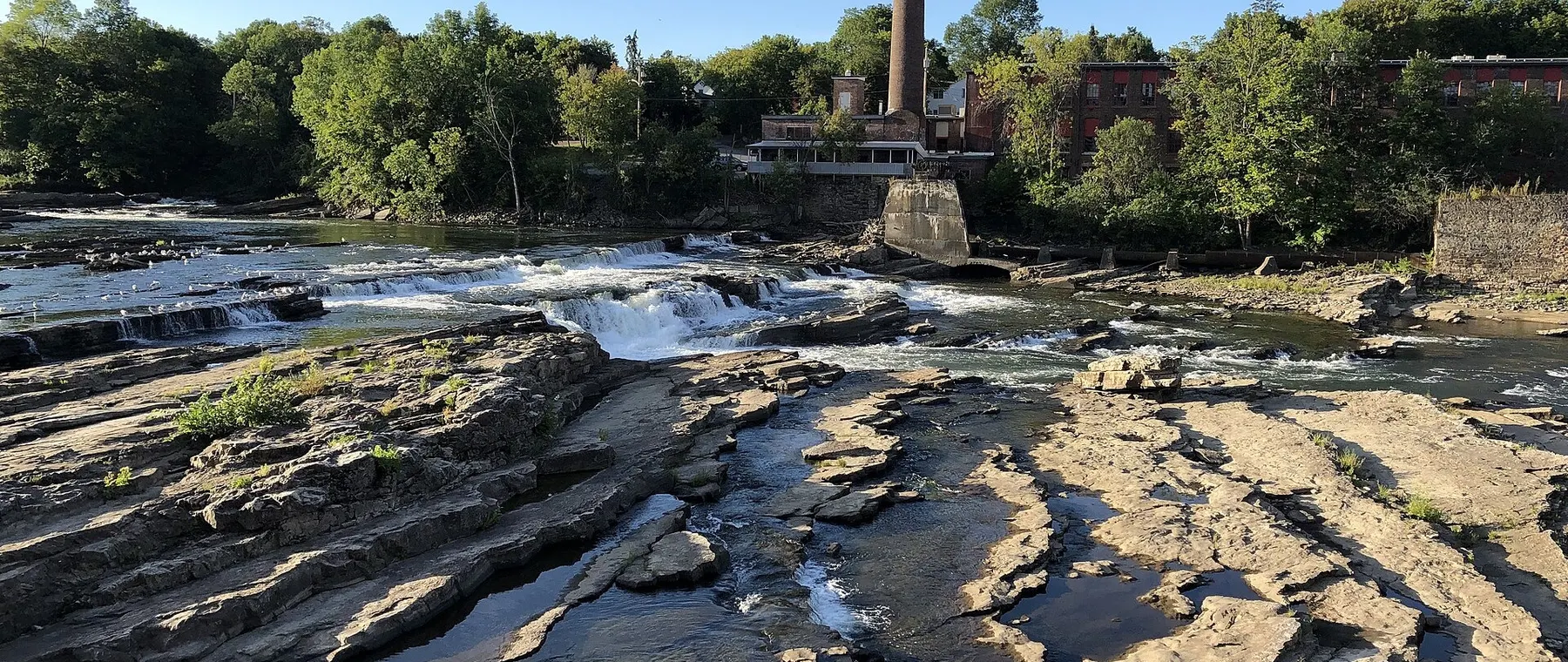
The riverside photo used for this article shows the Winooski River Falls in 2019. It is included as contextual imagery and does not depict the new hotel, the completed bridge or its current operating conditions. Guests should use the actual local route information to establish which paths and activities are accessible when they visit.
A future measure of the design in operation
Marriott's announcement identifies Nedde Real Estate and Lodging Capital Partners as the developers and Fathom Companies as the operator. It describes planned electric charging points and an electric shuttle linking the property with the airport and downtown Burlington, as well as water-saving fittings. The precise availability and schedules of transport and services should be confirmed with the hotel.
The most interesting questions about the energy strategy will arise as the building operates over successive seasons. A Vermont hotel experiences seasonal changes in building demand, making the actual relationship between solar generation, geothermal systems and the electricity supplied to the property important to the long-term outcome. The opening is a milestone, while the performance of those systems remains a matter for measured evidence.
For yacht owners, the hotel offers an opportunity to observe a coherent hospitality concept that connects interior craftsmanship, the activities of a particular community and the technical requirements of its accommodation. Its attractions need not depend on a claim that every environmental objective has already been demonstrated. The combination of an identifiable local character and a deliberate engineering approach is significant in its own right.
Sources and photograph
Source documentation: https://www.prnewswire.com/news-releases/sugar-house-hotel-a-tribute-portfolio-hotel-brings-vermont-character-to-sustainable-hospitality-302933554.html. Photograph: Winooski River Falls, Vermont, August 2019 — destination context, not the hotel — Ken Gallager, Wikimedia Commons, CC BY-SA 4.0; resized, re-encoded, same licence; contextual photograph taken in August 2019.. Resized and re-encoded for web display under CC BY-SA 4.0; the photograph retains that licence.