Contemporary art in the London autumn calendar
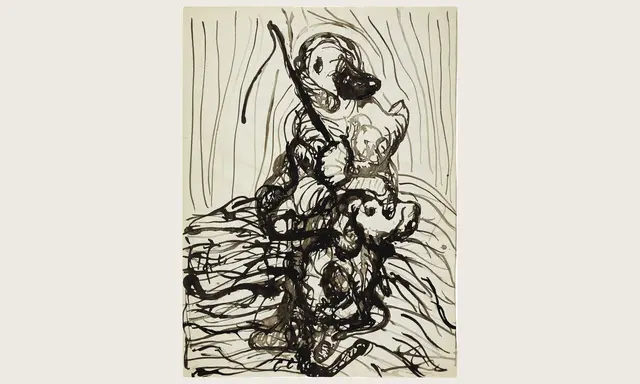
Sotheby’s Contemporary Evening Auction is scheduled for 15 October 2026 in London, with 37 works appearing in the catalogue. Georg Baselitz is represented by three opening lots, including two titled Ein neuer Typ and Ohne Titel (Ein moderner Maler). The sequence gives the sale a strong opening narrative while leaving room for very different artistic generations.
Albert Oehlen’s Schwindel follows in the initial run of lots, estimated at £1.2 million to £1.8 million in the currently published catalogue. Michel Majerus and Louis Fratino appear nearby, highlighting the wide span of practices covered by the contemporary label. A buyer should approach each object through its specific context rather than assume that market classification is a full art-historical description.
A wide range of aesthetic directions
Baselitz’s work has repeatedly unsettled conventional expectations of the figure, while Oehlen has explored the boundaries of painting and abstraction. The sale also includes works attributed to Andy Warhol, Mark Rothko and Willem de Kooning. Their presence creates a dialogue across approaches to repetition, colour, gesture and representation.
Antony Gormley’s Back IV and Bridget Riley’s Rose Shadow indicate that the category extends well beyond large-scale painted surfaces. Three-dimensional work asks different questions about orientation and display, and Riley’s precise optical composition calls for attention to viewing distance and light. Medium is therefore integral to the acquisition decision.
Reading estimates without overreading them
The opening Baselitz lots carry estimates ranging from £200,000 to £350,000 in their displayed brackets, while Oehlen’s higher estimate reflects different circumstances. That spread should not be interpreted as a definitive ranking of the artists or their importance. Estimate setting responds to the specific work, documentation, scale and market expectations.
An international collector needs to budget for buyer’s premium, applicable taxes, specialist shipping and ongoing insurance. A work may be suitable for the collection at one price and not another. Establishing a maximum before bidding allows the buyer to appreciate the event without turning its competitive atmosphere into a costly substitute for judgment.
The significance of condition and provenance
Contemporary art presents conservation issues that depend heavily on materials. Some paintings have unconventional supports or layered surfaces, while other works incorporate industrial products or complex fabrication. A conservator can help identify risks that may not be immediately apparent in photographs or a short catalogue description.
Provenance documents should establish the history of ownership and any relevant exhibitions or publications. The purchaser should request information about restoration and prior installation, then ensure that transport plans are suitable. A work’s spectacular appearance in a saleroom does not eliminate the responsibility to preserve it after acquisition.
An auction as a window onto collecting taste
An evening auction compresses significant artistic differences into a short public event, encouraging viewers to compare works that might otherwise inhabit distinct exhibitions. This can stimulate thoughtful collecting when the catalogue is treated as a research resource rather than a price leaderboard.
The sale’s live catalogue and auction conditions are the references for final titles, specifications, estimates and the scheduled session. Until bidding concludes on 15 October, all price discussion is necessarily prospective. What matters most is whether a selected work can withstand close scrutiny and retain meaning within the collector’s own cultural and personal interests.