A room designed around listening
A carefully considered sound system can transform the experience of listening to a familiar recording. The relationship between the room, the loudspeakers and the people using them is as important as the appearance of the equipment. On 17 November 2026, New Zealand music technology company Serato announced SoundSpace, a new studio and meeting place in the Arts District of Los Angeles. Its 4,500-square-foot interior combines a main performance area, a production studio and a library of equipment for musicians to explore.
The development is intended principally for DJs, producers and other artists. It is not announced as a conventional entertainment venue with regular public admission or a shop in which every displayed object can be purchased. Serato describes future workshops, demonstrations and showcases as part of its programme, alongside opportunities for the music community to experiment with its software and hardware.
For readers who enjoy music, architecture and the design of high-quality audio equipment, the project is interesting on a wider level. A leisure room in a house, an apartment or a yacht may have a very different purpose from a professional studio, but the decisions about which features should attract attention and which should remain discreet are related. SoundSpace offers an example of an interior in which the equipment and the activity it supports are deliberately given priority over decorative spectacle.
The collaboration behind the loudspeakers
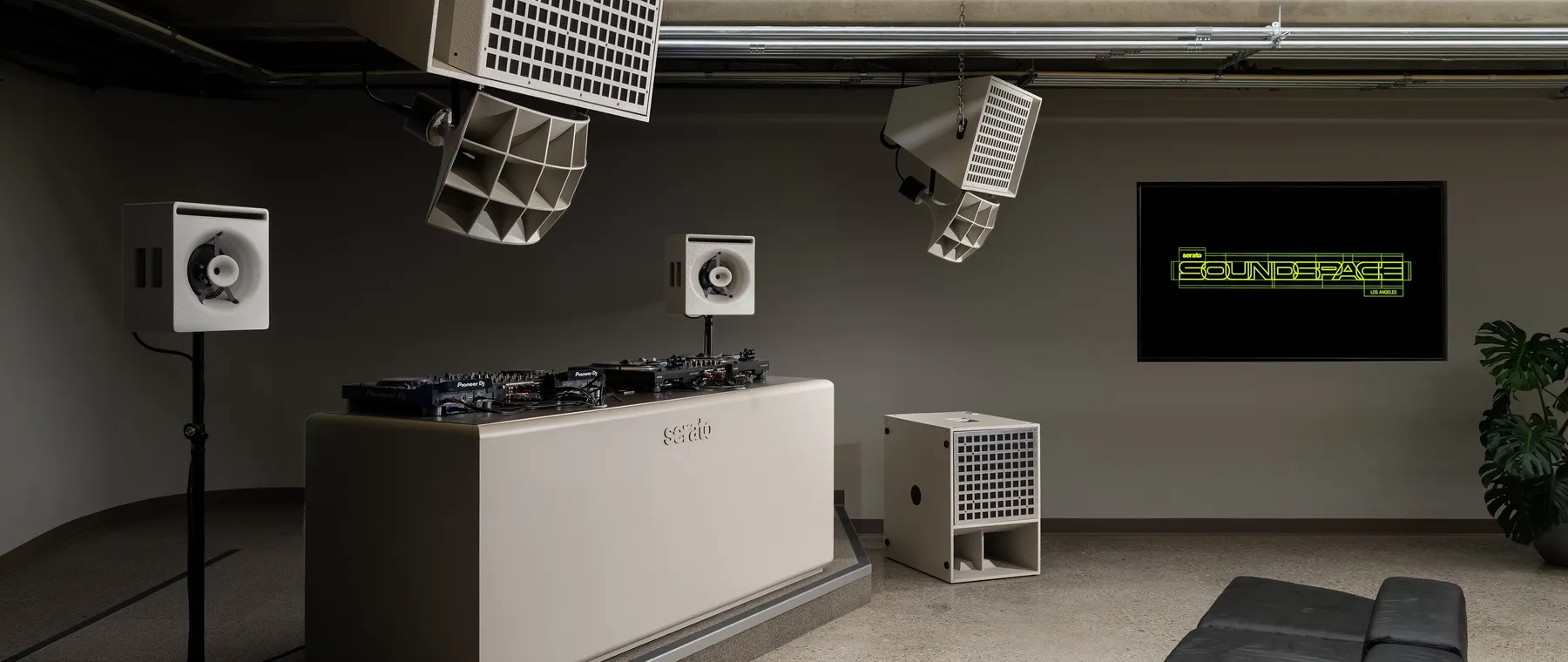
At the centre of the main area are two custom ON8 loudspeakers developed by Norwegian audio company NNNN and Devon Turnbull's OJAS design studio. Serato identifies this arrangement as the first integration of wide-dispersion multisectoral horns in the ON8 system. Originally developed for the Los Angeles space, the combination has subsequently been made commercially available, according to the announcement.
Horn loudspeakers have a striking physical presence because the visible form of the horn relates directly to the way it is intended to distribute sound. A designer can choose to conceal an audio system within joinery, but the approach here is to let the equipment become part of the visual character of the room. The scale and arrangement of the loudspeakers are particularly apparent in Hunter Kerhart's official photograph of the performance area.
The ON8s are accompanied by a Trent 25 transmission-line-loaded subwoofer using an eighteen-inch driver and a pair of Gage 60 loudspeakers. NNNN identifies the project as its first commercial installation in Los Angeles. The supplier's earlier installations include music venues in London and New York.
The announcement describes the system in highly favourable terms, but does not include independent acoustic measurements, a complete engineering specification or a comparative listening test. It would be inappropriate to conclude from the description that these same components would produce an equivalent result in a private home. A large professional room and a compact domestic space place very different demands on the equipment.
The difference between production and performance
The separate production room provides another perspective on the purpose of SoundSpace. There, Serato identifies NNNN Gage 30 loudspeakers and an unreleased U15 nearfield monitoring system. The company intends the room to be used for developing and refining recordings rather than simply presenting finished material to a gathering of listeners.
A musician evaluating a recording may want to hear details that would be less apparent in another environment. A DJ performing before an audience has other considerations, including the way sound is experienced by people in different parts of the room. Neither objective should be confused with the preferences of a private listener who wants to enjoy music comfortably at home. The desired acoustic characteristics and practical requirements can vary considerably.
This is one reason why choosing audio equipment on the basis of a prestigious installation alone may be disappointing. A domestic system should reflect the dimensions of the room, the locations of the listeners and the source material they enjoy. The acoustic treatment and placement of the equipment can deserve as much consideration as its brand or price.
Serato's approach includes a library of controllers and mixers, with experienced personnel intended to assist visiting artists. That aspect of the project makes the equipment available for a particular purpose: the development of creative work and the exchange of practical knowledge. The announcement does not establish that the studio offers unrestricted bookings to visitors who simply wish to listen to the system.
Stainless steel without the appearance of an industrial workshop
Designer Leon Mckay of Saintleo collaborated with Serato on the interior. The scheme takes inspiration from brutalist architecture, using bead-blasted and perforated stainless steel for a series of bespoke objects. A deliberately simple DJ booth anchors the performance area, while three substantial shelving structures house the equipment library. A matching bench provides visitors with a place to try products.
The treatment of the metal is significant. Stainless steel can be given a relatively reflective appearance, but a quieter surface finish can help it become part of a room without producing conspicuous reflections. Perforation also creates an interesting relationship between a solid volume and the light around it. The shelving remains visually distinct while allowing light to pass through some of its surfaces.
In the official interior photograph, the equipment is displayed against subdued architectural materials and furnishings, with a limited number of competing decorative elements. The approach is relevant to domestic design because a room dedicated to music or another leisure activity does not have to be filled with visual references to that activity. A carefully arranged listening chair and suitable storage may be more important to its enjoyment than conspicuous ornament.
The specific steel objects created by Saintleo were designed for this project. The announcement does not provide a retail catalogue of the fittings or establish their suitability for use in a marine environment. Someone considering a similar interior aboard a yacht would need to assess weight, fixing arrangements, maintenance and the relevant electrical and fire-safety requirements separately.
A programme that gives the equipment a creative purpose
The pre-opening gathering featured sets by The Alchemist, Novena Carmel and Jared Jackson. For the occasion, The Alchemist also prepared an hour-long mix for Apple Music, conceived around the influences of his Los Angeles background. The project is therefore being introduced through music itself rather than solely through the presentation of the new building.
Future events described by Serato include a private listening party with producer Dahi and workshops planned with Beatport, Kittens / PWR and Duckworld. The company intends its artist relations team to develop an ongoing programme and provide assistance to musicians using the studio. The November release does not specify a complete public calendar or the admission or eligibility arrangements for every activity.
A workshop can be particularly valuable when it makes a creative process more intelligible to somebody who has not previously attempted it. A visitor interested in recording may want to understand how a particular sound was altered, while an established musician may be concerned with refining a technique. Listening together in a well-equipped room can provide an opportunity to discuss those differences directly.
For someone who enjoys music as a leisure pursuit, the broader idea is worth exploring locally as well. Listening events, demonstrations and introductory courses can offer an alternative to repeatedly purchasing equipment. Understanding more about a recording or the means by which it was produced may contribute to the pleasure of hearing it at home. A new sound system is not the only route to a deeper appreciation of music.
Designing a more personal listening experience
SoundSpace illustrates the importance of starting with the activity rather than the objects associated with it. For a homeowner considering a dedicated listening area, a useful starting point might be to establish who will use it, whether they prefer to listen alone or with others, and how the room relates to neighbouring spaces. A system intended for evening listening in an apartment may need a different arrangement from one used for entertaining friends in a detached house.
The same questions become more specialised aboard a yacht, where the dimensions and construction of cabins, surrounding machinery and other equipment affect the acoustic environment. Professional advice and a suitable installation can be more worthwhile than selecting an unnecessarily elaborate system that cannot operate as intended in the available space.
Serato's new Los Angeles location is an interesting example of interior design serving a clear creative objective. Its combination of specialist sound equipment, understated metalwork and planned artistic activities makes it a distinctive development within the city's Arts District. It does not yet offer a confirmed programme of general tourist access or a published cost for private use. Readers interested in an event should consult the company's current arrangements rather than assume that the studio can be visited at any time.
The immediate news is the creation of a space where artists can work with audio technology and share their work. For a broader audience, the project offers an attractive reminder that the best reason to invest attention in audio equipment and interiors is ultimately the experience of listening itself.
Sources and lead image
Source documentation: https://www.prnewswire.com/news-releases/serato-soundspace-a-creative-home-and-sound-studio-for-djs-producers-and-artists-arrives-in-los-angeles-arts-district-302941401.html. Lead image: The main performance area at Serato SoundSpace in Los Angeles — Hunter Kerhart for Serato, official interior photograph released with the 17 November 2026 announcement.. Official issuer-supplied press photograph, reproduced for editorial coverage of the specific announcement and resized for web display.