Another side of a familiar destination
A visit to Macao can be as much about its urban history as about its hotels and modern entertainment complexes. The city's distinctive buildings and industrial sites reveal aspects of the work and trade that shaped the communities living there. On 17 November 2026, Sands China announced the opening of The Hall of Glory at the former Iec Long Firecracker Factory in Taipa. The permanent attraction occupies the factory's former fuse-making workshop and is the result of three years of research, planning and development.
The exhibition brings together physical objects associated with the former business, archival material, interactive digital installations and a newly built dome theatre. Its two main areas occupy a total of 140 square metres. Rather than offering a general account of Macao's past through a conventional sequence of information panels, the curators have focused on the history of the industry and its relationship with the changing city. The experience is located in the place where some of that history unfolded.
For Luxury Yacht Guide readers considering a visit to the Pearl River estuary, the opening offers a reason to spend time away from the more familiar hospitality districts. A carefully selected cultural stop can contribute to a holiday without requiring a costly excursion or a particularly complicated itinerary. The November announcement does not quote the admission arrangements or opening hours, which should be confirmed before visiting.
The former factory as a document of social history
Firecrackers have a longstanding association with celebrations in Chinese communities, and their manufacture was an important commercial activity in Macao. The exhibition's historical section traces the development of the industry from the 1860s to the 1990s. That span extends across major changes in the economy, the built environment and the ways in which people earned their living.
The history of a factory is not limited to the objects that it produced. Its buildings were occupied by people whose routines and experiences contributed to the life of the surrounding area. The placement of different facilities within a manufacturing site and the changes made to them over time can provide clues to the ways in which work was organised. Surviving signs, photographs and personal accounts may reveal aspects of a business that are less readily apparent from an account of its commercial success alone.
A visit to a former industrial site can therefore complement a tour devoted to grand public buildings and historic places of worship. Macao's architectural character has developed through different kinds of investment and occupation. A modest workshop can be just as significant to the understanding of a neighbourhood as a building with a more elaborate facade.
The organisers have used research undertaken by the Macao government and the Library of the Macau University of Science and Technology, along with material provided by cultural institutions and local historians. The development also incorporates oral histories from the community. That combination is important because different kinds of historical evidence can bring different aspects of an event or place into view. The exhibition is concerned with interpreting that evidence rather than recreating an operating factory.
Connecting original objects and digital interpretation
The first themed area, A Century of Iec Long's Radiant Splendor, includes the original concrete factory sign and tools, historical objects and archive photographs. These items provide a physical point of reference for the visitor. They coexist with digital displays rather than being displaced by them.
One of the more interesting installations is a version of curator Jeffrey Shaw's Linear Navigator, redesigned for the project by kinetic installation artist Joseph Chan. The equipment is intended to allow the visitor to move through information about the former factory layout and historical activities using an interactive presentation. That can be an effective way to relate an archive image to a particular part of a site. A static photograph establishes a view of a place at a moment in time; an appropriately designed digital installation can help place that view in a wider spatial and historical context.
The exhibition also presents historical mapping through which earlier cityscapes can be compared with their contemporary equivalents. For a traveller who has already walked through parts of Macao, the maps may provide a useful means of understanding what has changed. A building that survives today may once have occupied a very different setting, surrounded by activities that no longer exist in the immediate neighbourhood.
An additional section is concerned with the historical graphic design of firecracker packaging. Such commercial imagery can offer an interesting window into the way manufacturers communicated the identity of their products. Visitors can also experiment with a digital installation for creating their own label design. These are museum interpretation tools and virtual cultural activities, not instructions for manufacturing fireworks. The attraction's value lies in the connection between art, commerce and local history.
Looking upwards inside a four-metre dome
The second part of the development is the Sands Dome Theatre. The company describes its four-metre-diameter enclosure as the first LED dome theatre installed in Macao. It was built for this particular site using 674 modules of differing shapes and dimensions. Visitors are intended to sit in a circular arrangement from which they can look upwards at the images.
The first production, Look Up Macao, has been developed by Jeffrey Shaw with German visual design artist Bernd Lintermann and Australian photographer Paul Bourke. The team recorded views at churches, temples and other historic locations, bringing together 48 architectural scenes. These are presented in varying sequences, allowing each screening to offer a different combination of images.
The choice of subject has an appealing relationship with the physical experience of visiting older buildings. Visitors often encounter a decorative ceiling or an architectural structure from below, but may have limited opportunity to examine the relationships between its parts. An immersive presentation can make those relationships more apparent, while bringing images from places that would otherwise require separate visits into a single setting.
The theatre does not replace the experience of standing inside an actual historic building. Light, distance, scale and the surrounding activity all contribute to that experience. Its creative purpose is to encourage an interest in the real architecture of the city. A visitor discovering an unfamiliar place through the film may want to explore that location independently during the remainder of a stay. The November release does not specify the screening duration, capacity or access arrangements for visitors who need particular seating or other assistance.
The people behind the exhibition
Jeffrey Shaw and Sarah Kenderdine served as chief curators and artistic directors. Their collaboration brought together approximately 120 contributors from the region and further afield, including digital artists, researchers, designers and people familiar with the history of Taipa. Shaw is associated with interactive art and Kenderdine with the application of immersive visual technologies in cultural institutions.
The project also draws on the contributions of historian Albert Lai and Professor Ung Vai Meng, whose work on the resonant history and visual memory of firecrackers was presented earlier this year at Sands Gallery. The new installation develops that earlier exhibition in relation to the original factory site. Hong Kong Baptist University's Visualization Research Centre and other creative teams contributed to the development of the digital experiences.
The interaction between locally held knowledge and international exhibition design is especially relevant. A technological presentation can be visually impressive without necessarily illuminating the particular history of a place. The quality of an interpretation depends on the sources used and the way in which they are brought together. It is valuable when visitors are able to distinguish an original artefact from a digital reconstruction and understand the evidence informing both.
Sands China's November statement describes the exhibition as a part of its involvement in historic district revitalisation beginning in 2023. This is the company's account of the development. It does not include independently measured economic benefits for the surrounding community or an attendance forecast. Those longer-term results can only be assessed after the attraction has been operating.
Making heritage a rewarding part of a holiday
Macao offers a variety of possibilities for a traveller interested in architecture and the relationships between different cultures. A visit to the Iec Long site can be combined with time exploring Taipa, rather than treated as an isolated appointment between larger entertainment attractions. A meal in a neighbourhood restaurant, a walk through older streets and a conversation about the exhibition can extend the experience beyond the time spent inside its two rooms.
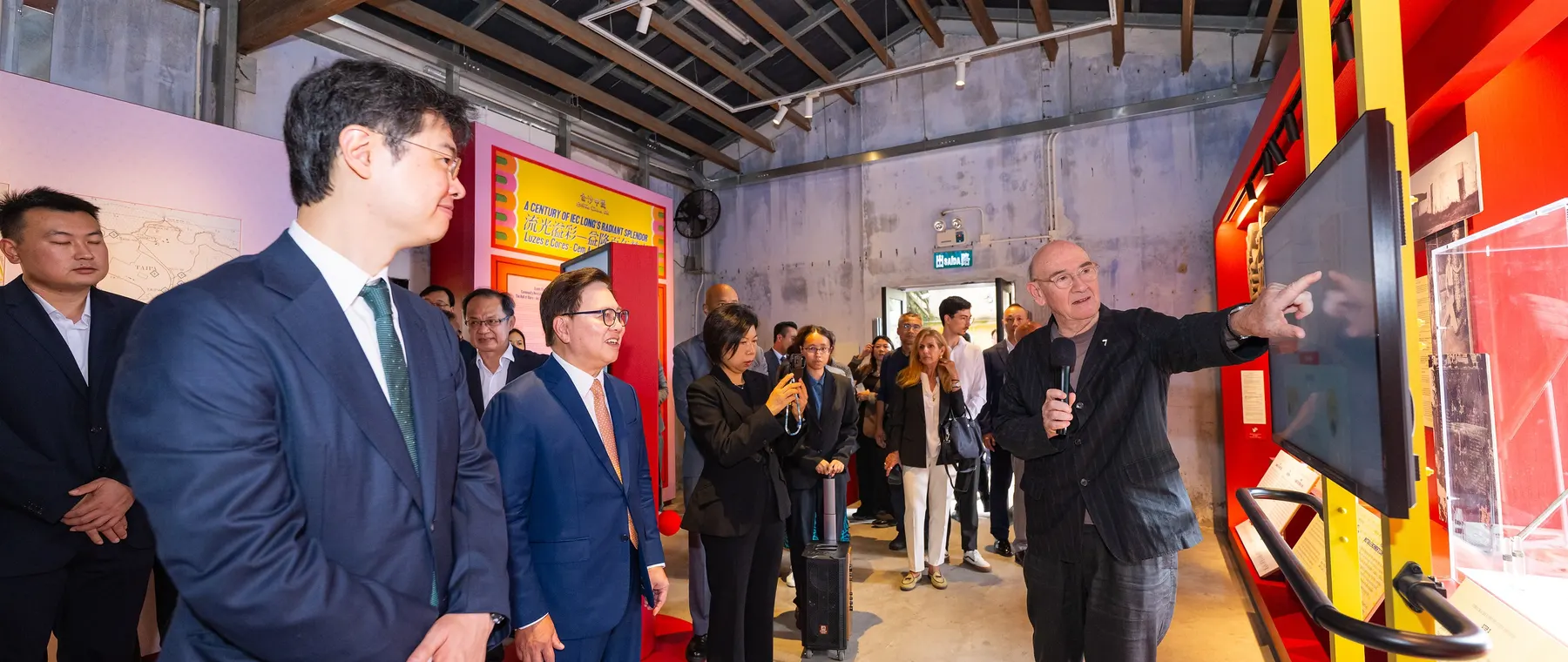
The official image accompanying this report shows the opening-day guided tour on 17 November. It documents the newly unveiled displays rather than promising the same guided experience for all future visitors. Anyone planning a visit should verify the current admission conditions, opening hours and arrangements for screenings directly with the venue.
For affluent travellers who value cultural experiences, the appeal of the new Hall of Glory is not dependent on the exclusivity of access. Its most compelling feature is the opportunity to examine the history of a place through several different kinds of evidence, including the architecture of the original site. The development is an attractive reminder that a destination can become more rewarding as its everyday history grows more familiar. The surviving workshop, the archival accounts and the digital interpretations may together encourage visitors to look more closely at the streets and buildings that surround them.
Sources and lead image
Source documentation: https://www.prnewswire.com/news-releases/sands-chinas-community-revitalization-programme-unveils-the-hall-of-glory--iec-long-firecracker-factory-302942150.html. Lead image: The opening-day guided exhibition tour at the former Iec Long Firecracker Factory in Macao — Sands China Ltd., official photograph supplied with the 17 November 2026 opening announcement.. Official issuer-supplied press photograph, reproduced for editorial coverage of the specific announcement and resized for web display.