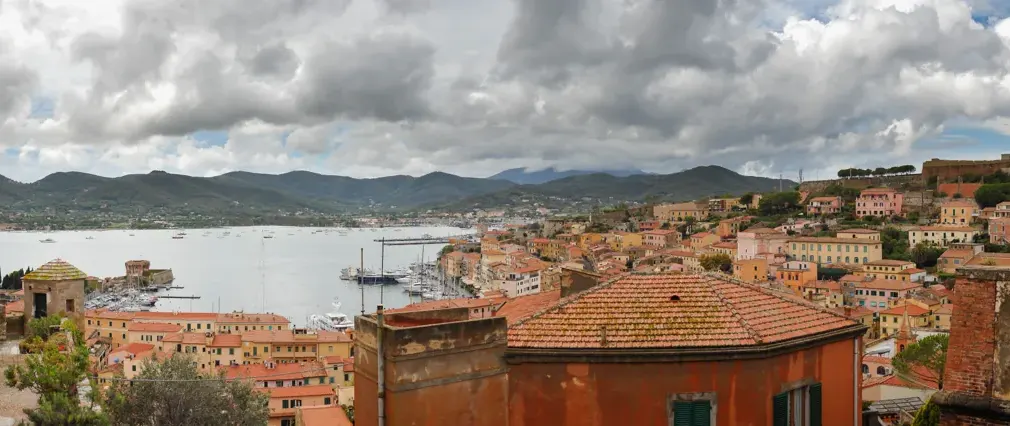
A working harbour with a Renaissance skyline
Portoferraio is an unusually rewarding arrival for a luxury yacht because its strongest visual feature is not a line of expensive vessels but a fortified town wrapped around a natural bay. Approaching Elba from the northern Tyrrhenian Sea, a skipper encounters a landscape of old defensive walls, harbourfront buildings and busy maritime infrastructure. The contrast is central to the experience. Ferries connect the island with the mainland, residents use the port as part of everyday life, and pleasure craft occupy an historic basin close to the town. For owners of 12–23.99-metre yachts, this mixture can feel more authentic than a marina designed solely around visiting holiday boats.
The local marina operator, Cosimo de' Medici, describes Portoferraio's natural inlet as sheltered from many winds and highlights the town's fortifications as the characteristic sight when approaching from sea. Shelter does not eliminate the need for an individual weather assessment, but it helps explain why the town became such an important harbour. A visit can be about architecture, food, an island landscape and a compact yacht base in equal measure. The right expectation is not an empty bay or a private anchorage; it is a lively Tuscan port with a historic pleasure basin immediately beside the old streets.
Understand the Darsena Medicea
The principal leisure-yacht facility is the Darsena Medicea, or Medici Dock, administered by Cosimo de' Medici srl. The operator's technical information lists 70 berths and indicates a maximum vessel length up to 70 metres and a depth up to 6.5 metres. These are overall technical figures, not confirmation that a specific yacht can enter any particular berth. A 15-metre cruiser, for example, still needs to match its beam, draft, manoeuvring requirements and shore-service needs against the berth offered. Larger-vessel capacity at one part of a marina should never be treated as a universal depth guarantee.
The marina's introductory description refers to around sixty places, while its technical specification lists seventy berths; these figures differ slightly within the same official source. The unambiguous practical lesson is that total capacity is not transient availability. A visitor should use the operator's booking system to obtain a current allocation and should not extrapolate from total berths to the number open on an August evening. The dock is close to shops and restaurants, allowing a crew to step directly into town after securing the yacht. That proximity is a principal attraction of Portoferraio for modestly sized luxury vessels.
Transit capacity is limited
The marina publishes a much smaller figure for visiting boats than its total berth count. Its technical page identifies five transit berths between 15 June and 15 September and three between 16 September and 14 June. This is a helpful reminder of why a yacht itinerary should be built around confirmed accommodation rather than the apparent size of a harbour. Exact availability, duration restrictions and policies can change with operational circumstances. The operator provides an online booking link and a published 2026 price list, which should be consulted directly for the proposed vessel and dates.
Because the transit allocation is small, flexibility is valuable. A crew considering Portoferraio as a spontaneous overnight call should plan an alternative before approaching the island and should check what form of confirmation the marina requires. The operator lists telephone +39 0565 944024, email porto@marinadiportoferraio.it and a booking option on its website; these are more reliable starting points than a third-party directory without recent updates. For peak dates, ask how the berth will be identified on arrival, whether professional assistance is available and which services are included. The historic setting is a luxury, but reliable arrangements remain the foundation of a relaxed visit.
Do not confuse the ferry port with the yacht basin
The Port System Authority for the Northern Tyrrhenian Sea makes an important operational distinction. Portoferraio includes ferry jetties, an Alto Fondale area used by larger commercial and passenger vessels, and the Darsena Medici basin, part of which is reserved for pleasure craft. The fact that a deep-water quay or ship berth appears near the old town does not mean it can be used by a visiting yacht. The same authority notes substantial ferry traffic during summer. A visitor should therefore know the yacht berth destination before entering, remain alert to commercial movements and follow current local harbour directions.
The official authority also describes a distinctive traffic practice for ships entering the main port, including keeping to the left and giving way to departing vessels. This historical port-description detail is not a substitute for current navigational rules, and yacht skippers must verify applicable instructions with up-to-date charts, notices and the harbourmaster. Rather than translating a website paragraph into a pilotage plan, the prudent crew contacts the destination and confirms its approach procedures. In Portoferraio, the setting may look like a sheltered postcard harbour, but it is also an operational gateway to one of Italy's best-known islands.
Services that make an island stop easier
Cosimo de' Medici lists drinking water and electricity at each berth, mooring assistance, boat-position monitoring, waste sorting with collection on the dock and a daily weather bulletin. It also advertises Wi-Fi, firefighting infrastructure and surveillance within the marina. Nearby services include showers, accessible toilets, fuel facilities, laundry, taxis and vehicle rental. The presence of a listed service does not establish that it can accommodate every yacht's connector, consumption rate or timing. The most efficient approach is to send the specific electrical, waste and fuelling requirements ahead of arrival.
For a 12–23.99-metre yacht, these practical provisions can turn an island stop into an opportunity to reset onboard routines. Batteries can be charged on shore power if compatible; fresh water can be taken responsibly; galley supplies may be refreshed before another coastal passage. A crew may want to handle routine tasks while guests visit the historic centre, but that division of labour still needs planning. Check collection hours, fuel delivery arrangements and the location of any service facilities rather than leaving everything to the moment of arrival. Good shore logistics quietly support the atmosphere of ease that guests expect.
Walk directly into the old town
The marina sits beside the heart of Portoferraio, where the first shore excursion can begin without a long transfer. The operator points visitors towards a covered market, local restaurants, bars, shops and a series of cultural sites, including Napoleon's Villa dei Mulini, the Archaeological Museum, the Foresiana Art Gallery and the Church of the Misericordia. The interest is not merely the number of attractions. There is a particular pleasure in leaving a yacht at the old quay and exploring a town that has developed around maritime trade, defence and island life across centuries.
A leisurely route can follow the waterfront before climbing towards the fortifications and viewpoints. The steep streets and exposed stretches invite sensible shoes, water and an unhurried timetable. A charter group interested in photography might take its time with the changing harbour perspectives, while guests who prefer food and conversation may stay closer to the quay. Restaurant availability and museum opening hours vary by season and should be checked at source. The strongest itinerary is one that allows guests to choose between history, markets and the simple pleasure of watching a real island port at work.
The Medici fortresses tell the larger story
Portoferraio's fortified profile is inseparable from its maritime identity. The local marina operator names Fort Falcone and Fort Stella among the town's principal landmarks, and their presence above the water gives the harbour a strong architectural silhouette. They also explain why this is such a photogenic place for yacht travellers: a camera can frame a historic defensive skyline and a modern cruising vessel without pretending the harbour has been frozen in time. The town's historical layers are more compelling when seen from both sea level and the elevated streets.
Napoleon's Villa dei Mulini adds another strand to the island's story, marking the association between Elba and Napoleon's period of exile. Visitors should verify public access and ticket arrangements with the relevant museum before promising a private group a particular visit. A short stop can still include an absorbing walk around the historic centre and fortification outlooks, even if one museum happens to be closed. The best travel writing does not reduce Portoferraio to a single famous name. Its harbour, townscape, markets and island connections provide sufficient reasons to stay even for people with little interest in Napoleonic history.
Elba beyond the marina
Portoferraio offers an introduction to the wider island of Elba and the Tuscan Archipelago. The marina operator specifically places the town beside the sea of Elba and the protected landscape of the Tuscan Archipelago National Park. Those surroundings create opportunities for walks, beaches, food-focused excursions and further coastal exploration, depending on season and the party's interests. The owner of a smaller luxury yacht can combine a harbour-based evening with a subsequent coastal leg, without committing the entire trip to a single resort environment. The appeal lies in variety rather than a guarantee of deserted beaches.
Any plan to anchor elsewhere around the island requires the same discipline as arrival in port. Protected-area boundaries, the seabed, weather, local restrictions and other traffic must be checked with current official sources. A sheltered beach in a promotional photograph may not be suitable for a yacht of a given draft, and a pleasant swimming cove may have environmentally sensitive seabed habitat. Charter guests should be briefed honestly about the difference between 'nearby by sea' and 'accessible safely today'. A flexible plan, with provisions for wind and sea conditions, keeps the island experience relaxed without pretending that navigation is a casual afterthought.
A port call with a good culinary rhythm
Food is a persuasive reason to leave the yacht in the Medici Dock for an evening. The covered market noted by the marina operator suggests a practical provisioning stop, while nearby restaurants and bars help create the feeling of an inhabited town rather than an exclusively seasonal waterfront. A guest day might begin with market shopping, move into an afternoon excursion and finish with dinner overlooking the harbour. What matters is not making unsupported promises about individual menus but allowing time to explore island produce and Tuscan cooking at its source. Opening hours and reservations should be checked with each business.
For crews, the close relationship between market and quay is useful. Provisioning can be done on foot when quantities are modest, and more substantial orders can be arranged with vendors where feasible. A yacht's galley may be the best place for an informal lunch, followed by an evening ashore that lets everyone experience the town's atmosphere. This is the quieter side of luxury yachting: convenience, good food, interesting architecture and the freedom to choose how much or how little to do. Portoferraio's advantage is that the experience begins almost as soon as the gangway is lowered.
Make Portoferraio a considered stop
A sensible itinerary starts with confirmation of a transient berth rather than the assumption that one will be available. Check the dates against the marina's seasonal transit figures, confirm dimensions and draft, and obtain the latest rates and cancellation terms. On approach, use current official navigation information and respect the separation between the passenger-port facilities and the pleasure-craft basin. Ask the operator for its current arrival instructions and the availability of necessary services. These ordinary checks allow the guest day to be about Elba, not berth uncertainty.
With that groundwork complete, Portoferraio can deliver a rich experience on a relatively modest yacht. The Medici harbour offers the convenience of town-centre mooring, while the fortifications and old streets provide an unmistakable sense of place. The island beyond introduces another layer of coastal exploration, subject to weather and conservation obligations. Owners and charter guests who value authentic destinations may find this more memorable than a marina with greater berth numbers but less cultural depth. A 12–23.99-metre luxury yacht is well suited to that style of travel: independent, comfortable and close to the life of the island.
Primary sources and photograph
- Cosimo de’ Medici marina — berths, technical specifications, services and 2026 pricing
- Northern Tyrrhenian Port System Authority — official Portoferraio harbour description
Hero photograph: “Portoferraio panorama 01”, panorama from Forte Stella, photographed 3 September 2012 by Mihael Grmek, via Wikimedia Commons, CC BY-SA 3.0. Historical location photograph; cropped and resized to WebP for publication. It does not depict live berth availability or 2026 traffic.