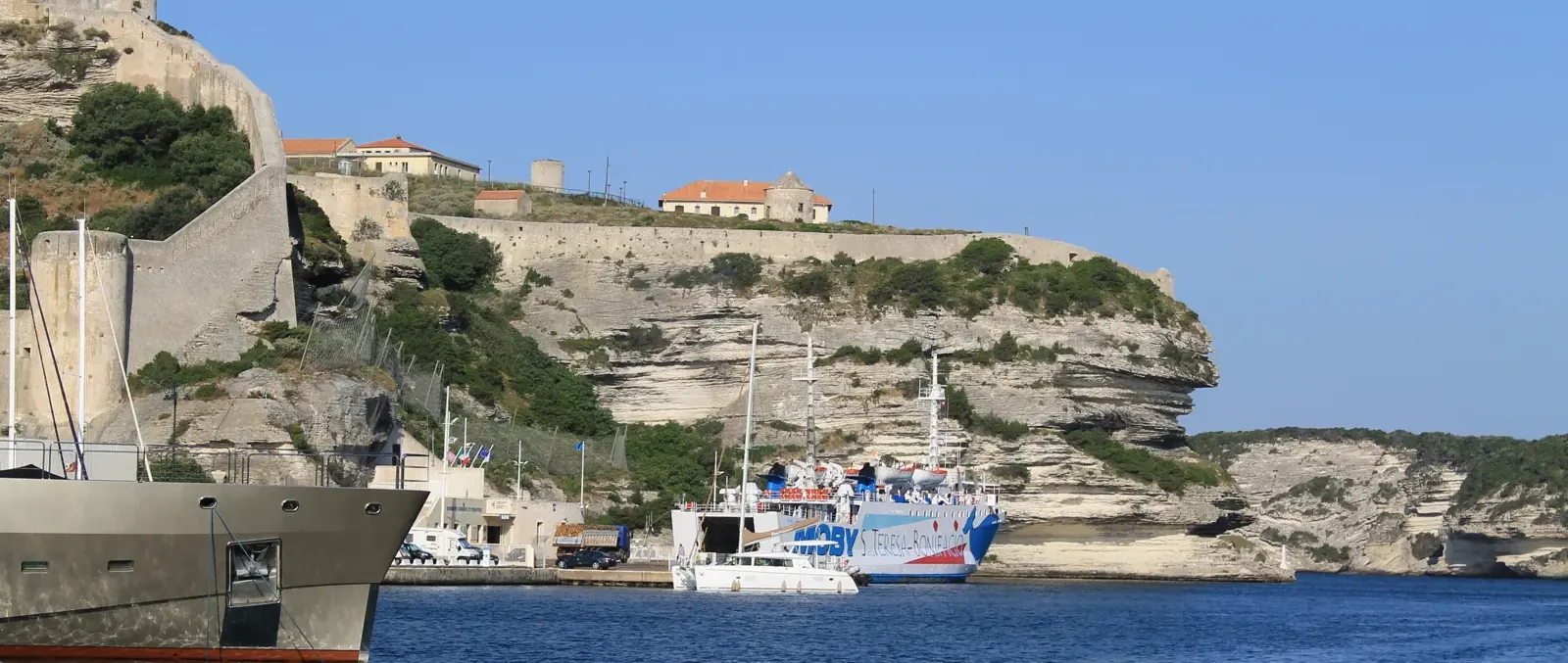
The harbour inside the cliffs
Bonifacio approaches are memorable long before a yacht has reached its berth. The Corsican town occupies a limestone promontory above a long, narrow harbour, where the waterway cuts through white rock before opening towards the quay and the buildings beneath the citadel. For the crew of a 12–23.99-metre yacht, this is a destination that rewards a slow, carefully planned arrival: the pleasure is not simply the view from offshore, but the contrast between open water, the enclosed inlet and the old town high overhead. The natural geography is the signature of the stop, and it also explains why spaces in the harbour are sought after.
The port authority describes Bonifacio as a major Mediterranean stop for visiting craft, reporting more than 10,000 transient boats in a year. That figure should be understood as a measure of demand, not an assurance of capacity on any particular day. The harbour is not a resort marina built around uniform pontoons; it is a working arrival point in a historically layered town. Small and mid-sized luxury yachts share a highly valued piece of waterfront with other visitors and commercial activity. A skipper who treats the destination as an urban port rather than an isolated anchorage will plan a more satisfying stay.
Book the berth before planning the evening
The first practical rule is unusually clear. According to Bonifacio Marina, berths are assigned through the Les Ports Corses application or the resaportcorse.com reservation service. The marina specifically states that it does not take berth reservations by telephone. That distinction matters because an informal call or a restaurant booking is not the equivalent of a confirmed berth. The yacht's actual length, beam, draft, timing and service requirements should match the information entered into the official system. Arriving without a suitable reservation in peak season risks turning the most anticipated stop into a frustrating diversion.
The published high-season restriction is particularly relevant to smaller luxury craft. From 1 to 25 August, the marina limits reservations to one night for vessels under 18 metres and two nights for other vessels. These are the marina's stated limits, not a recommendation for how long every voyage should stop. The practical result is that a 16-metre motor yacht may need to design an itinerary around a single night, whereas a 21-metre yacht may qualify for a two-night booking if space is offered. The exact allocation, available services, charges and any updated rule must be confirmed in the official booking system before departure.
The right sequence for arrival
Bonifacio sits beside the Strait of Bonifacio, the sea passage separating Corsica from Sardinia. Wind, swell, traffic and local restrictions can all affect the way a pleasant day at anchor turns into a workable harbour approach. A passage plan should therefore begin with current nautical charts, weather forecasts, notices to mariners, harbour communications and the vessel's own dimensions, rather than photographs of a sunny marina basin. This guide describes the destination, not a navigational pilot: entry tracks, approach marks, depth margins and the instructions of local authorities must be obtained from current authoritative navigational information.
That caution is especially important for visitors whose yacht is fast enough to move between Sardinia and Corsica in a single daylight passage. Speed expands the itinerary, but it does not remove the need to consider prevailing conditions and fatigue. Build enough time into arrival to speak with the harbour team and follow its berth allocation instructions. Check electrical connection needs, onboard water capacity and the availability of desired shore services. If the plan depends on a precise arrival hour, keep a realistic alternative. The most enjoyable Bonifacio stay begins when the crew can secure the yacht without feeling that the rest of the day has been spent chasing a booking.
A citadel town made for walking
Once alongside, the great attraction is the movement between the port and the upper town. The citadel rises above the sheltered basin, and the combination of stone streets, viewpoints, cafés and waterfront life creates a rhythm quite different from a purpose-built holiday complex. A morning can start with breakfast on deck and continue through narrow lanes high above the harbour; the afternoon can return to the quay for a long meal and an evening view of the masts. Distances may seem modest on a map, but gradients and steps are part of the experience, so comfortable shoes belong in the tender bag as much as a camera.
Bonifacio's value for luxury-yacht travellers lies in that close connection between vessel and place. A yacht of manageable size can feel part of a town, rather than simply sitting offshore as a floating hotel. There is no need to invent an exclusive beach club or to promise a deserted harbour to describe the appeal. The real pleasures are accessible: historic architecture, the theatre of boats moving through the inlet and the opportunity to explore Corsican food and culture on foot. Book any particular restaurant directly, especially in August, and leave room for a detour when the light over the limestone changes.
The Lavezzi Islands demand restraint
The nearby Lavezzi archipelago is often the image that draws boaters towards southern Corsica: rock forms, clear water and island landscapes within the protected Strait of Bonifacio. It is also a nature-reserve environment, not an unregulated playground. The Corsica tourism authority specifically advises that navigation and anchoring are controlled in designated areas and that anchoring on Posidonia seagrass is prohibited. An itinerary should not assume that any attractive patch of turquoise water is a permissible place to drop anchor. Consult the current protected-area charts, local notices and any mooring directions before deciding whether, where or how to stop.
Visitors landing on Lavezzu itself also need to be self-sufficient. The official tourism information identifies a lack of drinking water, bins, toilets, restaurants and shade on the island and describes walking surfaces that are rough in places. It also notes restrictions on pets. For a yacht party, this transforms an apparently simple picnic into a question of carrying water, taking back all waste, managing sun exposure and ensuring everyone is able to walk safely. Conservation rules can change. A sensitive skipper will decide the day's activity around the protected landscape and local conditions, not around the assumption that the tender can be landed wherever it is visually appealing.
Responsible luxury is part of the visit
The marina sets out clear environmental expectations for visiting owners and crews. Its guidance asks users to sort rubbish at designated points, limit electricity and water use, use appropriate facilities for bilge and wastewater, and fit water-saving nozzles when cleaning a boat. These are operational details rather than decorative sustainability claims. On a 12–23.99-metre yacht, water management and the handling of accumulated waste can be planned before arrival, reducing unnecessary running about after berthing. Crews should ask which collection and pump-out arrangements are available for their particular vessel rather than assume that a facility is compatible.
Bonifacio Marina reports that it achieved the European Ports Propres environmental certification in 2019 and renewed it in 2022, while also describing biodiversity-related commitments. This reflects an effort to manage the cumulative effects of a busy port beside sensitive waters. It does not mean every environmental pressure has disappeared. Visitors can contribute through ordinary practice: no discharge in harbour, no debris overboard, careful shore power use and respect for protected zones. A clean wake and a quiet, well-managed arrival are better signs of luxury seamanship than the amount of fuel or equipment a vessel carries.
A voyage between Corsica and Sardinia
Bonifacio's position makes it a natural hinge between a western Mediterranean cruise and the islands and harbours of northern Sardinia. The difference in atmosphere can be striking even when the distances are relatively short: Corsica's limestone citadel and intimate inlet on one side, Sardinia's varied coastlines on the other. That does not mean a fixed day trip is right for every yacht. Crossings should be judged against weather windows, traffic separation or routeing measures where applicable, and the range and comfort of the particular vessel. A well-paced itinerary may use Bonifacio as a destination in its own right rather than simply a refuelling stop.
For an owner with a week available, the sensible unit of planning is not the number of ports collected but the quality of time at each one. Bonifacio works especially well when there is enough daylight to enjoy the harbour from several perspectives. A night alongside can give the crew a chance to dine ashore and see the town after day visitors have moved on. With the August limits, a second night may not be possible for an under-18-metre yacht; therefore it is wise to prepare the next stop before arriving. Travellers should resist treating an optimistic online itinerary as proof of available berths.
Sant'Amanza and Cavallo are different facilities
The Bonifacio Marina website also presents Sant'Amanza Mooring and the port of Cavallo, but these must not be mistaken for interchangeable berths within Bonifacio's main town harbour. They have their own information, schedules, conditions and regulations. A booking described simply as 'Bonifacio' can lead to unpleasant surprises if it refers to a different locality or type of mooring. Before confirming, compare the actual geographic position, the journey to restaurants or the citadel, access to shoreside supplies, and the vessel's ability to use the berth or mooring responsibly.
The difference is particularly important for a guest itinerary that promises dinner in the old town or a morning walk above the cliffs. An offshore mooring or another island port can be a fine choice for its own reasons, but travel time and tender operations should be represented honestly. Where a reservation provider lists several sites under the same wider port organisation, owners should check the exact facility name on the confirmation. This distinction reflects a general rule of cruising: the destination is more than a harbour name in a booking system, and the guest experience depends on the precise location of the yacht.
The practical pre-arrival checklist
First, verify the dates, length of stay, vessel dimensions and current berth policy in Les Ports Corses or the official online reservation service. Second, obtain a current forecast and navigation information for the Strait of Bonifacio and ask the harbour office how to make contact on approach. Third, examine where onboard waste, wastewater, electricity and water can be handled without breaching marina requirements. Fourth, look at the walking route to the upper town and the requirements of any guests with reduced mobility. Fifth, if Lavezzi forms part of the plan, check protected-area rules separately from town-marina rules.
Contact details and prices can change, so the official marina website should remain the reference rather than a cached article. For a day of sightseeing, the most valuable preparation is often modest: reserve the berth properly, arrange dinner if desired, leave the upper town unhurried and avoid building the schedule around unverified watersports access. The point of a small-luxury-yacht cruise is flexibility. In Bonifacio, that flexibility is enhanced—not diminished—by respecting a tightly managed harbour and the protected waters immediately outside it. A good itinerary fits the place rather than asking the place to fit a rigid itinerary.
Why Bonifacio deserves more than a photograph
Photographs rarely convey how unusual this harbour is. The striking limestone approach is only the introduction; the deeper satisfaction comes from a town that remains recognisably Corsican and from the chance to explore its streets without a long transfer from a distant resort dock. A mid-sized luxury yacht offers a balanced way to experience that character. The vessel supplies privacy and familiar comforts, while the shore supplies scale, history, views and spontaneous discoveries. That relationship is why a relatively short stay can be memorable even when there is no opportunity for a long beach excursion.
The price of that desirability is competition for space and the need to treat the coastline carefully. Bonifacio's marina does not promise a berth to every arrival, and its August duration restrictions are explicit. The waters around Lavezzi deserve equal care. Travellers who accept these realities will see more than a postcard stop: they will experience a dramatic port, a walkable citadel and a living marine landscape. That combination makes Bonifacio one of the most distinctive choices for owners and charter guests exploring Corsica aboard luxury yachts in the 12–23.99-metre range.
Primary sources and photograph
- Bonifacio Marina — official marina information and reservations
- Bonifacio Marina — environmental commitments and policies
- Bonifacio Marina — current local regulations and notices
- Visit Corsica — Lavezzu and protected-area visitor guidance
Hero photograph: Bonifacio harbour, 28 June 2013, by Patrick Nouhailler's…, via Wikimedia Commons, CC BY-SA 3.0. Historical place photograph; cropped and resized to WebP for publication. It is not a depiction of today's berth availability or traffic.