One digital system across four different Porsches
On 3 November 2026, Porsche detailed a new generation of its Porsche Communication Management system for the 911, Taycan, Panamera and Cayenne families. The announced platform combines more powerful hardware, an updated operating language called Porsche Digital Interaction and a wider range of connected services. It is intended for newly produced vehicles as the rollout proceeds, not an immediate retrofit for every Porsche already on the road. That distinction is important because model, market and production date will determine exactly what a buyer receives.
The four vehicle families serve quite different owners. A 911 driver may chiefly want immediate access to navigation and audio, while a Taycan customer may depend more heavily on charging information. Porsche is seeking a recognisable way of using the screens across these products without pretending that the cars themselves are interchangeable. The value of consistency appears when drivers move between different vehicles or when a household owns more than one Porsche. Familiar menus can reduce the time spent relearning controls.
A new hardware platform is the underlying change
The company says the latest system-on-chip architecture can provide up to five times the computing power of the earlier platform. Porsche associates that increase with faster starting, shorter loading periods and smoother multitasking. Such figures describe the potential of the platform under the company’s comparison conditions; they do not guarantee that every operation will feel exactly five times quicker. Real-world performance will also depend on installed software, connected services and how a particular owner uses the system.
More capable hardware matters because in-car screens increasingly handle many activities at once. Route guidance, media playback, telephone functions and vehicle settings may all remain available in the background. Delays when moving between those tasks can make a sophisticated cabin feel surprisingly dated, even when the vehicle drives beautifully. Porsche also describes the architecture as a foundation for future digital functions. That creates scope for improvements after delivery, although no owner should assume that every later feature will be compatible with every car.
Porsche Digital Interaction aims for visual coherence
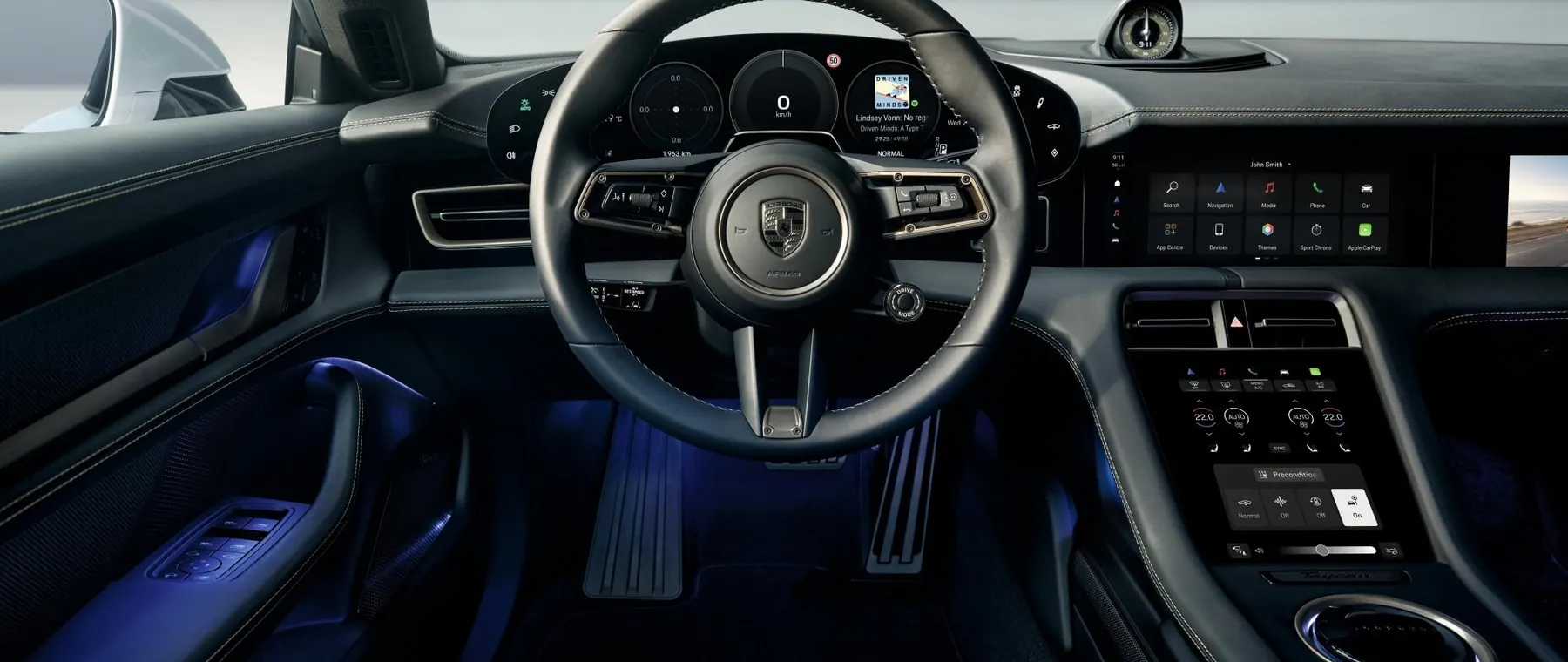
Porsche Digital Interaction brings an interface approach already introduced with the Cayenne Electric to other model lines. It uses configurable widgets, five selectable themes and a freely rotatable three-dimensional representation of the vehicle in its actual exterior colour. Selected settings can be accessed through the virtual car. This is a design choice as much as a technical one: an image that resembles the owner’s own car may make certain settings easier to understand than an abstract list of controls.
A polished graphic is only useful if it supports a clear task. The quality of an interface should be judged by how quickly a driver can find a setting, how consistently related functions behave and whether critical information remains readable. Porsche says it has worked on clear layouts and a common operating logic. Prospective buyers should still test the interface with the car stationary and compare the tasks they use most. A visually attractive screen is not automatically the easiest screen for every person.
Navigation and charging become more closely connected
The new Navigation Plus system includes a three-dimensional map presentation, online map data and traffic information. For electric vehicles, the Porsche Charging Planner considers charging stops and battery preconditioning when calculating a route. This is a particularly relevant difference between an everyday navigation display and one integrated with an electric car’s energy management. The driver needs to understand both where to travel and how the planned route may affect charging requirements.
There are still practical limits to navigation technology. Charging-site availability, local conditions and map information can change between planning and arrival. In unfamiliar territory, drivers should retain a margin for unexpected delays and confirm important stops. Porsche notes that some smartphone integration, including electric-route functions, depends on the market. Owners planning international journeys should therefore check the services enabled in their country rather than rely on specifications taken from a different regional website.
The AI Voice Pilot handles more natural requests
Porsche describes its upgraded Voice Pilot as a large-language-model-based assistant able to understand natural speech, follow-up questions and multi-step requests. Navigation, selected vehicle settings, media and certain apps are among the functions it may control. The emphasis is on reducing the need to recall a precise command phrase. That could make digital services more accessible to people who prefer speaking to navigating menus, provided the assistant interprets the intended action accurately.
The capability should not be mistaken for unrestricted control over the vehicle. Porsche explicitly describes selected functions, and availability can differ by model and market. Drivers should test familiar examples, such as finding a destination or adjusting an entertainment source, before becoming dependent on the assistant. A voice system is most useful when it communicates clearly that it has understood a request. Responsible operation still requires the driver to watch the road and retain direct control of the car.
Music and apps form a broader connected ecosystem
The revised platform brings Porsche applications, smartphone services and selected third-party providers into a more integrated arrangement. An App Center lets owners select and update supported in-car applications. The company identifies audio and video streaming, parking, navigation and charging among the service areas. Apple Music becomes available directly through the Porsche App Center in eligible markets, with Dolby Atmos spatial audio supported when the car has the necessary compatible sound system and an active subscription.
Premium audio is often discussed in terms of speaker counts and power, but the surrounding software matters too. Finding a playlist, moving between sources and seeing information clearly are part of the daily experience. Porsche names its Bose and Burmester systems in connection with the new audio capability, while also describing some support through Apple CarPlay. Customers should confirm which exact equipment configuration provides which functionality. A headline feature may require a particular package, software version or paid service.
Software updates can change the ownership experience
The new hardware supports comprehensive over-the-air updating, allowing Porsche to supply revised software and selected functional enhancements after the car has left the factory. This is significant because the in-car digital environment no longer needs to remain frozen at delivery. It also changes how owners think about maintenance: software status and connected-service terms become additional things to check alongside the mechanical service record and condition of the vehicle.
Updates should still be managed deliberately. Owners need to know whether a change requires the car to be parked, how long it may take and what happens if a service is temporarily unavailable. Porsche has not promised every possible future function for all vehicles, and an upgradeable platform should not be represented as an indefinite guarantee. Used buyers should establish the car’s actual software version and the connected features presently active, particularly when comparing examples from different production months.
What buyers should verify before ordering
The manufacturer says the system will be introduced gradually across newly manufactured 911, Taycan, Panamera and Cayenne models. That makes a build-date check essential. The presence of a familiar model name alone does not confirm that a particular car contains the new computing platform or digital operating interface. For a new order, the dealer should provide the applicable specification for the selected market, powertrain and options. For stock vehicles, the vehicle identification and equipment list matter more than generic launch photography.
The 3 November announcement is best understood as a platform transition across several luxury cars, with performance, design and ownership implications. Its success will ultimately be judged through ease of use and the usefulness of ongoing services, not only through a more impressive processor specification. A buyer should spend time with navigation, pairing, voice commands and the relevant audio functions on the actual vehicle. Current pricing and subscription details need checking with Porsche because the global release does not establish them for every market.