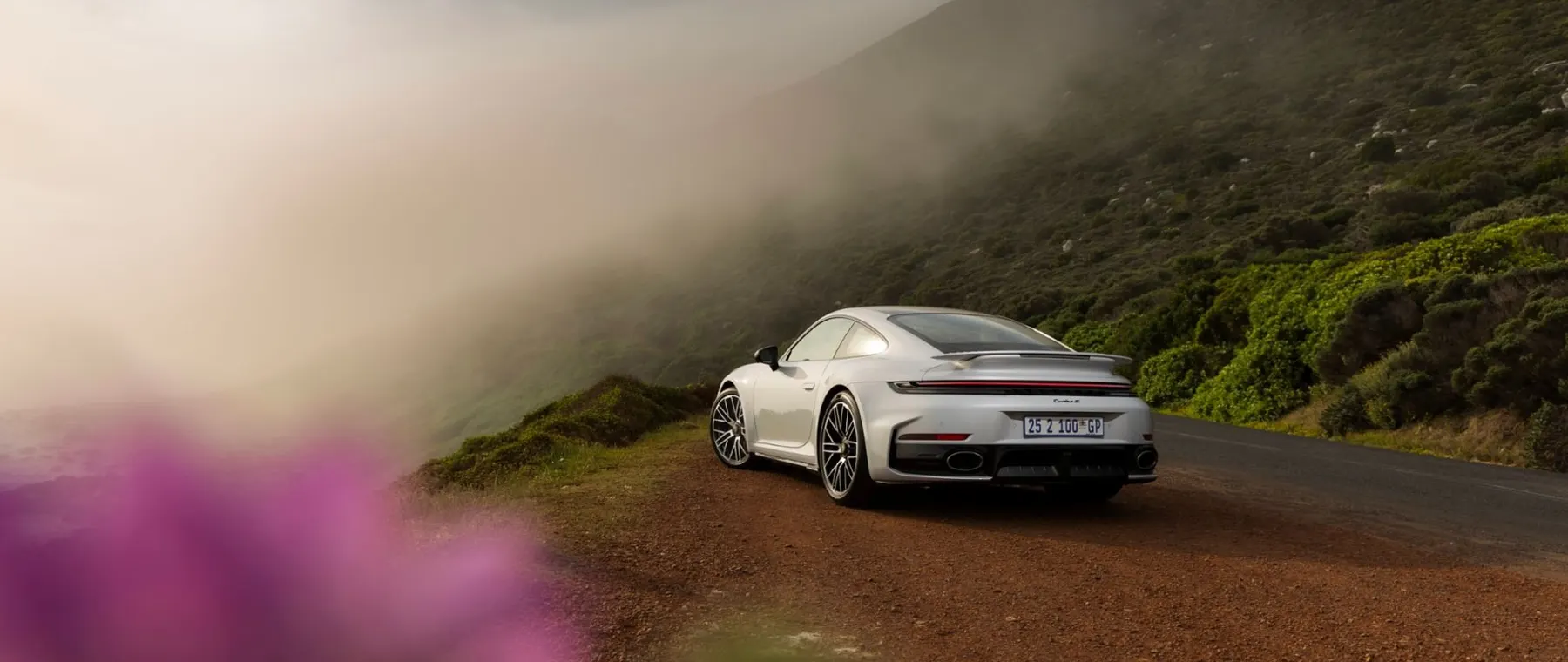
Porsche takes the newest Turbo S onto Cape mountain roads
Porsche South Africa has put its latest 911 Turbo S Coupé through a private media driving programme in the Western Cape, taking journalists onto mountain roads, open highways and the celebrated Du Toitskloof Pass. The event, reported by Porsche on 9 October 2026, was designed to demonstrate the car's unusual blend of very high performance and long-distance refinement in conditions that reflect how owners might actually use it.
Rather than unveiling another 911 variant, the drive offered an opportunity to see the recently introduced Turbo S away from a motor-show display. The location was an important part of that decision: South Africa's Western Cape provides a mix of flowing bends, changing elevation and spectacular scenery. It demands a car that can respond confidently to different surfaces without treating every journey as a timed lap.
Du Toitskloof Pass puts handling in focus
The winding route through Du Toitskloof Pass became the central feature of Porsche's programme. The pass offers repeated changes of direction and wide views over the surrounding mountains, giving drivers an opportunity to explore how steering, traction and suspension work together. It is a public-road setting, however, not a closed racing circuit, and any demonstration must remain subject to speed limits, other traffic and weather conditions.
For the 911 Turbo S, the key characteristics include Porsche's all-wheel-drive system and standard rear-axle steering. On a tight road, rear-axle steering can make a vehicle feel more agile at lower speeds while supporting stability at higher speeds. The feature does not eliminate the need for careful judgement; smooth inputs and good visibility remain more important than any electronic aid when mountain roads are unfamiliar.
A T-Hybrid engine changes the Turbo formula
The current Turbo S uses a 3.6-litre six-cylinder boxer engine incorporating Porsche's T-Hybrid system with two electrically assisted turbochargers. The manufacturer quotes a combined output of 523 kilowatts, equivalent to 711 metric horsepower, and peak torque of 800 newton-metres. An eight-speed PDK transmission delivers power through the Porsche Traction Management all-wheel-drive system, giving the flagship 911 a substantial performance reserve.
Electrically assisted turbocharging differs from the large plug-in hybrid systems familiar in many luxury SUVs. The compact 1.9-kilowatt-hour battery and 400-volt architecture are engineered primarily to support power delivery and response rather than to provide conventional electric-only touring. In an everyday grand-touring car, immediate throttle response can be useful when overtaking or climbing, although the system's maximum output should never be confused with permission to drive aggressively on public roads.
Acceleration is extraordinary, but comfort is the story
Porsche lists a zero-to-100-kilometres-per-hour time of 2.5 seconds for the Coupé and a top speed of 322 kilometres per hour. Those headline figures place the Turbo S among the fastest production sports cars, but they reveal less about the way an owner experiences a long journey. The important questions for a real trip concern cabin noise, passenger comfort, driving position, luggage, ride quality and the availability of modern assistance systems.
The Western Cape route was intended to demonstrate that high performance does not require a punishing everyday experience. Porsche describes responsive power delivery alongside refined suspension behaviour, with the vehicle capable of shifting between an energetic mountain-road character and relaxed highway travel. The actual comfort experienced will also depend on road surface, seat choice, tyres and personal expectations.
Chassis technology manages conflicting demands
The new generation includes a sophisticated chassis package that coordinates active aerodynamics, suspension and traction. Porsche's Dynamic Chassis Control employs an electro-hydraulic roll-stabilisation approach suited to the T-Hybrid electrical architecture, while the standard rear-axle steering influences both agility and confidence at speed. Active cooling elements and a moving rear wing also allow the car to respond to different driving conditions.
These are interconnected systems rather than independent showroom features. More engine performance creates greater braking and thermal demand; more grip can impose larger loads on tyres and suspension; and road comfort still needs to be preserved for journeys that may last hours. An owner comparing equipment packages should ask which features are standard in the local market, how they are maintained and how replacement costs differ from less complex 911 variants.
Touring through the Western Cape is an experience of its own
The Western Cape attracts driving enthusiasts for its mountain passes, vineyard landscapes and coastal roads. Du Toitskloof Pass is only one part of that picture, and a well-planned itinerary may combine quiet scenic stops with accommodation and local experiences that cannot be appreciated from behind a steering wheel. The region's appeal is therefore broader than an opportunity to drive a powerful car through a series of corners.
Visitors should select routes based on daylight, weather and the condition of their vehicle rather than simply reproduce a manufacturer media schedule. Mountain cloud, changing temperatures and traffic around popular viewpoints can affect travel times. Rental or privately shipped vehicles bring additional insurance, registration and local road-rule considerations that are separate from the performance capabilities of the car itself.
Porsche's regional operation is seeking real-world feedback
The Cape programme forms part of Porsche South Africa's effort to give journalists and content creators a direct understanding of new vehicles in settings relevant to regional customers. Toby Venter, chief executive of Porsche South Africa, emphasised the breadth of the Turbo S's capabilities, describing a car intended to combine high performance with everyday usability. The programme showcased the product rather than announcing a new production plant or a separate special edition.
Regional media events can also reveal which aspects of a car matter to local owners. Heat, altitude, road conditions and the availability of specialist service support all influence the experience of using a sophisticated sports car outside Europe. Prospective buyers should consider dealer support, parts availability and warranty arrangements alongside the vehicle's headline specification, especially if it is to be used frequently rather than stored in a collection.
An owner-focused alternative to a track-only sports car
The 911 Turbo S occupies a distinctive place within the sports-car market because it aims to offer usable luggage space, weather confidence and comfort without surrendering much of the performance expected from a supercar. The Western Cape demonstration reinforces that positioning. It should not be treated as an independently measured comparison against rival cars, nor as a promise that every owner will achieve the same driving impressions.
For luxury travellers who enjoy combining a memorable road journey with a destination, the new 911 offers a particularly capable means of travel. Its appeal ultimately depends on how naturally performance, controls, cabin comfort and real-world convenience work together. The confirmed October development is Porsche's South African media drive and the official photographs of the Turbo S amid the Western Cape scenery.