An island visit that begins with restraint
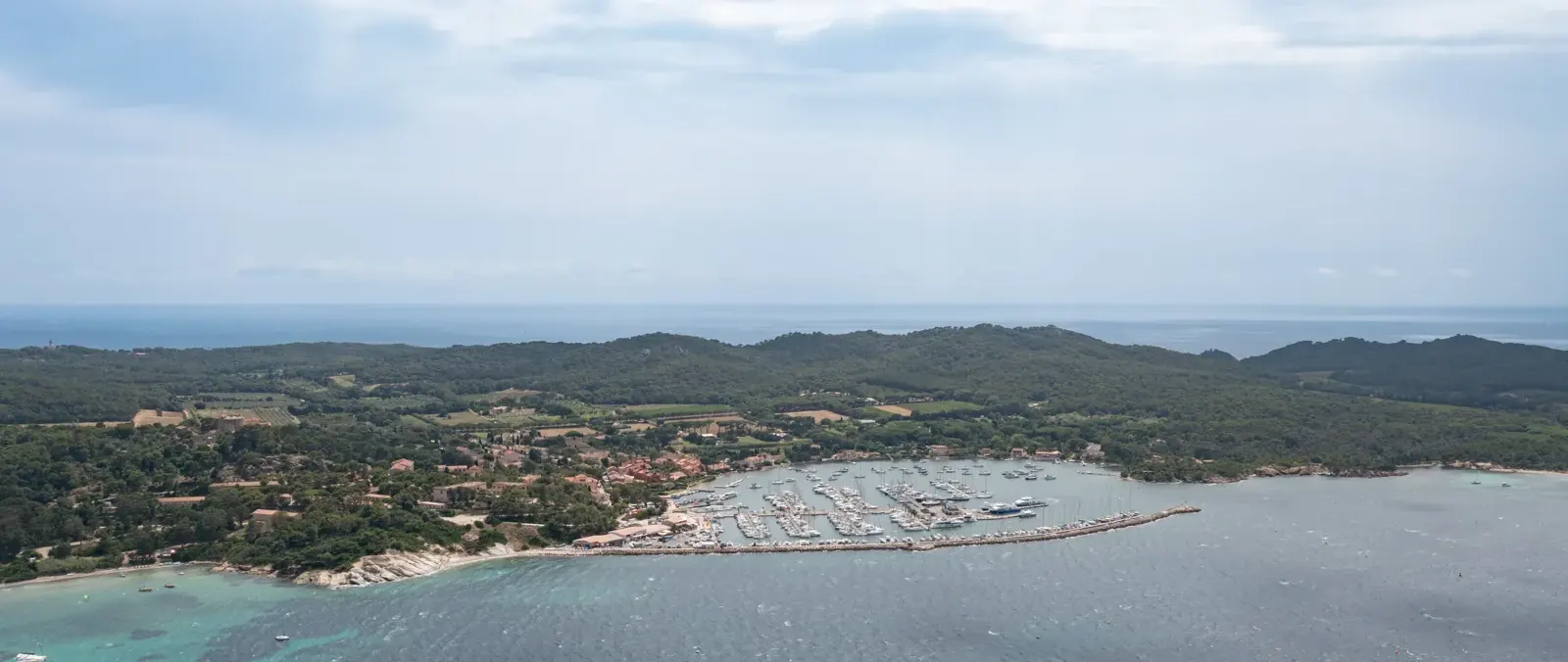
Porquerolles looks deceptively simple from the cockpit: a low Mediterranean island with a harbour, sandy bays and green ridges close to the Côte d’Azur. Yet its strongest luxury is the combination of accessible village life and protected scenery. The island belongs to the Îles d’Hyères, the group known as the Golden Islands, and the surrounding national-park framework means that a yacht’s arrival should be planned with unusual care. A beautiful anchorage is not automatically an unrestricted anchorage.
For owners of 12.00–23.99-metre yachts, the attraction is the scale of the experience. One can spend a day ashore exploring by bicycle, pause for lunch in the village and enjoy a quieter harbour evening without needing an elaborate itinerary. The island is close to the Riviera in geography but has a different rhythm. Respecting current marine rules and visitor guidance is part of enjoying it, not a complication to be waived by the size of a vessel.
Understand the setting before approaching
Porquerolles is one of the principal islands off Hyères, alongside Port-Cros and the Île du Levant. Provence-Alpes-Côte d’Azur’s official tourism service presents it as a place of beaches, tracks, village cafés and cycling, rather than as a dense resort. Its northern shore contains several much-visited beaches and the harbour, while other parts of the island retain a markedly wilder appearance. That contrast is the reason a brief stop frequently becomes an extended stay.
A yacht approach begins with proper navigation and official notices, not with a photograph of a turquoise bay. Harbour capacity, vessel dimensions, sea conditions and local regulations need checking for the actual date. The national park publishes specific 2026 marine-regulation material for Porquerolles, reflecting a protected environment where navigation, anchoring and underwater activities may be restricted by location. A skipper should consult the current documents and the relevant authorities before choosing where to stop or whether a tender may land.
The harbour and the village form the social centre
The island’s port puts the visitor within reach of Porquerolles village, a compact setting that rewards walking slowly. Small squares, places to eat and independent services create a convivial base after time at sea. The port itself has a history connected with coastal defence, and the national park’s destination information recalls the development of fortifications associated with French royal interests. The maritime setting therefore has a depth that is easy to miss if the visit is measured only in beach hours.
Arriving aboard a private yacht does not remove the need to confirm an allocated berth or an authorised stopping place. Boats in the luxury-yacht range vary substantially in beam, draught and required services, and availability changes with the season. If the yacht remains elsewhere, shore transfer should use approved landing arrangements. A little forward organisation helps guests spend their first hour in the village enjoying its atmosphere instead of searching for a space that may not be open to them.
The pleasure of exploring on two wheels
Regional tourism promotes cycling as a particularly enjoyable way to explore Porquerolles. On a small island, bicycles let visitors move between village life, pine-fringed tracks and open viewpoints while preserving the relaxed pace that makes the destination special. There is an opportunity to experience more than the nearest beach, but it is sensible to choose a route that fits the group’s fitness, available daylight and the surfaces permitted for public use.
Guests need not treat a cycling day as a sporting challenge. A morning ride, a stop to appreciate the landscape and a return for lunch can be enough. Hire availability, opening hours, restrictions on particular paths and seasonal visitor numbers should be verified locally. For a mixed group, combining a shorter ride with a walk or café visit is often more considerate than imposing a long circuit. The best itinerary is one in which people actually notice the island around them.
Notre-Dame and the island’s celebrated beaches
Plage de Notre-Dame is a familiar name in accounts of Porquerolles, and the national park maintains visitor information specifically for it. Official regional tourism also highlights Plage d’Argent, Langoustier and the island’s other coves. These sites draw visitors for their scenery, but their popularity makes good environmental practice especially important. The shoreline is not a private bathing platform attached to whichever yacht happens to be nearby.
Where access and sea conditions allow, the most satisfying way to enjoy a beach may be to visit from an authorised landing point and spend time ashore. Check the current rules for swimming, anchoring, powered tenders and any activities involving the seabed. Poseidonia seagrass beds and sensitive coastal habitats can be harmed by careless anchoring, and the island’s protected status calls for precise behaviour. The guiding principle is simple: enjoy the clear water without leaving damage behind.
What the 2026 national-park rules actually mean
The Parc national de Port-Cros publishes current navigation and recreational-boating guidance, including a Porquerolles marine-regulation leaflet labelled 2026. Its site also explains that park waters contain differently regulated areas. These are operational documents: permitted activities depend on the exact zone, vessel and circumstances. An owner should use them together with up-to-date charts, local notices and direct harbour advice, not substitute a general travel article for a navigation plan.
Some web searches also reveal proposals for reorganising moorings around Porquerolles towards 2028. The existence of a project does not mean that its proposed arrangements are already in force. Equally, a rule stated in an older brochure may have been superseded. This article therefore does not offer a single blanket permission for all boats below 24 metres, nor does it publish coordinates as approved anchorages. The appropriate approach is to verify the present regime before a visit.
Beaches, paths and nature as the main attraction
There are plenty of Riviera destinations in which a yacht acts primarily as a gateway to restaurants and nightlife. Porquerolles offers a different balance. The village supplies a welcome social centre, while the beaches, paths, pine-covered slopes and coastal views provide the real sense of discovery. This makes the island suitable for an owner who wants the comfort and privacy of a well-equipped yacht without spending every hour in a conventional resort environment.
Early starts and modest daily plans help preserve that atmosphere, particularly at busy times of year. A beach walk in softer morning light or an afternoon cycle away from the most crowded route may become the highlight. Even in a place praised for tranquillity, demand for transport, rental bicycles and dining can change abruptly with holidays and weather. Courtesy towards residents and other visitors is as important as any advance booking.
A practical forty-eight-hour approach
For a two-day visit, begin by confirming where the yacht can legally and safely remain. Arrive in appropriate daylight and conditions, complete the necessary harbour formalities and allow the crew to assess the next day’s weather. The afternoon can be devoted to the village, waterfront and an unhurried meal. A calm first evening gives everyone time to understand the place before moving between beaches or heading along unfamiliar inland paths.
On the following morning, consider a bicycle or walking excursion, with a beach visit added only after checking local access guidance. Keep one flexible part of the day for a change in wind or sea state; a protected-island itinerary should never depend on a risky tender transfer. If children or less mobile guests are travelling, choose shorter distances and a reliable return option. The aim is a restorative stay, not an ambitious list of points ticked from a chart.
Why a smaller luxury yacht can be an advantage
Between 12 and 23.99 metres, a yacht can offer genuine privacy and comfort while requiring less infrastructure than the largest superyachts. That does not guarantee space in a small port, and it certainly does not make environmental restrictions optional. It does allow owners to build a rewarding holiday around a few thoughtfully chosen destinations. Porquerolles is especially persuasive because its shore attractions are close to the maritime landscape rather than separate from it.
Before leaving, review the harbour forecast, local regulations and onward route, and plan waste and wastewater management responsibly. The national park specifically asks mariners to avoid pollution and respect protected areas. The enduring pleasure of Porquerolles lies in finding a rare balance between island hospitality and visibly cared-for nature. For the luxury-yacht owner, that balance is worth more than a boast about how close the anchor was dropped to a famous beach.
Official sources: https://provence-alpes-cotedazur.com/en/get-inspired/natural-areas/porquerolles-island/; https://portcros-parcnational.fr/votre-visite/la-reglementation/navigation-plaisance; https://capel.portcros-parcnational.fr/en/reglementation/; https://www.portcros-parcnational.fr/fr/des-decouvertes/une-destination-dexception/la-mer-et-les-fonds-marins/plages/plage-de-notre-dame; https://destination.portcros-parcnational.fr/fr/outdoor-site/39-Port-de-Porquerolles
Photograph: dronepicr, aerial view of Porquerolles harbour photographed in June 2023. Wikimedia Commons, Creative Commons Attribution 2.0 Generic. Photo resized to WebP. Original: https://commons.wikimedia.org/wiki/File:Aerial_view_of_the_Porquerolles_Port,_Hy%C3%A8res,_France_(53698061449).jpg ; licence: https://creativecommons.org/licenses/by/2.0/ . The image shows the actual port, not a claimed current berth availability.