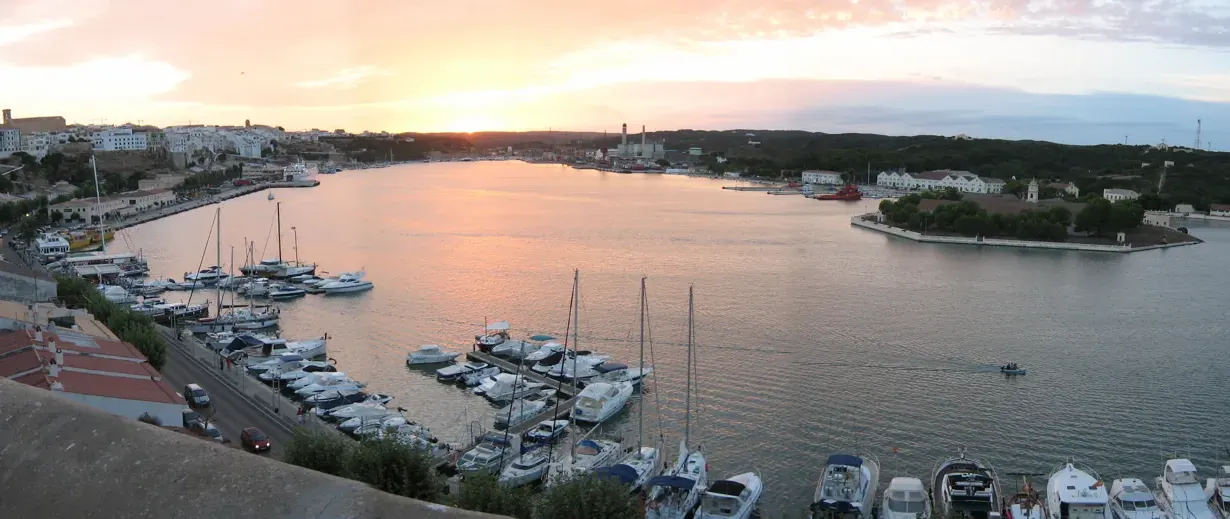
A harbour that shapes the entire visit
Arriving at Maó by water is a different introduction to Menorca from arriving by airport or road. The long indentation of the coast allows a yacht to move gradually from the Mediterranean into a harbour whose walls hold military works, waterside settlements, quays and the old town above. Balearic Islands tourism describes the inlet as more than five kilometres long and identifies it as one of the Mediterranean’s major natural harbours. It is the geography, not simply a berth, that gives this destination its sense of occasion.
For the owner of a yacht between 12 and 23.99 metres, the appeal is unusually complete. A day can combine a serious harbour approach, art and architecture ashore, a leisurely lunch and a return to a vessel close to town. This is a destination in which the yacht is a practical base for discovery rather than merely a transport connection between beaches. The experience remains dependent on weather, available berthing and local harbour instructions, so advance planning is part of a relaxed arrival.
Read the harbour before choosing a berth
The mouth of Port de Maó leads towards several distinct shores, rather than one uniform marina basin. Historic defensive sites and the settlement of Es Castell sit along the wider harbour landscape, while central Maó rises above its waterfront. The official island tourism guide highlights the length of the inlet, its long history of navigation and the combination of islets, fortifications and neighbourhoods. Those features justify a slower, attentive passage when conditions and harbour traffic permit.
Practical mooring decisions should be made from current official information and direct confirmation with the intended operator. A yacht’s advertised length alone does not guarantee a suitable berth: beam, draught, services, shore-power arrangements and access for passengers all matter. Visiting skippers must respect commercial movements and any instructions issued by harbour control. Do not assume that a quiet-looking stretch of shore is an approved anchorage, or that a private vessel may approach a historic islet without permission.
From the quay to Maó’s upper town
The old town sits on higher ground above the waterfront, and the transition from waterside promenade to urban streets is an essential part of the visit. Balearic tourism describes a historic centre of winding lanes and pale Mediterranean buildings, mixed with English-influenced architectural details from periods of British rule. Its distinctive enclosed bay windows, known locally as boinders, are a reminder that Menorca’s story is more complicated than a familiar Spanish-island postcard.
The most satisfying shore excursion need not be packed with appointments. Allow time to climb gradually towards the centre, look back over the harbour, take an unhurried coffee and wander through contrasting streets. Owners hosting friends can make the city walk a gentle counterpoint to the yacht’s outdoor routine. Comfortable shoes and a realistic appreciation of hills are more useful than elaborate plans. In hot weather, schedule the steepest walking for cooler hours and reserve a comfortable return route to the quay.
A cultural itinerary beyond the obvious harbour view
Maó rewards attention to places that reveal how commerce, defence and civic culture have overlapped. Official tourism material points to the Museu de Menorca, the Claustre del Carme market and the Teatre Principal de Maó, described as Spain’s oldest opera house. These are distinct experiences: a museum offers historical context, the market connects visitors with everyday shopping and food, and a theatre visit introduces an island tradition that extends beyond the sailing season.
Another worthwhile stop is the old town’s religious and civic architecture, including the church of Santa Maria and its historic organ. The precise opening hours, performances, ticket rules and access arrangements vary, so check each institution rather than treating an itinerary as a guaranteed schedule. The aim is to encounter a lived-in island capital, not assemble a checklist of attractions. A long-form visit might mean one cultural stop, a waterside lunch and time spent browsing local shops.
Illa del Rei and art in a maritime setting
One of the harbour’s most distinctive cultural destinations is Illa del Rei, also known as Isla del Rey, an island within Port de Maó. The Balearic tourism board specifically identifies the Hauser & Wirth art gallery there as a feature of a harbour visit. Art in this setting creates an appealing contrast: contemporary exhibitions coexist with the long maritime history of a sheltered port once shaped by trade, military occupation and medical quarantine.
An islet location makes logistics important. Visitors should consult the gallery or its authorised transport information for current access and operating days rather than assuming they can land a yacht tender directly. A well-organised excursion fits naturally into a longer stay, especially for guests whose interests extend to architecture and contemporary art. It also demonstrates why Maó deserves attention as a luxury-yacht destination in its own right, even when the owner has already cruised the more famous Balearic bays.
The Lazaretto, fortifications and a complicated past
The harbour’s defensive and health-history landmarks tell a different story from the fashionable waterfront. Tourism sources mention the historic Lazaretto quarantine complex, La Mola fortress and the remains associated with Sant Felip. They recall centuries when control of a natural harbour meant influence over trade and naval movement. Rather than present them as decorative ruins, a good visit recognises their relationship to the island’s changing rulers and maritime importance.
Guided visits may provide the most coherent way to understand some of these sites, but travellers must check present-day public access directly. Some buildings host cultural functions or have restricted areas; not everything visible from a yacht is a walk-in attraction. If guests have only one afternoon, choosing a single fortification or interpretation centre will often be more rewarding than rushing from point to point. A leisurely cruise through the harbour can introduce the landscape before a targeted visit ashore.
Es Castell and the southern waterfront
The southern shore opens another perspective on the harbour. Es Castell is identified by the official tourism board as a settlement with its own maritime interest and military heritage, including references to the S’Esplanada military museum. The area’s waterfront atmosphere gives visitors an alternative to remaining exclusively in central Maó, and its proximity to fortifications helps explain the strategic importance of this natural inlet.
This is a useful place for a relaxed meal and conversation after a morning ashore, but visiting by tender or local transport requires the usual practical checks. Landing arrangements, private moorings and ferry activity must be respected. If the yacht is berthed farther along the inlet, arrange transport in advance instead of assuming every waterside point offers convenient passenger access. The pleasure of Menorca lies partly in allowing enough time for simple encounters, including fishing harbours and quiet terraces.
How a two-day yacht stay can work
A practical first day starts with a confirmed berth and a controlled arrival. After mooring, take time to orient everyone to the harbour and the route into town. Spend the afternoon among Maó’s streets, market and historic buildings, then plan a relaxed meal. This sequence deliberately avoids a rushed tender excursion immediately after docking. It also allows the skipper to assess local weather, harbour traffic and tomorrow’s plans while guests settle into the pace of the island.
On the second day, choose between an art-focused excursion to Illa del Rei, a guided visit to the Lazaretto or a fortification, or a wider harbour tour with authorised local operators. The official tourism board offers a boat excursion as one way to appreciate the inlet’s defensive structures and islands. That does not imply private yachts may copy every ferry route or landing. Keep a flexible schedule, retain alternatives for wind or weather, and leave time for one final harbour panorama before departure.
Why the 12–23.99-metre scale suits this destination
Luxury yachts in this range occupy a useful middle ground. They can provide overnight privacy, a genuine galley and saloon, and enough outdoor space for a relaxed hosted meal, while retaining the practicality of a relatively compact vessel. In Maó, these advantages support a city-and-waterfront itinerary in which owners are not dependent on organising every excursion around a large crew operation. The exact handling, draught and shore-access advantages depend on the individual yacht, rather than its category alone.
The long harbour also makes responsible seamanship visible. A skipper should monitor the official chart, notices and local instructions, plan an approach suitable for the vessel, and confirm permissions before any tender landing. Busy destinations can look calm from a waterfront photograph, yet manoeuvring room, crosswinds and marine traffic are real operational considerations. Good luxury travel is not the promise that logistics disappear; it is the freedom that comes from having handled them professionally before guests arrive.
Beyond Maó: Menorca without a hurried circuit
It is tempting to turn every Balearic visit into a rapid sequence of coves. Maó offers a better argument for staying put a little longer. The eastern harbour provides cultural variety, dining and a substantial urban setting within reach of the boat, while the rest of Menorca remains available for later exploration. Official Balearic information points to the island’s additional ports, beaches and protected natural landscapes, but routes and anchoring permissions cannot be assumed from a tourism brochure.
For owners planning a longer passage, the best extension depends on season, sea state, berth availability and conservation requirements. Menorca’s protected coastal areas demand particular care, so use current local guidance rather than treating a picturesque cove as permission to drop anchor. A memorable voyage is defined not by how many stops appear on a map, but by the time spent experiencing each place. Maó makes a strong case for beginning with the harbour itself and discovering the island at a thoughtful pace.
Official sources: https://www.illesbalears.travel/en/menorca/municipalities/mao; https://illesbalears.travel/en/menorca/the-port-of-mao; https://www.illesbalears.travel/en/menorca/the-historic-center-of-mahon; https://www.illesbalears.travel/en/menorca/a-boat-ride-through-the-mao-port; https://www.illesbalears.travel/en/menorca/menorca-the-island-of-harbours
Photograph: Carles garcia-roca, “Port magon.jpg” (Maó harbour, 2009), Wikimedia Commons, Creative Commons Attribution 2.5 Spain. Adapted to WebP for web display. Original: https://commons.wikimedia.org/wiki/File:Port_magon.jpg ; licence: https://creativecommons.org/licenses/by/2.5/es/deed.en