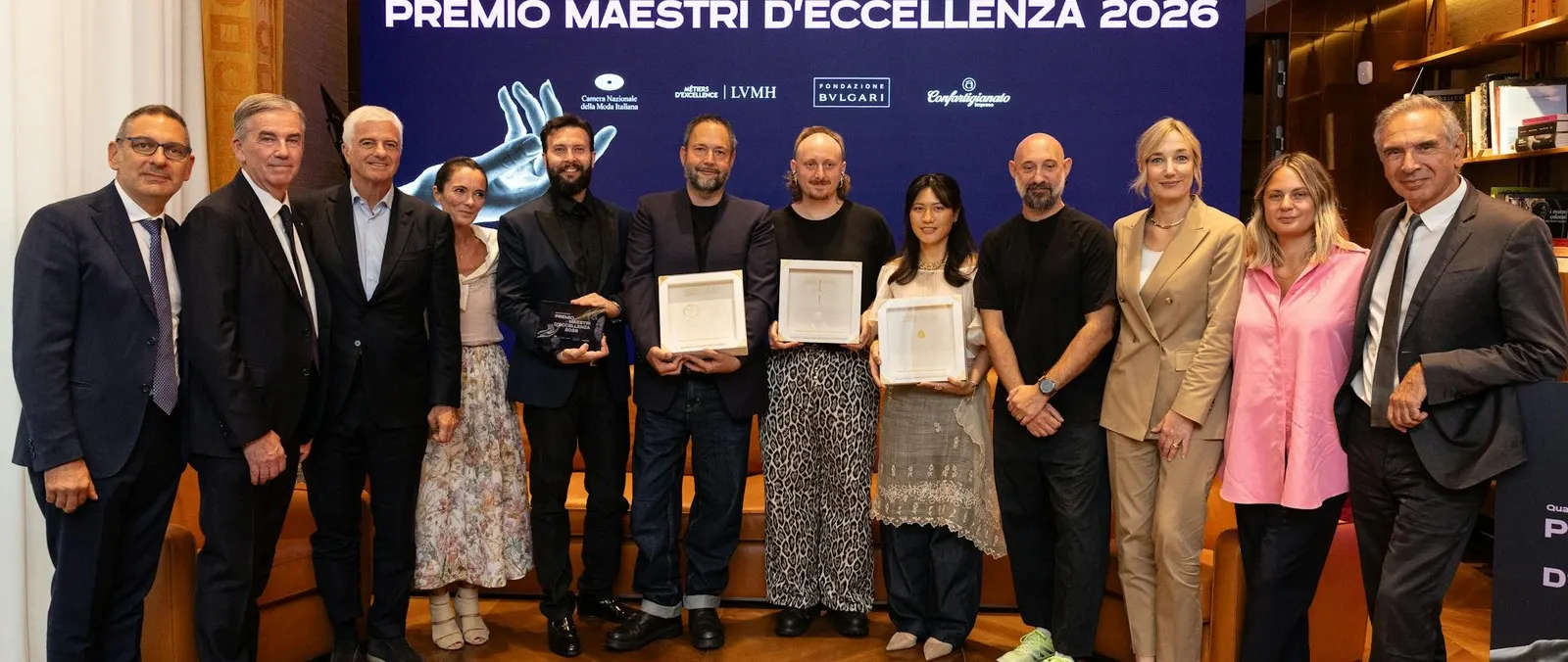
LVMH and Fondazione Bvlgari have announced four winners of the fourth Premio Maestri d’Eccellenza, an annual programme created to recognise and support Italian craftsmanship. The initiative is organised with Confartigianato Imprese and Camera Nazionale della Moda Italiana, bringing together luxury, fashion and national craft organisations around the question of how specialist skills can be protected and passed forward.
The 2026 awards cover established excellence, emerging talent and innovation, reflecting the fact that heritage craft survives only when experience and renewal develop together. The ceremony at Bvlgari Hotel Roma also underlines how closely Italy’s luxury economy remains linked to small workshops, specialist makers and highly trained individuals rather than industrial scale alone.
The awards treat craftsmanship as an economic asset
Italian luxury is often discussed through brands, design houses and finished products, but many of those objects depend on skills that sit deeper in the supply chain. Stone setting, leatherwork, metalwork, textile finishing and other specialist practices can require years of training before a maker reaches the level expected by leading maisons.
The Maestri d’Eccellenza programme gives those skills public visibility and financial support. By recognising practitioners directly, the award shifts attention from the final logo toward the human expertise that allows high-end objects to meet demanding standards of finish, durability and originality.
Experienced masters and emerging makers share the platform
One category is designed to recognise established artisans whose work represents exceptional technical and cultural knowledge. Another focuses on emerging talent, acknowledging that continuity depends on younger makers seeing a viable professional future in crafts that can otherwise struggle to attract apprentices.
That balance is important because preservation alone can turn craftsmanship into museum practice. Skills remain alive when they continue to generate careers, businesses and new work, allowing traditional methods to respond to contemporary design rather than becoming frozen demonstrations of the past.
Innovation is framed as a way to protect heritage
The innovation category recognises projects that use new processes or technologies without erasing the historical skill at their core. Digital tools, alternative materials and more efficient production methods can strengthen craft when they remove repetitive limitations while preserving the judgement and handwork that give an object character.
This is especially relevant to luxury manufacturing, where customers increasingly expect both heritage and progress. A maison cannot rely indefinitely on tradition as a marketing claim if the underlying workshops are unable to recruit, modernise or operate sustainably enough to survive.
Fondazione Bvlgari connects the prize to a wider cultural mission
Fondazione Bvlgari’s involvement gives the programme a direct connection to one of Italy’s most internationally recognised jewellery houses. Jewellery is an especially clear example of how design depends on specialist execution, with gem setting, polishing, metal forming and finishing often requiring collaboration across several highly trained crafts.
The foundation can therefore use the award to extend attention beyond Bvlgari’s own workshops. By supporting excellence across disciplines, the programme contributes to the broader ecosystem from which Italian luxury draws suppliers, talent and cultural credibility.
Luxury clients increasingly value visible making
For collectors and buyers, understanding how something is made has become part of the value of ownership. Workshop visits, provenance, named artisans and documented techniques can create a stronger relationship with an object than brand recognition alone, particularly at the highest price levels.
The 2026 Maestri d’Eccellenza winners represent that shift toward visible craftsmanship. The award is ultimately less about nostalgia than continuity: ensuring that specialist knowledge remains economically relevant, creatively ambitious and capable of producing the next generation of Italian luxury rather than merely celebrating the last one.