Two towns and a distinctive coastal landscape
At the eastern end of Normandy's celebrated chalk coastline, Le Tréport provides a contrasting experience to the large resort marinas of the Mediterranean. Across the local waterfront, the seaside architecture of Mers-les-Bains offers a particularly rewarding reason to visit: an opportunity to study how the nineteenth-century fashion for holidays by the sea transformed the built environment. The two towns are best considered together by visitors interested in the history of coastal leisure. Their scale encourages walking and close observation rather than an itinerary dominated by transfers. For someone cruising in a yacht between twelve and twenty-four metres, however, the distinction between an attractive place to visit and a suitable place to berth is important. Le Tréport's published marina listing describes its facilities but does not specify a maximum acceptable yacht length. Establish the suitability of the actual vessel with the operator before incorporating this harbour into a passage. The cultural excursion can also be undertaken independently of a stay in the marina.
A small tidal marina with precise operating constraints
TransEurope Marinas lists one hundred regular berths and ten visitor positions, the latter arranged for alongside mooring. That is a notably different proposition from a destination with hundreds of dedicated visitor places. An owner should request confirmation of a specific position rather than equate total capacity with availability. The published description also states that admission is through a lock operating during the four hours preceding and the four hours following high water, both by day and at night. These are planning parameters, not permission to enter. The harbour master must confirm the current operating procedure, actual depth, local restrictions and suitability of the entrance and lock for the yacht's dimensions. A late arrival following an Atlantic passage could have very different consequences here from those at an unrestricted deep-water marina. The appropriate response is to plan an alternative and leave the skipper sufficient discretion to modify the approach. Never rely on the timing of shore reservations when deciding whether to proceed into an unfamiliar harbour.
Matching the yacht to the available berth
The operator's description includes gated pontoon access, water, electricity and sanitary facilities. It does not establish that the electrical supply is suitable for the whole domestic load of a fully equipped twenty-metre motor yacht, nor does it provide a beam or draft guarantee. Owners should supply true overall dimensions, including equipment extending beyond the nominal hull, and ask about the allocated position's power, water and manoeuvring space. Weight and dimensions may also affect the practical suitability of an alongside arrangement. For a family arriving after several days afloat, access to provisions and restaurants is a useful advantage; it is not a reason to overlook boat-specific limitations. The published harbour office number is +33 2 35 50 63 06, with VHF channel 12 and the enquiry address letreport.plaisance@smpsm.fr. The network states that officers are available around the published tidal operating period. Check current arrangements directly; none of these details constitutes a confirmed booking. A shore-based alternative remains valuable if the harbour cannot accommodate the yacht.
The railway that changed how people approached the coast
The heritage of the neighbouring resort illustrates a larger transformation in nineteenth-century travel. Mers-les-Bains developed as visitors discovered sea bathing and railway travel made the coast accessible to a wider affluent clientele. According to the local tourism authority, the first villas appeared in 1869. Instead of simply occupying accommodation for an occasional visit, families commissioned buildings that expressed their personal tastes and the social ambitions of an emerging holiday culture. The resulting neighbourhood offers a concentrated architectural record of a period when the seaside itself became a desirable place to spend a season. The local tourism office describes approximately five hundred villas within the characteristic district. Their proximity creates a rare opportunity to compare the external treatment of different houses during a single walk. Look for the differences within the ensemble, rather than assuming that every building belongs to the same style. Some display an exuberant decorative vocabulary while others use more restrained compositions. The neighbourhood remains a living place, not an open-air collection of buildings available for unrestricted entry.
Façades as a collection of materials and craftsmanship
An architecture-oriented visit can begin with the individual materials visible from the public pavement. The tourism authority identifies architectural ceramics, ornamental metalwork and other decorative elements among the characteristic features. The great international exhibitions in Paris helped create a context for such products, demonstrating what industrial production and the decorative arts could accomplish together. Between about 1880 and 1930, coloured ceramics became an especially useful means of distinguishing the façades of fashionable houses. The district includes examples of the products of firms such as Brault et Gilardoni and Hippolyte Boulenger et Compagnie. For a visitor who commissions interiors or maintains a yacht, there is a useful parallel between the appearance of a decorative surface when first installed and the challenge of preserving it in a harsh coastal environment. The repeated patterns, projecting windows and metal balconies are subjects for careful observation. Examine how separate craftsmen contributed to an overall design, and how practical decisions about exposure and maintenance can coexist with an ambitious aesthetic.
Living heritage rather than an architectural theme park
The district's protected status provides another reason to appreciate the individual details. The local tourism office describes the involvement of roofers, joiners, masons, decorative metalworkers, painters and ceramic specialists in the ongoing work of maintaining the villas. Preservation involves specialist oversight and permissions rather than simply replacing old material with a superficially similar modern product. This is relevant to owners who follow architectural restoration or collect objects with a documented history. Original elements may be valuable for reasons that cannot be reproduced by appearance alone. The same principle applies to an historic yacht: thoughtful maintenance begins with an understanding of what survives, which parts have been altered and what the owner wants to preserve. A walk through Mers-les-Bains can be enjoyed without entering private property, touching decorative surfaces or disturbing residents. The official villa circuit gives visitors a structured route. Local guides can offer fuller historical context, subject to their current availability. Allow sufficient time for the visit rather than arriving just before a scheduled departure.
A different perspective from the cliff railway
On the Le Tréport side, the funicular offers a change in viewpoint from the narrow streets and waterfront. The local visitor office dates the inauguration of the present installation to 2006 and describes the tunnels cut through the cliff by the earlier generation of builders. The combination of old engineering and current infrastructure is itself worthy of attention. It provides access to elevated views of the coastal landscape, where the relationships among the town, harbour, cliff and neighbouring resort are easier to appreciate. At the time of publication, the attraction is advertised as free and open throughout the year, with shorter operating hours outside the principal summer season. Check the operator's schedule before visiting because maintenance and weather may affect operation. Visitors should remain within marked public areas and follow local advice near the cliffs. Photographers can use the elevated viewpoint to understand the landscape at a larger scale before returning to the streets to examine ceramics, windows and balconies in detail.
Planning a shore day around the harbour's rhythm
A shore day for a yacht party does not have to follow the same sequence as a conventional coach excursion. If the yacht has a confirmed berth, guests can separate their interests, with some visiting the cliff railway and others exploring the villas in greater depth. A shared lunch allows the group to compare experiences before an afternoon along the seafront. The published tourist information highlights around four hundred seasonal beach cabins between May and October; visitors in November should not expect the full summer installation or the same programme of activities. The year-round architecture is the stronger foundation for an off-season visit. Check restaurant openings and book a table directly if desired. It is sensible to choose a meal location with convenient return arrangements rather than promise an exact boarding time on the basis of a leisurely route. The captain should determine when the yacht needs to be prepared for departure, especially when leaving through the lock must coincide with appropriate tidal conditions.
A rewarding stop for owners interested in design
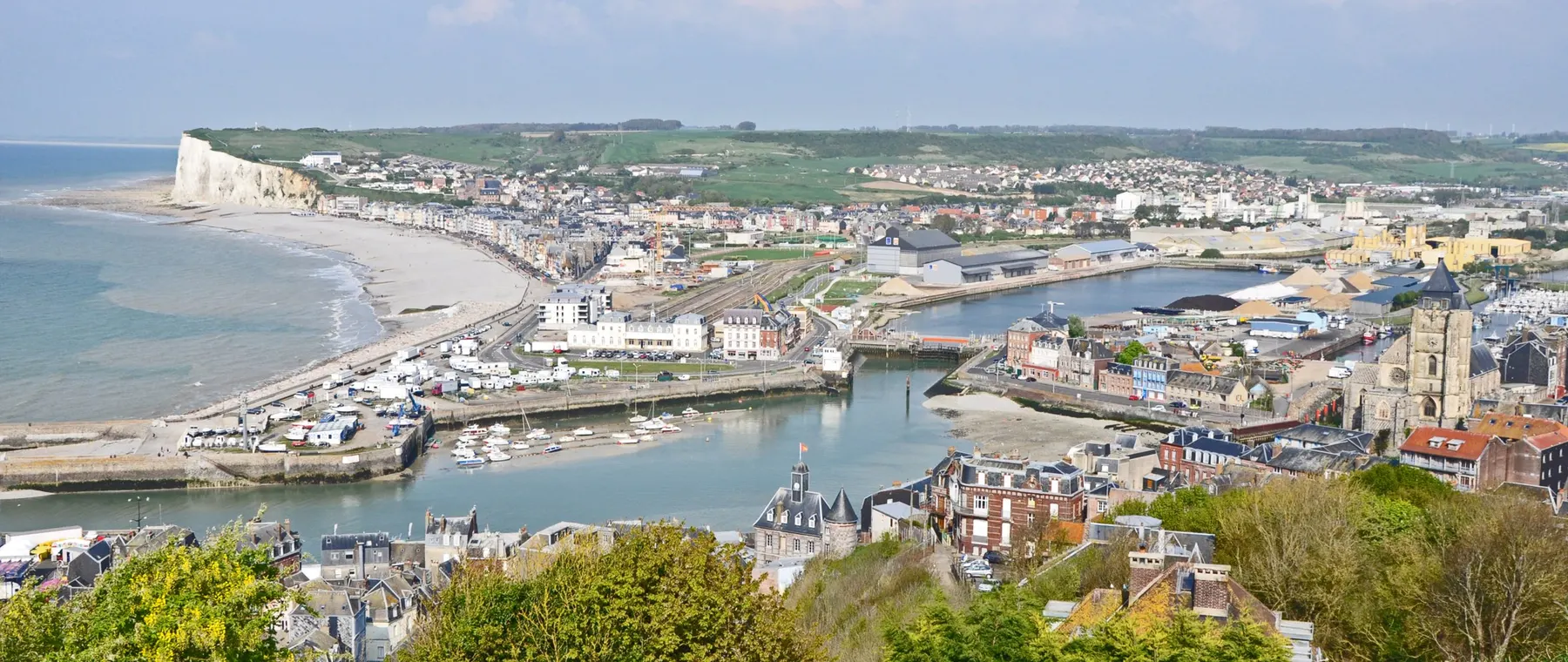
The particular attraction of Le Tréport and Mers-les-Bains is not a claim to rival the largest yacht destinations in terms of berth capacity or luxury services. Their significance lies in a distinctive combination of coastal history, architecture and a genuine working maritime setting. For owners accustomed to commissioning interiors, the surviving villas provide a readable lesson in personalisation, skilled workmanship and the long-term consequences of material choices. For guests who enjoy photography or heritage, the contrast between intimate street details and views across the coastline can make a relatively modest journey especially satisfying. Plan first around the requirements of the vessel, then around the interests of the people on board. Visitors unable to secure a suitable position can explore the two towns from another confirmed harbour or as part of a land excursion. That flexibility preserves the value of the destination without making unsupported promises about access for larger yachts. The accompanying photograph, taken in 2014, illustrates the relationship of the two towns and is not evidence of current berthing conditions.
Sources and photograph
Source documentation: https://www.transeuropemarinas.com/marinas/le-treport/, https://www.destination-letreport-mers.fr/la-destination/presentation-des-communes/mers-les-bains/, https://www.destination-letreport-mers.fr/la-destination/les-incontournables/culture-savoir-faire/villas-belle-epoque/, https://www.destination-letreport-mers.fr/la-destination/les-incontournables/culture-savoir-faire/le-funiculaire-du-treport/. Photograph: Le Tréport and Mers-les-Bains viewed from above — Philippe Alès / Wikimedia Commons. Resized for web display under CC BY-SA 3.0.