A gathering dedicated to the work of the hand
On 7 and 8 November 2026, Japan's Cabinet Office brought approximately forty crafted objects to the Kyoto State Guest House for the invitation-only JAPAN SUI COLLECTION exhibition Mastery of Touch, Mystery of Time. More than 160 people attended, including collectors and cultural professionals. A report issued on 13 November describes six live demonstrations, a fashion presentation by Junko Koshino and a programme of music and dining. The objects encompassed ceramics, lacquer, textiles, metalwork and other traditions. They were organised around the idea of waza, the developed skill underlying a finished work.
For owners considering bespoke luxury yacht interiors, the event is an opportunity to explore a different understanding of craftsmanship. The value of an object may lie partly in qualities that become apparent only after encountering its maker and observing the processes necessary to produce it. Such an understanding can inform a contemporary commission without requiring the imitation of an established cultural tradition.
Braiding as a means of constructing a textile
Kouki Matsushima demonstrated the Iga Kumihimo tradition by making an obijime, a braided cord associated with kimono dress. The historical uses of related braiding techniques extended to elements of Japanese armour and sword fittings. The contemporary demonstration drew attention to their continuing possibilities in clothing and accessories.
A braid can be considered as a material constructed from the controlled relationship of separate strands. Its appearance is not entirely distinct from its physical behaviour. Decisions about the strands and their arrangement are relevant to the flexibility, thickness, pattern and character of the finished object. Combining small elements in a different sequence may change the visible design without changing the basic materials.
Someone commissioning a textile accessory can appreciate the difference between selecting a prefabricated decorative cord and working with a maker to develop an individual arrangement. The intended function should be established before the detailed pattern. An object intended principally for display may present different requirements from one subject to repeated handling. Where an item is expected to serve a practical role aboard a yacht, its suitability must be considered independently of the artistic precedent. Decorative braid is not a substitute for marine equipment designed and rated for safety-critical work.
Metal inlay and the importance of scale
Kentaro Inada presented Higo metal inlay, using a preparation technique known as nunome-giri. The organisers describe its considerable precision: more than ten fine grooves may be cut into the metal within a millimetre. The prepared surface receives the precious metal of the decorative inlay.
The scale of those marks illustrates an important distinction between an object photographed at a distance and the actual work of its maker. A relatively simple finished design may contain a complex series of operations that the casual viewer cannot distinguish. The effect of the inlay depends on the character of the prepared ground and the care taken in establishing the relationship between the two metals.
A contemporary metalworker creating small objects for a private residence or yacht may also consider the way a change of surface affects a person's interaction with the finished piece. A carefully developed handle, small decorative plate or cabinet fitting can become a point of attention through the precise treatment of its material. The historical process should not be assumed to provide the appropriate construction method for every modern fitting. The artisan and the vessel's design specialists should establish the intended purpose and any technical requirements from the outset.
Kintsugi and the decision to preserve a damaged object
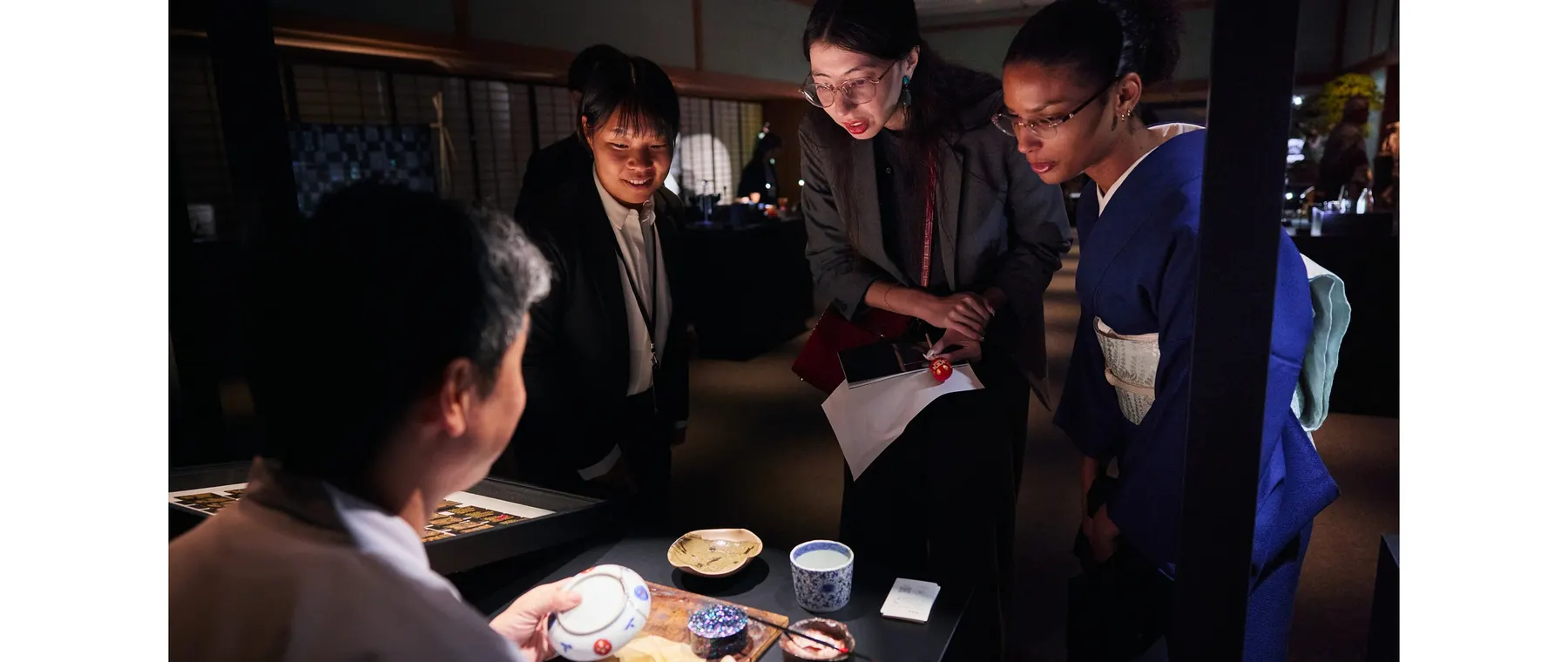
Lacquer specialist Yuzo Eto demonstrated kintsugi, the repair of broken ceramics through the use of lacquer and metallic decoration. The event photograph reproduced with this feature documents guests observing that demonstration. The method takes a visible approach to the history of an object, rather than making the complete disappearance of the break its sole objective.
This principle offers a particularly interesting approach to collecting. An object with a documented history of repair can remain meaningful to its owner. The repair may allow continuing appreciation of its original form and introduce evidence of the care taken to preserve it. That does not mean that deliberately damaging an item improves it, or that the same repair method is appropriate to every ceramic.
For a valuable object, the relevant material and condition should be assessed with a qualified practitioner. Food-contact use, structural stability and the intended treatment of an old glaze may require specific consideration. A repaired vessel should not automatically be used for serving food simply because it once performed that function. A contemporary commission may instead explore the visual relationship between repaired surfaces and original material without risking a historically or personally significant work.
Making a cushion without machinery
The exhibition included Takuya Niwa's demonstration of shaping a zabuton cushion by arranging cotton fibres manually. It is an example of craft whose complexity may be less obvious in the final object than the tiny grooves of a piece of metalwork. The arrangement of the filling contributes to the character of the cushion, and the decision-making involved takes place largely within the finished textile cover.
Comfort aboard a luxury yacht similarly depends on several aspects of furniture that are not visible in an interior photograph. The internal construction, the selected material and the way it is supported can be more important to actual use than a striking exterior fabric. A conversation with a furniture maker or upholsterer can identify these differences during the development of an interior.
A traditional floor cushion is not necessarily the appropriate solution for a moving vessel. Its intended location, restraint and compatibility with relevant fire-safety requirements must be considered. The lesson offered by the demonstration is the importance of the invisible construction of a comfortable object. It encourages clients to explore what the furniture is made from and how those elements work together rather than judging its suitability solely through appearance.
The colour and construction of folk objects
Shoichi Hashimoto showed the layered papier-mâché construction and painted treatment of traditional Japanese folk toys. Yohei Kato demonstrated Fūsai-zome, an approach to gradation dyeing building upon a longstanding tradition. The two demonstrations offered different perspectives on how colour and material become part of an object's character.
In one case, the visible paint is applied to a built-up form. In the other, colour transitions develop across a textile. The distinctions matter because the surface is created through physical operations that cannot simply be reproduced by selecting identical colours on a screen. A photograph can be useful in communicating a layout, but accurate samples and examination of the intended materials are valuable when an owner is choosing a finish.
Collectors interested in small crafted objects may find that their attraction grows through understanding how individual pieces are made. Contemporary artists working in these fields can offer their own interpretations, and those should be recognised as distinct commissions rather than incorrectly represented as examples of an earlier historical technique.
Fashion and the contemporary life of traditional skills
Junko Koshino produced the event's fashion presentation, bringing references to Rimpa, kimono, Nishijin textiles and indigo dyeing into a contemporary context. The performance was accompanied by DRUM TAO, a Japanese percussion ensemble. Its combination of fashion and music reflected the organisers' broader objective of demonstrating the continuing life of artistic practice rather than presenting tradition as something confined to a museum display.
Designers working with historic precedents face decisions about which elements to retain and which to reinterpret. A textile may retain a recognisable method of manufacture while acquiring a different silhouette or use. The cultural meaning and authorship of the original material should be acknowledged rather than concealed beneath a general description of luxury design.
For someone planning a wardrobe suited to extended travel, craftsmanship can offer a reason to select a smaller number of well-considered pieces. A distinctive textile or individually produced accessory may contribute more to the character of a wardrobe than a succession of similar objects purchased principally for their association with a particular label. The purpose of the commission and the identity of the person making it remain important.
Taking the experience beyond the exhibition
The Cabinet Office established JAPAN SUI COLLECTION in 2025. The organisers describe further European presentations as planned, although the November report does not establish dates or access arrangements for those events. The Kyoto gathering itself has concluded and was not a public exhibition available for ordinary ticketed visits.
Its significance for owners who appreciate craftsmanship lies in the connections made between several quite distinct artistic disciplines. Braiding, dyeing, shaping a cushion, repairing ceramics and working precious-metal inlay involve different forms of knowledge. They nevertheless share the principle that a finished object emerges through an extended sequence of decisions by people who understand their materials.
A thoughtful contemporary commission begins by acknowledging that expertise. The client can establish the intended use, discuss the character of the object and give the maker appropriate scope to develop a solution. For a yacht interior, the relevant technical specialists should be involved wherever the object affects the vessel's structure, safety or operation. That relationship between a well-defined purpose and a distinctive artistic response is one of the most valuable forms of luxury craftsmanship.
Sources and photograph
Source documentation: https://www.prnewswire.com/news-releases/japan-sui-collection-kyoto-presents-mastery-of-touch-mystery-of-time--7-8-november-2026-302938848.html. Photograph: Yuzo Eto demonstrates kintsugi at Mastery of Touch, Kyoto — Photo courtesy of JAPAN SUI COLLECTION, supplied by the Cabinet Office, Government of Japan, with its 13 November 2026 press release.. Official issuer-supplied press photograph, reproduced for editorial coverage of the specific announcement and resized for web display.