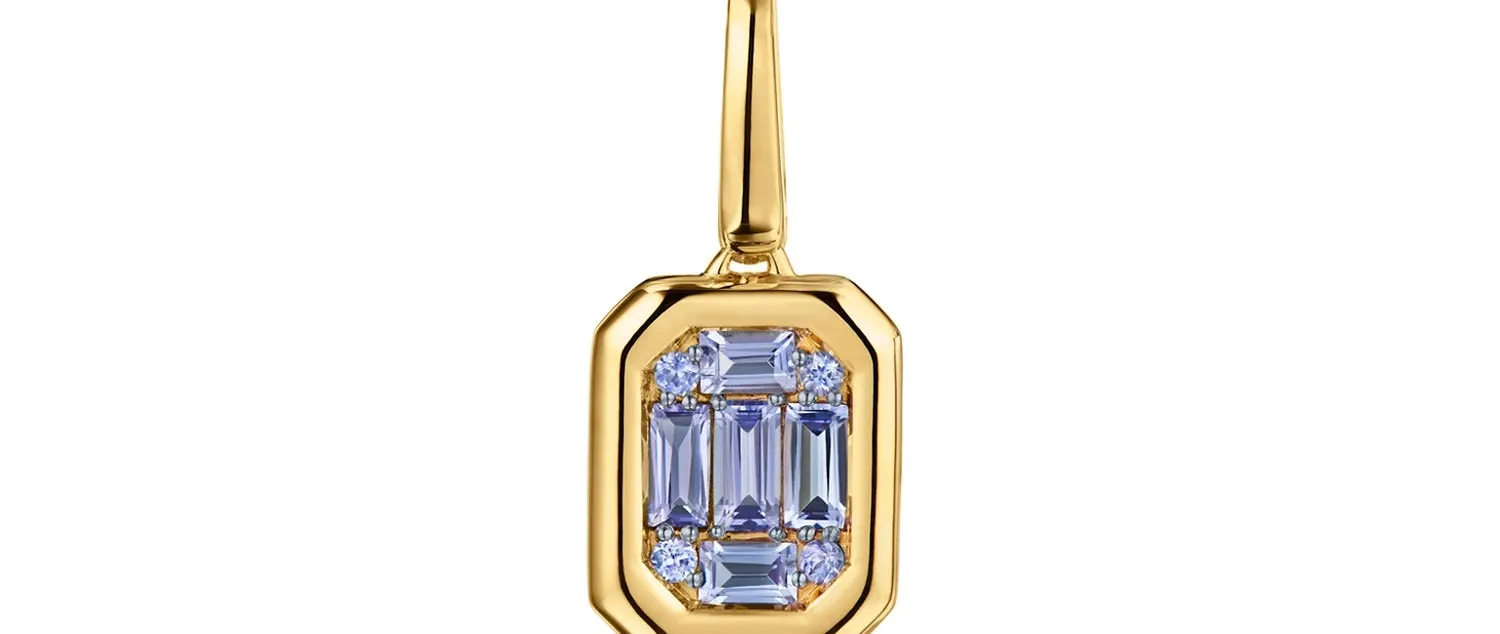
New York fine-jewellery house Kwiat has expanded the idea of personal adornment through Charmed, a collection of small precious-metal pendants and gemstone motifs designed to represent individual interests, memories and milestones. Its official online catalogue displays more than thirty variations, ranging from diamond hearts and horseshoes to coloured stones, symbolic forms and an elaborate nautical anchor. One of the simpler designs is an illusion-set tanzanite charm in 18-karat yellow gold, listed at $2,400 when the collection was reviewed on 22 November 2026. The range offers an alternative to a single dramatic piece of jewellery: a collector can select one carefully considered symbol or assemble a combination over time. The attraction is personal rather than inherently financial, and the value of any charm depends on the materials, craftsmanship and meaning it holds for its wearer.
Small objects can carry substantial meaning
Charms have long been used to mark relationships, beliefs, journeys and important moments. Their scale makes them relatively easy to wear, while their symbolic forms invite a story that may only be fully understood by the owner. Kwiat's new range works within this familiar tradition but uses precious metals and gemstones in a luxury-jewellery setting. The company presents different motifs instead of imposing one universal interpretation on the collection. A gold horseshoe could refer to a personal sporting interest or a family memory, for example, while an anchor might recall a voyage. Neither meaning is inherent in the material. That flexibility is one reason charms appeal to collectors who want something more individual than a logo. It also means an expensive item is not automatically the most meaningful. The success of the purchase depends on the relationship between the object and the person wearing it.
The tanzanite charm in focus
The official studio photograph accompanying this article shows Kwiat's Charmed illusion-set tanzanite charm in 18-karat yellow gold. Its colour introduces a different visual impression from a conventional white-diamond pendant. The catalogue lists it at $2,400, although retail prices, availability and applicable tax can change. The design is one specific member of the collection, not evidence that every charm includes tanzanite or is offered at the same price. Tanzanite has a distinctive blue-violet appearance and should be considered according to its individual quality and suitability for wear. Buyers who admire the colour should also discuss durability and care with the jeweller, particularly if the piece will be worn frequently. The small format may make the charm easy to combine with other jewellery, but its setting and attachment still deserve careful examination.
Why the illusion setting matters
An illusion-set gemstone is arranged to create a particular visual impression, which may make the gem appear more expansive or integrated into its surrounding metal. The technique is part of the design and should not be confused with an assertion about the stone's actual size or value. The precise construction of Kwiat's tanzanite piece should be established from its product details and a close inspection. Setting quality is important because a charm may swing or touch clothing and other pendants during ordinary use. A buyer should look at the edges, surface finish and the way the gemstone is secured. Studio photography is useful for appreciating colour and form but may conceal small construction details. A well-made luxury jewel should remain attractive when examined closely, not only in an enlarged online photograph.
Diamonds, platinum and gold
Other Charmed designs use diamonds with platinum, 18-karat yellow gold or combinations of those metals. The selection gives buyers different visual weights, from a bright diamond surface to warmer gold tones. These materials are not interchangeable in colour, density or handling properties, and the right choice often depends on the rest of the wearer's collection. A delicate gold charm may combine naturally with an existing yellow-gold chain, while a platinum pendant could complement cooler-toned jewellery. The catalogue's metal descriptions should be checked for each style because not every design uses the same alloy or precious-metal combination. A collector should retain the specification with the receipt rather than rely on the appearance of the metal alone. Details such as closure strength and ease of cleaning may matter more in the long term than an initial preference for one colour.
A wide vocabulary of motifs
The current assortment includes hearts, horseshoes, religious symbols, a peace sign and designs based on coloured gemstones. Each has a different possible audience, and some carry meanings that deserve particular sensitivity. A faith-related symbol should not be selected solely because it appears fashionable if the intended recipient attaches deeper significance to it. Conversely, a simple heart or star can be associated with a very personal event without any formal symbolism. Kwiat's approach makes it possible to build a selection around individual preference rather than purchase a standard matching suite. That freedom is attractive, but it can also encourage unnecessary accumulation. A more thoughtful collection might contain only a few carefully chosen motifs, each with a reason for being worn. The point of personal jewellery is not the quantity of pieces but the individual associations that give them life.
Comparing coloured gemstones
The collection includes variations using tanzanite, garnet, citrine, tsavorite and sapphires. This creates a palette that extends far beyond a diamond-only assortment and allows buyers to choose colour as an expression of taste. The official catalogue gives distinct retail prices for particular designs, with some illusion-set gemstone charms appearing in the low thousands of US dollars. Those figures should not be interpreted as universal valuations for stones of the same mineral type. Gemstones differ in treatment, colour, clarity, cut and other qualities that influence their value. Care requirements can also vary. An owner who intends to wear a jewel every day should understand whether the stone is appropriate for that use. A reputable jeweller can explain the limitations without reducing the pleasure of choosing a colour that feels personally significant.
The chain is part of the design
A pendant is not complete as a wearable object until it is paired with an appropriate chain or bracelet arrangement. The size and construction of the attachment loop influence what can be used safely, and a heavier charm may require a sturdier chain. Several small charms worn together can create movement, sound and friction, all of which affect comfort and wear. A necklace shown in promotional photography may not be included in every product purchase, so buyers should confirm the exact contents of the transaction. The same consideration applies to clasp types and the total length of the finished arrangement. These details may seem minor compared with the gemstones, but they shape the experience of wearing the jewellery. A beautiful charm that catches on clothing or hangs awkwardly may be less satisfying than a simpler piece chosen with greater attention to practicality.
Jewellery for an international traveller
Small fine-jewellery pieces can accompany an owner between a city residence, holiday property and yacht, but their portability does not remove the need for care. Chains should be stored in a way that avoids tangling, while gemstones and polished metals may need protection from contact with harder objects. Jewellery should not be left loose in drawers aboard a moving vessel. Owners also need to understand whether their insurance covers the item when worn, carried or kept in different locations. Receipts and clear photographs can support inventory management, particularly when several similar pieces have been acquired over time. Customs requirements can vary by country and may be relevant to valuable purchases brought home from abroad. The advantage of a small keepsake is that it can hold a story across many settings; the corresponding responsibility is to protect it without making ownership unnecessarily complicated.
A considered approach to giving jewellery
A charm may be a thoughtful gift because it reflects something specific about the recipient. A tanzanite jewel could appeal to someone who particularly likes violet-blue stones, while a horseshoe or anchor may connect with a shared interest or memorable journey. The giver should still consider what the person actually wears. Metal allergies, preferred chain length, everyday activities and the scale of existing jewellery can all affect whether a gift becomes a favourite. A symbol that seems obvious to the giver may have a different meaning to the recipient, and assumptions should be avoided where possible. High price alone is no guarantee of a successful gift. Thoughtful selection, accurate product information and a realistic understanding of the recipient's style are better guides. Where uncertainty remains, choosing a simple design with the recipient's involvement can be preferable.
The cost of ownership beyond the price tag
The published retail price is one part of a luxury-jewellery purchase. Over time, a piece may require cleaning, inspection of its settings or repair of a chain or attachment. These services should be discussed with the jeweller, particularly for delicate coloured-stone designs. Insurance may also be appropriate depending on the value and the owner's wider collection. Buyers should avoid treating the retail price as a prediction of resale performance. The value achieved in a later sale could be influenced by market demand, condition, documentation and the specific style. A charm chosen for sentimental reasons may remain priceless to its owner while having a much lower secondary-market price. That is not a contradiction: emotional and commercial value are different. A sensible collector recognises both without turning a personal keepsake into an unsupported investment promise.
Building an heirloom record
Jewellery can remain within a family for generations, but the story attached to an object is easier to preserve when records are kept. The owner may wish to retain the original product description, date of purchase, invoice and any documentation concerning gemstones or maintenance. A short personal note about why a charm was acquired can be just as meaningful to a later family member as a formal certificate. Without context, a small gold pendant may tell only part of its story. Collections that develop gradually can become a quiet record of travel and family life. Their significance is not necessarily apparent to a stranger or an auctioneer. Keeping the reasons for acquisition alongside the physical object creates continuity between generations and adds depth that a price or brand name cannot fully express.
What Charmed offers collectors in 2026
The official Kwiat catalogue confirms an assortment of personalised charm designs in precious metals, diamonds and coloured gemstones, including the tanzanite example illustrated here. The collection is noteworthy as a luxury format because it favours small-scale symbolism over the visual impact of a single elaborate jewel. The individual pieces can be worn alone or considered as part of a developing personal collection, subject to appropriate compatibility and care. For Luxury Yacht Guide readers, its relevance lies in meaningful portable jewellery for people whose lives move between travel, work, family and leisure. The most convincing reason to buy is not the expectation of appreciation or social status. It is the combination of sound craftsmanship, a design the wearer enjoys and a story worth remembering.
Sources and image provenance: Kwiat's official Charmed collection catalogue, reviewed 22 November 2026, including listed gemstones, metals and product pricing. Lead photograph: Kwiat studio image of the illusion-set tanzanite charm in 18-karat yellow gold. Material-care and collecting commentary is independent Luxury Yacht Guide analysis.
Sources and image credits
Reporting based on Kwiat official Charmed product catalogue, checked 22 November 2026.
Lead photograph: Kwiat Charmed Illusion-set Tanzanite charm set in 18-karat yellow gold, official product photograph. Photograph: Kwiat, original studio image of the Charmed Illusion-set Tanzanite Charm from the current 2026 official jewellery catalogue; depicts this particular charm rather than the entire collection. Original official image source.