A jewellery-led approach to a mechanical watch
The new Calibre 101 Chain demonstrates how a watchmaker can make historic micro-engineering an essential part of a sculptural high-jewellery object. This development is relevant to owners and guests who pursue luxury motoring, hospitality, private travel or collectible objects alongside their yachting interests.
Diagonal rows of brilliant-cut white diamonds alternate with bands of black HyCeram, creating a contrast between precious stones, polished gold and an engineered composite surface. This mix of traditional and contemporary materials helps distinguish the new model from conventional gem-set watches whose dials remain the obvious focal point.
The remarkable scale of Calibre 101
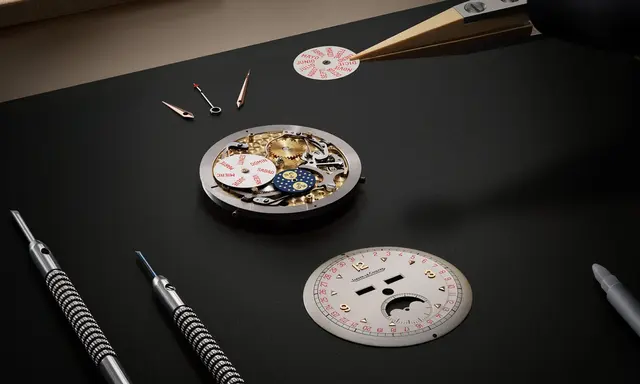
The original Calibre 101 dates from 1929, when Jaeger-LeCoultre extended the compact two-level Duoplan concept to an even smaller rectangular mechanism. The manufacturer gives its dimensions as just 14 millimetres long, 4.8 millimetres wide and 3.4 millimetres thick, with a volume of approximately one-fifth of a cubic centimetre.
The first versions contained 74 parts, while the current fifth-generation movement has 98 components without changing the defining external dimensions. Jaeger-LeCoultre states that assembly of those tiny components takes about 40 hours, and that the calibre’s annual production remains limited to only a few dozen movements.
The movement runs at 21,600 vibrations an hour and has a 33-hour power reserve, figures that are less striking than the technical achievement of producing a practical mechanism at such an extraordinary scale. For collectors, the hidden labour behind a working movement provides an important counterpoint to the immediately visible value of the diamonds.
An idea with roots in 1955
The new watch takes inspiration from a 1955 Duoplan model nicknamed Chain, whose heavy pink-gold links made the bracelet central to the design. Jaeger-LeCoultre has translated that historical language into sculptural details on the sides of the new bangle without treating the earlier watch as a pattern to be copied exactly.
The revival is particularly relevant at a moment when watch collectors are examining archival design in search of alternatives to familiar sports watches. It also shows that a historical complication or movement can be given new artistic expression without abandoning its technical identity.
Because the mechanism is so small, the designers can distribute the metalwork and gems around a piece that would otherwise be difficult to accommodate with a full-size calibre. Miniaturisation here does not simply make a smaller watch: it changes what forms of jewellery are possible.
What owners should ask before commissioning
The maison has not presented the new piece as a mass-market timekeeper, and a prospective buyer should expect an individual discussion of availability and specifications. The final cost is not established by the design announcement; the craftsmanship and gem-setting requirements make the purchase a specialist high-jewellery decision rather than a straightforward watch comparison.
The bangle’s fit, the accessibility of winding and setting controls, and the practical implications of wearing precious materials should be considered alongside the calibre itself. Insurance, secure transport, servicing and any restrictions on adjustment are particularly important for a high-value object intended to be worn regularly.
Calibre 101 Chain ultimately illustrates the point where a collector’s interest in micro-engineering meets the artistry of a jewellery atelier. Its appeal lies in the integration of both disciplines, not merely in the record-setting size of the mechanism or the number of stones on display.
For readers combining cruising with international travel or collecting, the announcement provides a useful reference point when planning a private itinerary or acquisition. Individual costs, access and conditions should be verified with the company concerned before making a commitment.