An inheritance of fashion beside a working harbour
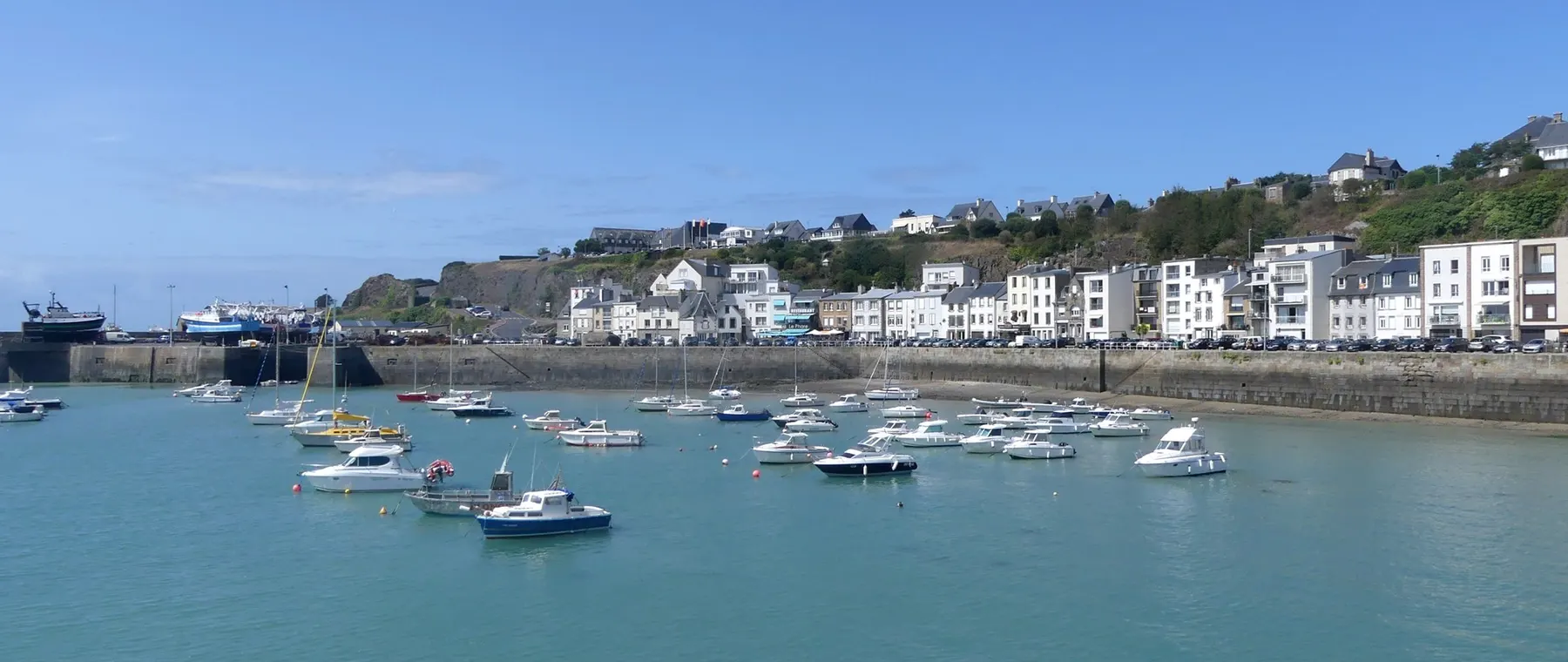
Granville, on the western coast of Normandy, occupies a rocky promontory at the edge of the Bay of Mont-Saint-Michel. The regional tourism authority identifies three particularly distinctive experiences for visitors: the fortified upper town, the childhood home of Christian Dior and the nearby Chausey archipelago. For owners of yachts measuring between twelve and twenty-four metres, these attractions suggest an itinerary in which the relationship between the coast and the cultural landscape is as important as the voyage itself. The actual marine arrangements must be agreed with the responsible operator, since the substantial tidal range affects the environment in which recreational and commercial vessels operate. Granville's historic harbour is not interchangeable with every visiting yacht facility, and a shore visit can equally be arranged from another suitable coastal base. The accompanying licensed photograph shows the outer harbour during an ebb tide in summer 2019. It provides a record of the real maritime setting rather than a representation of today's depths or harbour access.
The Haute-Ville and the logic of a fortified promontory
Normandy Tourism traces much of the upper town's fortified character to the strategic position recognised by the English during the fifteenth century. The ramparts enclose older streets, residences and buildings associated with Granville's military and religious past. Walking here enables visitors to investigate the relationship between the rock on which the town stands, the built defences and the views over the surrounding water. A yacht guest may initially appreciate the silhouette of the upper town from the sea, but the architecture is easier to understand when moving through the spaces themselves. The scale and arrangement of houses reflect conditions quite different from those encountered in contemporary developments constructed for leisure boating. For a family interested in architecture, a guided visit can add historical context to an independent walk. The terrain and steps need to be considered when selecting the route. Confirm accessibility and actual restrictions before planning a visit, and allow enough time to appreciate individual streets rather than prioritise the greatest possible number of viewpoints.
The childhood environment of Christian Dior
The tourism authority identifies Villa Les Rhumbs as the house in which Christian Dior grew up. His parents acquired the property in 1905, and its garden and coastal setting are closely associated with his early memories. The name Les Rhumbs refers to the traditional divisions of the compass rose, a particularly appropriate connection for visitors whose own journey has been made aboard a yacht. The house now accommodates the museum devoted to the couturier and the heritage of the fashion house. A visit offers a different experience from seeing a contemporary fashion collection at a boutique or runway event. It enables guests to consider the relationship between a designer's formative surroundings and the visual world that may subsequently have influenced the work. The house and its garden are themselves part of the interpretation. Do not assume that a particular dress, archive object or historical collection is permanently on display. Consult the institution's current exhibition information and opening schedule before arranging the visit.
The garden as an integral part of the experience
The regional destination information highlights the views available from the garden of Villa Les Rhumbs towards the sea and the Chausey islands. For people who take an interest in collecting, fashion or interior design, a garden is a useful opportunity to consider creative influences that are not themselves finished fashion objects. The changing qualities of light, the relationships among colours and the arrangement of views may offer a way of appreciating the environments in which designers develop their visual sensibilities. A private yacht interior presents very different technical conditions from a country house or coastal villa, but the experience of moving between sheltered rooms and open outlooks can be significant in both settings. An owner can observe these relationships without treating the house as a model for direct reproduction aboard. Seasonal conditions affect the appearance of plants and the overall atmosphere of the garden, so there is value in allowing sufficient time to observe what is actually present rather than reconstruct a familiar summer image.
The Richard Anacréon Museum of Modern Art
Granville's Musée d'art moderne Richard Anacréon provides a further cultural attraction in the Haute-Ville. The Normandy tourism guide describes collections of painting, graphic works and books associated with the first half of the twentieth century. Among the figures mentioned are André Derain, Raoul Dufy, Pablo Picasso and Maurice de Vlaminck, alongside writers including Colette and Jean Cocteau. The combination of literature and visual art is of particular interest to collectors who wish to understand the relationships among different forms of creative practice. A book may have significance through an author's work, the design and typography of an edition, its illustrations or the history of an individual copy. Such connections can be difficult to appreciate when works are displayed only as isolated examples of a single medium. Ask about the current exhibitions and any special access arrangements in advance. The presence of a name in the museum's collection information does not guarantee that a particular work is presently on view.
Chausey and a landscape transformed by the tide
The Chausey islands offer a markedly different experience from the urban streets of Granville. Normandy Tourism describes a granite archipelago in which the number of exposed islands and rocks varies dramatically between low and high tide, and notes the protected bird habitat and the historic use of its granite. This geography is especially important for private yacht operators. An attractive area shown on a tourism map or visible during a passenger excursion cannot be assumed to provide suitable water depths, routes or anchoring arrangements for a substantial yacht. The captain must assess the actual navigational requirements using current authoritative charts, tide and weather information and applicable local restrictions. The family's island experience need not depend on the private vessel entering the archipelago. The regional visitor information identifies passenger services from Granville as an alternative. Check the current service arrangements, return options and conditions of access. Guests can enjoy a carefully arranged island visit while the yacht remains at its confirmed berth.
A culinary programme with a maritime identity
The regional tourism authority identifies blue lobster from the waters around Chausey and the Granville whelk among the local seafood specialities. Its account highlights the stronger seasonal association of lobster with the warmer part of the year. For an owner who entertains regularly aboard, there is particular interest in learning how the producers, fishing activities and local food businesses contribute to the meals served in Granville. Availability, origin and price should be checked with individual suppliers rather than assumed from a destination description. The town's markets offer another opportunity to explore ingredients; the guide identifies a Saturday morning market and additional market arrangements on other days. Confirm the current schedule. Where produce is purchased for the yacht, the crew should arrange appropriate transport and storage rather than rely on guests to manage goods unsuited to a long excursion. A meal ashore and a carefully organised meal aboard can offer complementary experiences. Both are more meaningful when the food is understood within the setting from which it originates.
Seasonal cultural life and the transport connections
Granville's annual carnival is recognised on UNESCO's intangible cultural heritage list, according to Normandy Tourism, while the summer cultural programme includes the Sorties de bain festival. The tourism guide contains dates for the 2026 carnival, which has already taken place, so a prospective visitor should consult the actual programme for future editions instead of treating those dates as upcoming. The town also has rail connections, including services from Paris Montparnasse. This gives the owner a practical alternative for accommodating guests whose land-based travel is independent of the yacht's movements. Current railway and passenger vessel timetables should be checked before committing to an itinerary. A family principally interested in a particular exhibition or festival can preserve that experience even if unsuitable sea conditions require a change in the yacht's programme.
Giving the fashion and maritime visits their own time
A considered visit may devote one day to the Haute-Ville and another to the Dior museum and garden, with an additional excursion to the islands or modern art museum where arrangements permit. The captain should confirm the yacht's accepted dimensions, safe access and essential services with the marine operator and use current navigational information throughout the voyage. Granville's distinctive value lies in the relationship between its tidal coastal landscape, historic architecture and twentieth-century cultural heritage. A luxury-yacht holiday can accommodate all three without requiring the vessel to move for every shore excursion. The most rewarding itinerary is one that gives guests sufficient time to appreciate the museum's interpretation and the landscape itself, while retaining practical alternatives whenever the weather or operating conditions make a planned yacht movement inappropriate.
Sources and photograph
Source documentation: https://nl.normandie-tourisme.fr/wat-je-echt-niet-mag-missen/granville/. Photograph: Granville outer harbour on an ebb tide, summer 2019 — Florian Pépellin / Wikimedia Commons, CC BY-SA 4.0. Resized for web display under CC BY-SA 4.0.