A compact yacht, an unusually generous cruising ground
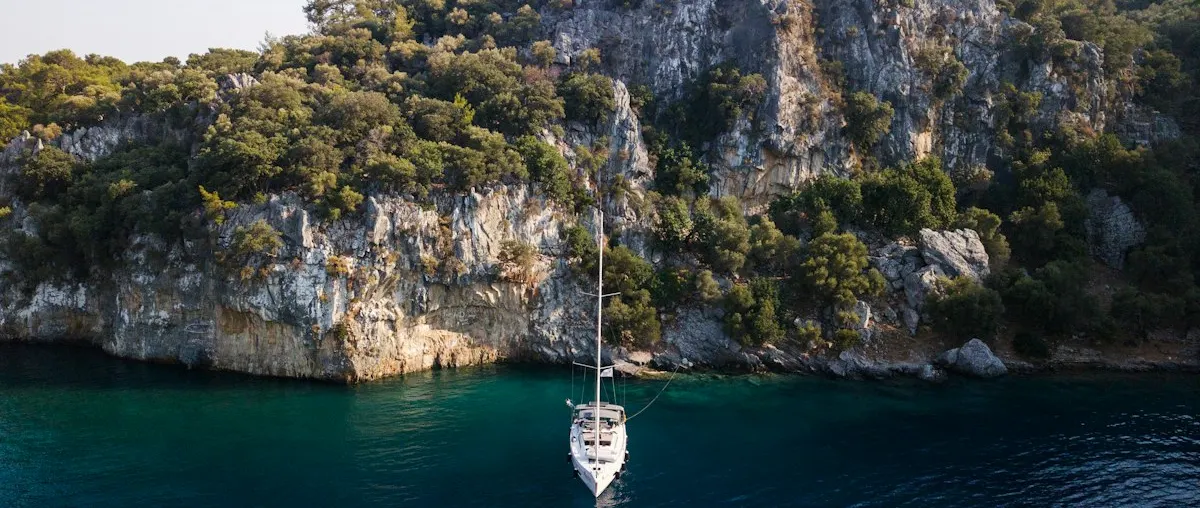
Göcek rewards the owner who does not measure a destination by the length of its waterfront. From the helm of a 12–24-metre yacht, this corner of Türkiye offers an appealing contrast: an established marina town for reliable shoreside arrangements and a ring of forested bays and islands that invite a slower rhythm. It is possible to enjoy a polished dinner ashore one evening and wake with a sheltered shoreline in view the next, without turning the passage into a long-distance expedition. That balance, rather than any claim of complete seclusion, is the essence of a Göcek yacht break.
The Turkish Ministry of Culture and Tourism describes Göcek as a former small fishing town that has become an important centre for yacht tourism. Its official account points to the natural harbour, islands, coves and pine-covered hills. Those are not decorative details for a vessel in the luxury-yacht range: they shape the itinerary. The skipper can plan shore services first, then decide how much time the yacht should spend moving. Guests can have the comfort of a well-serviced base without treating the entire visit as a marina stay.
Begin with the berth, not the beach
For a visiting yacht of approximately 12 to 24 metres, a reserved berth is the sensible starting point. D-Marin Göcek publishes a capacity of 388 yachts and says its facilities accept vessels up to 85 metres. That maximum is a statement about the marina’s overall capability, not a promise that every berth is suitable for any yacht on any date. A 14-metre yacht with modest draft and a 23.5-metre flybridge yacht requiring particular shore power are different booking propositions. Share the true length overall, beam, draft, electricity requirements, arrival time and tender arrangements before a berth is confirmed.
D-Marin also lists round-the-clock mooring assistance, security and technology such as smart pedestals. These are useful conveniences for crews managing guests, supplies and short itineraries, but visiting yachts should verify which features and services apply to their particular booking. The marina’s official information places Dalaman International Airport around twenty minutes away; that is a helpful access reference, not a guaranteed transfer duration in every traffic condition. Plan generous margins if a yacht arrival, aircraft landing and guest embarkation must coincide.
The approach and the first hour alongside
The most enjoyable first afternoon is usually the one that was prepared before the headland came into view. Check the latest charts, navigation warnings, local instructions and actual weather. In a busy cruising area, give the approaching marina a clear ETA; never assume that a berth assigned weeks earlier remains unchanged. A practical D-Marin arrival guide specifies VHF channel 73 for Göcek and recommends contacting the team before entering, with the mooring plan, fender side and assistance clarified in advance. Use the operator’s current instructions rather than relying solely on a published guide.
Once secured, allow time for paperwork, power connections and a check of shore access before anyone rushes to explore. The same marina advertises continuous assistance, while its front-office hours change with the season. That distinction matters for late arrivals: an available mooring team does not necessarily mean every administrative task can be completed at midnight. Confirm formalities directly with the operator, and for an international voyage ask the appropriate authorities and agent about applicable arrival, immigration and customs requirements.
Why the Twelve Islands are more than a checklist
The popular name “12 Islands” sounds like an invitation to count stops, yet the better approach is to treat it as a broad cruising district. The ministry’s official visitor information names a collection that includes the Yassıca Islands, Hamam Bay, Bedri Rahmi Bay, Tersane Island, Göbün Bay and Boynuzbükü, among other places. Its description also refers to the Kapıdağı Peninsula and the countless enclosed corners between open water and wooded shore. The exact set used for a commercial boat tour is not an obligation for a private itinerary.
For a two- or three-day visit, fewer stops usually create more memorable hours. A yacht that attempts to call at every advertised place risks losing the qualities its guests came to enjoy: quiet breakfasts, an unhurried swim and the chance to see the shore change colour as the sun lowers. Choose a workable circuit from current charts and conditions, allowing enough flexibility to move when a bay is crowded or the wind shifts. A beautiful anchorage in a brochure may not be a safe overnight stop for the vessel in front of you.
A day among the Yassıca islands
The Yassıca group appears both in the ministry’s regional description and in GoTürkiye’s official guide to the coast. That gives it a clear place on the sightseeing map, while leaving the skipper to determine whether a particular inlet suits the yacht’s draft and the day’s conditions. Guests might spend the day alternating between a carefully chosen swim area and the shade of the aft deck, with the islands as scenery rather than items to tick off. On a 12–24-metre motor yacht, the journey is often short enough for lunch to remain the centrepiece of the day.
The useful luxury here is time. Keep the tender ready where its operation is permitted, brief guests about rocks and boat traffic, and appoint a crew member to watch swimmers when other craft are nearby. Shore access should be planned only where allowed, without trampling vegetation or disturbing wildlife. GoTürkiye promotes the islands’ emerald shores and clear water; thoughtful visitors help retain those qualities by taking every item of waste back aboard and keeping noise modest in the more intimate corners.
Bedri Rahmi, Tersane and the attraction of a story
Not every stop should be judged only by the colour of the sea. Bedri Rahmi Bay and Tersane Island recur in official itineraries because the district offers cultural as well as natural interest. The GoTürkiye Blue Voyage material recommends both among Göcek’s points of interest, connecting the coastal route to local history and shore exploration. For guests who want context, that can be a welcome counterpoint to a day spent swimming. A crew briefing explaining where the yacht is travelling and what the place is known for can be more engaging than an anonymous “secret bay” label.
It is worth resisting the temptation to promise access to a specific ruin, beach, quay or path without checking locally. Archaeological sites may have conservation restrictions, landing conditions can change, and a tender landing that is comfortable at noon may be difficult later in the day. Read the chart, follow posted rules and use local knowledge. A properly planned visit leaves room for someone to remain aboard while others explore, particularly when the shore route is uneven or the afternoon becomes hot.
Hamam Bay and the limits of a famous name
Hamam Bay is among the locations the tourism ministry includes within the Twelve Islands region. GoTürkiye also refers to the sunken remains near what visitors call Cleopatra’s Baths as part of the area’s appeal. The legends make engaging conversation on deck, but they should not be presented as archaeological proof of any royal bathing visit. What is certain is that this landscape is promoted for its mingling of bays, islands and historical traces. The editorial distinction between legend and documented heritage helps preserve the destination’s credibility.
A guest itinerary can use the bay as a scenic waypoint rather than a guaranteed anchorage. The practical questions remain the same: holding ground, depth, permitted anchoring areas, nearby traffic, weather exposure and the distance to shore. Avoid dropping an anchor on sensitive seabed, and use an authorised mooring where available. The prettiest line on a route map is not always the most responsible or comfortable choice, particularly for a deeper-draft yacht or one carrying several guests who expect a peaceful night.
The town is part of the holiday
Göcek is not merely somewhere to plug in shore power. GoTürkiye highlights a compact town with restaurants, shops and markets, including a Sunday market in its visitor account. This makes an appealing low-effort morning after a cruise: walk the waterfront, browse the produce and local goods, and return aboard in time for a relaxed afternoon. Exact stall locations, opening hours and seasonal availability should be checked locally; a published visitor guide cannot guarantee that an individual trader will be present on the day of arrival.
The town’s dining offer is another reason not to spend every night in a bay. A restaurant evening gives the yacht’s galley team breathing space and allows guests to experience the shore rather than looking at it from the flybridge. On a shorter luxury yacht, where one or two crew may carry several roles, that operational pause matters. Reserve ahead when visiting in a busy period, ask about transport if the berth is away from the centre and agree the boarding arrangements before a late dinner turns into a hurried return.
Göcek Island and a different kind of beach day
The official GoTürkiye guide suggests using a water taxi to visit a beach on Göcek Island and mentions facilities in the area. That is a useful alternative for guests who prefer the certainty of a shore destination to a swim from the yacht. Nevertheless, water-taxi services and last departures change over time. The guide mentions an evening final boat in its example, but the current timetable must be verified on the day. Do not build an excursion around an outdated departure time.
For the crew, the distinction between taking the tender and using a local licensed service is worth discussing. A water taxi can simplify shore logistics, while the tender may be appropriate where access and conditions permit. The decision depends on actual berthing rules, weather, passenger mobility and whether a reliable pickup can be arranged. It is the sort of small operational choice that separates a graceful day from one dominated by radio calls and last-minute changes.
Fethiye as an extension, not an obligation
Official tourism promotion places Göcek within a wider blue-voyage route towards Fethiye, mentioning destinations such as Knight Island and places further along the coast. The temptation is to extend every itinerary because the map makes the next cove look so close. Yet a guest on a 16-metre yacht who has booked a short escape may value time at anchor more than an additional hour under way. Choose Fethiye as an extension when the group wants a more varied shore programme, not as an obligatory box to complete.
If the plan does include a longer movement, discuss it early: cruising speed, expected fuel use, sea state, berth availability at the destination and what happens if the weather window narrows. Allow for the possibility of turning back or staying another night in the Göcek area. The same flexibility that makes the coast attractive can be lost when a rigid itinerary is printed before the crew has checked the day’s realities.
What changes between 12 and 24 metres
Within the luxury-yacht category, a difference of ten metres alters the experience considerably. A 12- or 13-metre vessel may be nimble and easier to accommodate in some marinas, but it usually has less storage and fewer separate crew spaces. At the upper end of this range, guests may enjoy more private cabins and a larger deck, while draft, berth dimensions and tender handling can require greater care. Neither end is intrinsically “better” for Göcek; the sensible fit depends on the guest list and the intended balance of shore time and secluded bays.
An overnight itinerary should be planned around the vessel as it actually exists, not around a generic length label. Consider stabilisation at rest, generator management, noise, water capacity, tender stowage and whether children or less mobile guests can safely use the swim platform. A shallow cove that looks effortless on a video may be unsuitable for a deep-draft yacht. At the same time, a larger vessel need not rush to a distant resort simply because its range allows it. Comfort often improves when the programme becomes simpler.
Responsible time on the water
The area’s pine forest, coves and clear water are central to its appeal, which makes environmental etiquette practical rather than ornamental. Avoid anchoring on seagrass or other sensitive seabed where prohibited or avoidable. Respect local marine protections, no-discharge rules, speed limits and restrictions around archaeological places. Keep wastewater and rubbish managed properly and reduce wake near swimmers, small boats and shore. None of this requires an elaborate environmental campaign; it requires crew discipline and a realistic plan for where waste will be taken ashore.
A quiet boat is frequently a more luxurious boat. Limit unnecessary music reaching other anchorages, run equipment considerately and plan water sports in areas where they are permitted and safe. These details become particularly important where dozens of vessels may be drawn to the same famous bay. The objective is not to claim ownership of a picturesque cove for the afternoon, but to let other visitors and local residents enjoy it too.
Choosing the season and protecting the plan
D-Marin markets Göcek as a year-round marina, yet a year-round berth service should not be confused with identical cruising weather in every month. Conditions, daylight, visitor numbers and the availability of excursions change with the season. Its own November-arrival guidance discusses earlier darkness and the possibility of stronger weather systems, which reinforces a simple point: a shoulder-season voyage demands more deliberate navigation and contingency planning than a fair-weather day out.
For a guest trip, let the crew build a primary route and one genuinely attractive fallback. If the sea prevents the preferred anchorage, a marina day with a waterfront walk or restaurant booking can still feel like a holiday. Check weather forecasts and local notices repeatedly; do not let a fixed lunch reservation dictate whether an exposed passage is prudent. Being able to change plans without disappointing guests is one of the understated strengths of a well-run private yacht.
A realistic three-day outline
Day one can be deliberately modest: arrive at the confirmed Göcek berth, settle the yacht, walk into town and dine ashore. Day two can focus on the Yassıca area and one additional bay selected from current navigation information, rather than a race around all twelve named islands. Day three might allow a quieter morning afloat before returning for fuel, provisioning or an onward transfer. This is a sample editorial outline, not a prescribed route, sailing instruction or assurance that any particular anchorage will be available.
An extra day adds flexibility rather than necessarily adding distance. Guests might choose more time at a sheltered bay, a visit to Göcek Island using an operating local service, or a carefully planned extension towards Fethiye. The crew should build in margin for tides or weather where relevant, marina procedures and the reality of changing guest preferences. A schedule that leaves empty space is often precisely the one that feels most luxurious.
The lasting appeal of Göcek
Göcek’s strength for the 12–24-metre visitor lies in the way it joins practical shore infrastructure with a cruising landscape that does not demand an ambitious passage to become rewarding. D-Marin’s published facilities give one clear option for an organised start. The ministry and GoTürkiye identify a wider setting of islands, bays, historic points and a functioning town. Together they support a holiday that can change emphasis each morning: explore, swim, walk, dine, or do very little at all.
For owners and charter guests alike, the best measure of success is not how many place names appear in the logbook. It is whether the yacht remains comfortable, the crew can operate safely, and the guests finish with a stronger sense of the coastline than they had on arrival. Choose the berth carefully, confirm every local detail, protect the places you visit and allow time for Göcek’s greatest asset: the unhurried pleasure of being on the water.