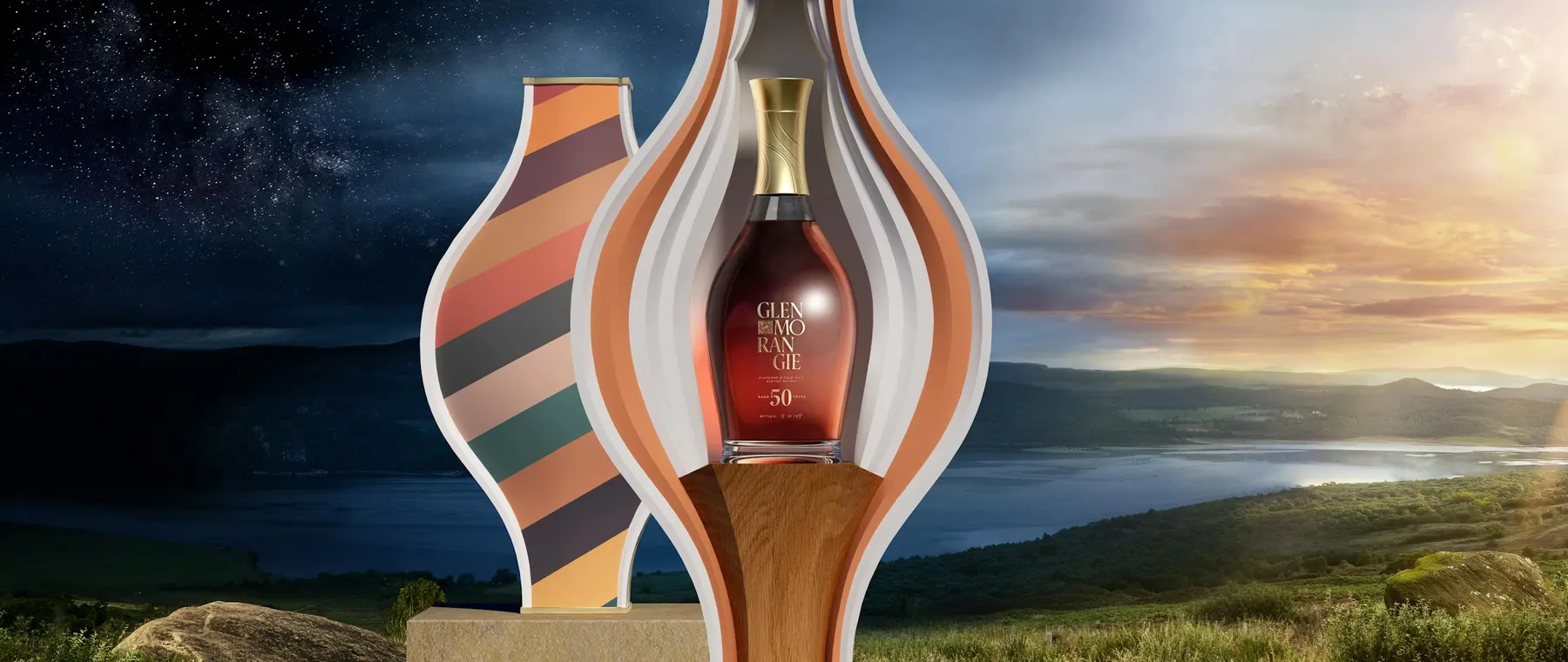
Glenmorangie has released a 50-year-old whisky that reaches back to the distillery’s production in the 1970s. Only 149 bottles have been produced, making the release as much a study in patience and cask judgement as a conventional new expression.
The whisky also carries a direct link to the distillery’s earlier working methods because some of the spirit was produced when Glenmorangie still used its own floor maltings. That historic connection gives collectors another layer beyond age alone.
A cask story spanning decades
When Dr Bill Lumsden joined Glenmorangie in 1995, the whisky was already approaching two decades of age. He identified casks with potential for much longer maturation and continued to follow their development over the years.
In 1999, whisky matured mainly in bourbon casks with a smaller sherry-cask component was brought together and transferred into an old bourbon cask. It remained there for a further 25 years before release.
Age is expressed through flavour
Glenmorangie describes aromas including baked orange, raisins and nutmeg, with caramel, Assam tea, clove and oak tannin on the palate. The profile aims to preserve the house’s elegance while adding the depth expected from five decades in wood.
For serious whisky buyers, that balance matters because extreme age can easily become dominated by oak. The release is positioned around maturity and complexity rather than age as a number by itself.
Porcelain becomes part of the object
Each bottle is accompanied by a handmade porcelain case created with American ceramic artist Peter Pincus and his studio. The collaboration took more than three years to develop.
Pincus created a palette of 50 pigments, linking the presentation directly to the whisky’s age. That turns the outer case into a collectible object rather than simple packaging.
A release for patient collectors
With only 149 bottles available, the 50 Years Old will naturally sit at the rare end of Glenmorangie’s range. Its significance comes from the combination of scarcity, maturation history and bespoke presentation.
For collectors who value provenance, the strongest detail may be continuity across generations of production and decision-making. The whisky is effectively a record of the distillery’s past carried forward into a modern release.