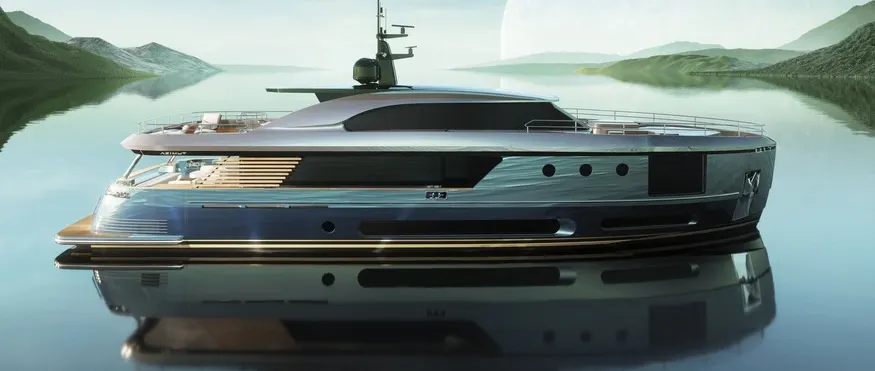
When Azimut Yachts announced its partnership with Artissima in October 2024, the Italian boatbuilder presented the relationship as a meeting of industrial design, contemporary art and the experience of moving through carefully designed spaces. The arrangement extended beyond displaying yachts beside works of art. The company supported the fair in Turin and became a partner in MADE IN, a residency programme that places young artists inside working businesses. By the 2025 edition, that proposal had produced a documented work: the film Notturno by Gaia De Megni, made during her residency with Azimut.
The distinction between announcement and outcome is important. The original 2024 communication described the intention to host an artist and commission a new work for the following year's exhibition. Artissima's own project record subsequently identifies the selected artist, names her film and confirms that the work was presented through MADE IN in 2025. The later evidence turns what could otherwise be merely a corporate marketing story into a traceable exchange between a manufacturer and an independent artist.
Artissima as a setting for experimentation
Artissima has been held in Turin since 1994 and places particular emphasis on contemporary work, experimentation and international galleries. The 2024 edition, titled The Era of Daydreaming, ran from 1 to 3 November at the Oval Lingotto Fiere. Azimut's October company newsletter described its role as official partner and outlined plans for a specially designed environment inside the fair's VIP restaurant. The theme was imagination, with dreamlike natural landscapes used as part of the brand's presentation.
There is a clear commercial dimension to such an installation: participating companies want their identity to be visible among collectors, designers and gallery representatives. But the setting also raises a more interesting question about what happens when an industrial product is placed in the language of contemporary art. A yacht is built to serve people at sea, with a complex combination of structure, machinery and accommodation. An artwork need not perform any of those functions. The connection can be productive without pretending that designing a vessel and making a film are equivalent activities.
The original 2024 proposal
Azimut's contemporary art announcement identified two distinct parts of its involvement. One concerned the 2024 fair's guest environment, while the other involved the MADE IN programme. The company said that a young artist would visit its production facilities and develop a new work drawing on the relationship between creative practice and industrial craftsmanship. The goal was to present that project at Artissima in 2025.
At that point there was no justified basis for naming the eventual artist or declaring the artwork complete. The original announcement described an intention and a future programme. Keeping those dates separate matters for any historical account because sponsorship often leads to ambitious language about what might happen, while subsequent independent records are needed to show what actually took place.
MADE IN brings artists into companies
MADE IN is an Artissima residency initiative developed with the Turin Chamber of Commerce. Its premise is that a company's technical knowledge, processes and materials can be resources for an artist, rather than simply a backdrop for advertising. Selected artists enter participating businesses, learn something about the way they work, and use that encounter to develop an original project.
The third edition was launched in 2024 and realised in 2025. Alongside Azimut, the participating industrial and design companies were Dinolè, Sabelt and Xerjoff. The programme was coordinated with Sonia Belfiore of Ultravioletto Arte + Impresa. Each participant brought a different type of expertise, from textile production and performance safety equipment to perfume and yacht manufacturing. This variety matters because the resulting works were not required to resemble one another or to serve the same corporate message.
Artissima describes a committee chaired by director Luigi Fassi and involving the participating mentor galleries. That committee selected Gaia De Megni to work with Azimut Yachts, supported by Mazzoleni as the mentor gallery. Other artists worked with the remaining companies. The selections and the nature of the project are documented by Artissima, providing evidence beyond the builder's own promotional communication.
Gaia De Megni's Notturno
De Megni's work for the residency was Notturno, a film made in connection with the Azimut production environment. Artissima describes the shipyard as transformed into a suspended nocturnal space. With machinery quiet, lights reveal familiar industrial structures in a different register, and the work uses a collective game of cops and robbers to create a sequence between reality and imagination.
That description places the activity of the shipyard at the centre of the artwork without making a yacht into a conventional luxury product advertisement. Production halls have their own rhythms and sensory qualities: footsteps, reflections, mechanical sounds, pauses and the changing presence of workers. A film can approach those elements by changing the time of day and the way the viewer is invited to look. Artissima's account focuses on anticipation, memory and the atmosphere of production rather than announcing a new hull or measuring a technical innovation.
The film's content should not be invented beyond the evidence provided by the organiser. In particular, the source does not establish the precise length of the film, a list of named performers, an independent critical reception or a commercial release. Those would require separate documentation. What can be stated confidently is the artist's identity, the name of the work, its connection to Azimut and its appearance within the 2025 MADE IN project.
Why a manufacturing site can be an artistic subject
A yachtbuilder's premises offer a distinctive setting because the final objects produced there are designed for travel and leisure, but their making involves concentrated industrial work. An owner may experience quiet cabins, expansive decks and a polished finish; the construction stage involves engineering, repeated checks, machinery and the movement of materials. Showing that contrast can shift attention from a finished product to the people and systems that make it possible.
Artissima's residency format gives artists a reason to spend time in those working environments rather than relying on publicity photographs. The artist is not required to create a technical diagram or a sales film. Instead, experience of production can become part of a work with its own intention. The independence of that intention is what distinguishes a serious residency from a brand merely attaching its name to the arts.
The 2025 exhibition closes the circle
The Artissima 2025 fair ran from 31 October to 2 November, and the MADE IN presentation included new works produced through the third-edition residencies. Its official project page lists Notturno and records the selection of De Megni for Azimut. This completes the basic chronology that began with the company's 2024 announcement: the partnership was proposed, a participant selected, a work created and the result presented to the fair's audience.
The completion should not be expanded into an unsupported claim that the film won a prize, was acquired by a museum or formed part of Azimut's permanent collection. The organiser's records establish an exhibition and residency outcome. For a historical feature, that is sufficient and more useful than treating every brand association with a fair as an award or a permanent cultural institution.
A wider conversation about design and identity
There is a natural relationship between the aesthetic decisions involved in yacht design and the wider world of art, architecture and fashion. Both can be concerned with proportion, movement, materials and how people experience an environment. Yet the practical constraints remain different. A yacht must operate safely and efficiently, meet applicable rules and support the needs of its owners and crew. A film can use those surroundings to investigate a question without having to solve an engineering problem.
The Azimut-Artissima relationship is interesting precisely because it allowed those disciplines to meet without requiring them to collapse into one another. Azimut provided access to its industrial setting and brand context. Artissima supplied the programme and selection structure. De Megni brought an independent artistic practice to the project. Those roles should be distinguished in a factual record of the collaboration.
How the project belongs in a yacht company's history
For the company CRM, the partnership belongs under marketing, culture and institutional relationships, with dates and the participating organisations attached. It is not a sale of a yacht, a new dealership or a yacht launch. Likewise, the completed film belongs to the artist's and Artissima's project histories as well as to Azimut's corporate activities.
Luxury Yacht Guide's original email source is Azimut's 15 October 2024 company newsletter, CRM correspondence 428. Artissima's official MADE IN third-edition record provides the subsequent 2025 outcome. Using both makes it possible to explain the project chronologically, identify the artist and work, and distinguish the manufacturer's intention from the organiser's confirmation of what was completed.
The resulting story is less about brand visibility at a fair and more about an unusual encounter: a filmmaker engaging with the atmosphere of a working yachtbuilder, and a manufacturer participating in a contemporary art programme whose final product was not another vessel. It is a dated, documented example of how a luxury yacht brand can take part in cultural production without the subject being mistaken for a new model or a conventional product launch.