Azimut's December 2025 design communication drew attention to a connected interior language across three models in its Fly family: the Fly 62, Fly 72 and Fly 82. Rather than treating each saloon as an isolated decorating exercise, the builder presented the work of Turin-born architect Fabio Fantolino as a consistent approach to colour, soft forms and the relationship between interior rooms and open-air living. It was a useful moment to examine how the same creative ideas can be applied across yachts of different sizes without pretending that their layouts or technical specifications are interchangeable.
The manufacturer's original newsletter described a modern interpretation of Italian interiors associated with the 1970s. Its most memorable design detail was a warm palette identified as orange-brown, used to make a deliberate contrast with the blue of the surrounding sea. Azimut positioned this as a shift towards a softer, more personal style of yacht interior. That is a design claim, not a technical performance measurement, and its significance lies in how different spaces are arranged and experienced.
A designer's vocabulary across three boats
Fantolino's collaboration with Azimut developed over multiple yacht projects. The builder's records identify the Fly 72 as an important early expression of this language, followed by the Fly 62 and Fly 82. Each belongs to the Fly line, but there are material differences in length, deck space and the roles of the interior and exterior helm areas. A convincing family identity must be recognisable without assuming that all three yachts have the same amount of usable floor area or the same cabin plan.
The December 2025 communication presented the group together. It emphasised indoor-to-outdoor continuity and a style that draws upon historical design without making the rooms appear like museum recreations. For owners who may spend several hours indoors during a passage or in poor weather, this attention to atmosphere is not merely cosmetic. Furniture placement, natural light and an intuitive route between the saloon and cockpit all affect how a boat feels on an ordinary day, even if they do not change its certified sea-keeping capability.
The role of colour in a yacht interior
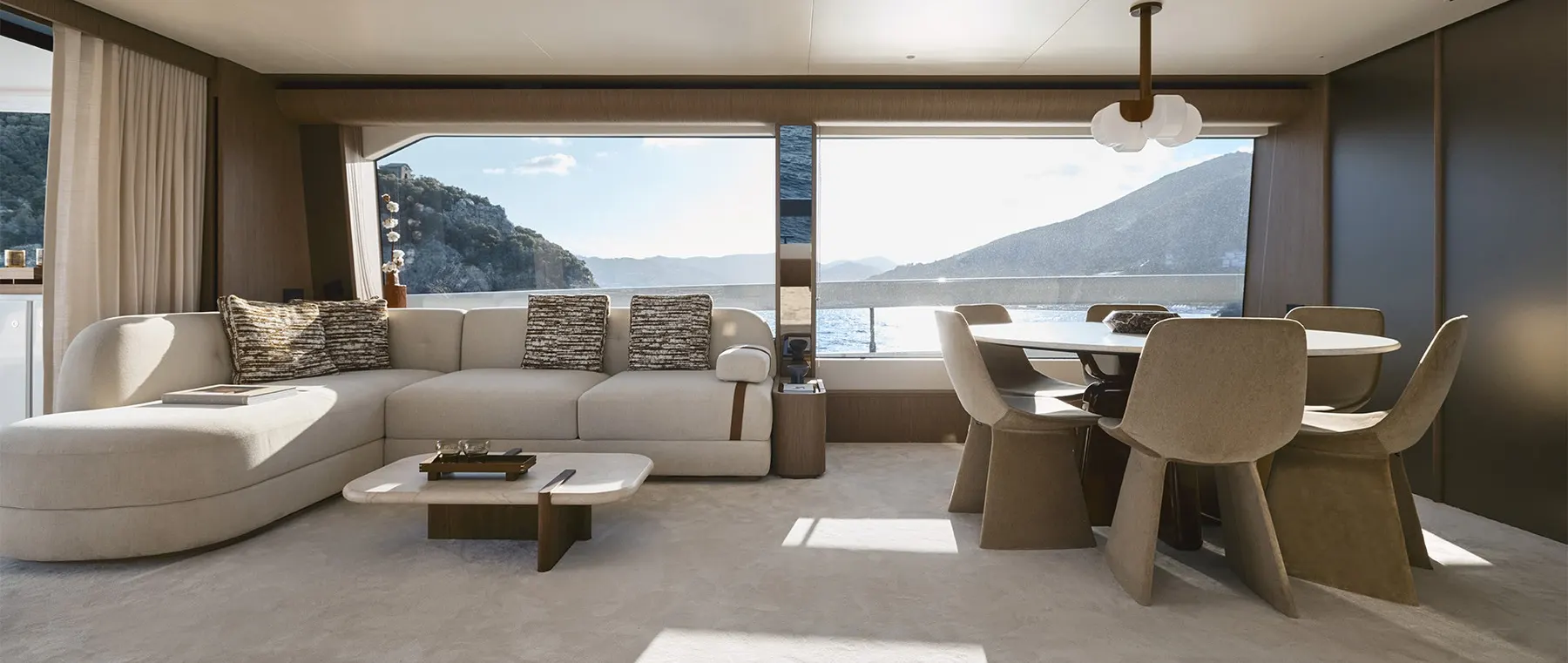
Colour is a relatively low-mass way to affect perceived space, yet it can determine whether a room feels crowded or relaxed. Warm brown and orange tones may soften the effect of large windows and polished joinery while providing a contrasting frame for the sea outside. The builder's description of an orange-brown palette suggests a deliberate rejection of the familiar all-white minimalist interior, although the actual outcome depends on materials, lighting and the particular version specified by an owner.
A palette is also more practical when it works across different conditions. Colours that appear balanced in bright Mediterranean sunshine can take on another character in diffuse northern light or under artificial illumination after sunset. Upholstery and decorative details should be judged in those different settings. Marketing photographs are useful references for a design concept, but they are not substitutes for inspecting physical finishes and understanding how they age after years of wear, cleaning and exposure.
References to 1970s Italian design
Fantolino's reported interest in the 1970s does not mean these yachts were fitted out with antique furnishings or copied directly from a historical house. It is better understood as a stylistic reference to softer geometry, expressive colour and tactile surfaces. Those qualities can sit comfortably alongside the more functional demands of contemporary yachting. Rounded furniture shapes, for example, may create a welcoming lounge but still need to be arranged with consideration for movement when the vessel is underway.
In a marine environment, visual references must be reconciled with anchoring, access, cleaning and maintenance. A table cannot be assessed only from its silhouette; its fixings and clearance also matter. A fabric may be visually appealing but require particular care. The manufacturer's original newsletter did not list every individual material specification for all three models, so it would be misleading to name suppliers or certified fire ratings not documented in the sources.
Fly 62: space used with purpose
The Fly 62 represents the smaller part of this design group. Here, the saloon, galley and connection to the aft cockpit need to deliver multiple functions within a relatively compact hull. The central design challenge is not simply to make the room look larger in photographs but to make it feel usable while people are eating, socialising, moving through the yacht or preparing for a passage. Fantolino's work has been described as creating fluid, welcoming spaces through carefully controlled lines and contrasts.
Owners comparing this design with another yacht of similar length should examine sightlines from the entrance, access to the galley, natural ventilation, the size of circulation routes and the relationship between seating and windows. These are individual assessment points rather than claims that the Fly 62 necessarily outperforms a competing model. The aesthetic helps create a sense of continuity, but its practical value can only be judged against the way a family actually uses the boat.
Fly 72: an established collaboration
Azimut's Fly 72 provided one of the earlier public examples of Fantolino's design language in the family. The manufacturer has discussed the architect's pursuit of a balance between elegance, design and technique, with onboard spaces arranged to feel connected rather than fragmented. The yacht's additional size offers different options for separating activities and accommodating guests, but it also creates the temptation to fill every available area with furniture.
The restraint described in the 2025 communication is relevant here. A quiet visual composition can allow sea views, natural light and the movements of those aboard to become the focus. There is no single correct amount of decoration for a yacht, and the finish a buyer prefers may differ substantially from the photographed show boat. Customisation and individual specification therefore remain essential when discussing a design language across a range.
Fly 82: a larger expression, not a direct enlargement
The Fly 82 occupies a larger segment, extending beyond the sub-24-metre boats that form the principal Luxury Yacht Guide news fleet. Its interiors offer another context for the collaboration, rather than proving that the smaller models are reduced-scale copies. Azimut credits the same architect with this interior project and Alberto Mancini with its exterior design. The larger yacht's layout and technical arrangements must be considered independently, even where finishes and shapes share visual characteristics with the Fly 62 and Fly 72.
The December 2025 newsletter grouped the three models to tell a story about style. For a lifestyle design feature, that broader comparison is appropriate, but it should not blur the distinction between the different market categories. A person considering a Fly 82 will face questions about berthing, crew, running costs and cruising plans that are not identical to those of a Fly 62 owner. Design consistency does not erase those operational differences.
Connecting saloon and cockpit
Across contemporary motor yachts, the transition between indoor and outdoor areas is a major design priority. Buyers often spend as much time in the cockpit and upper deck as they do in the saloon. The 2025 announcement's emphasis on au fil d'eau living—spaces that feel close to the water—can therefore be seen as a response to actual patterns of use. A saloon that looks inviting from outside may encourage people to move easily between decks throughout the day.
These connections also need to function when the yacht is moving. Doors, steps, handholds and sightlines affect safety and comfort in ways that a single promotional image cannot show. Larger openings can enhance the feeling of space, but they must still be integrated with the boat's structure and weather protection. Design writing is most useful when it recognises that the dramatic visual moments are supported by less visible engineering and careful fit-out decisions.
The value and limits of manufacturer photographs
The official Azimut photographs accompanying the December communication provide a clear record of how the builder wanted the interiors to be seen at the time. They illustrate the palette, furniture arrangements and relationship with exterior light. They do not, on their own, verify an individual yacht's delivery status, an owner's selected fabrics or future resale value. Those are separate matters that require hull-specific records and current evidence.
This is especially important when the same design team works on several models. A photograph from a Fly 82 campaign should not be silently used to depict the cabin arrangement of a Fly 62. A comparative article can use a branded image with an accurate credit and description, while stating that the interior programme spans several different boats. In the underlying fleet database, each image and specification should remain attached to the appropriate model or hull.
A distinctive moment in Azimut's design history
The lasting point of Azimut's December 2025 announcement is that it made the collaboration legible as a family of interiors. The Fly 62, Fly 72 and Fly 82 were not presented as unrelated designs but as different settings for Fantolino's interest in warm colour, controlled contrast and a more relaxed connection with the sea. The reference to 1970s Italian interiors gave the work a cultural shorthand, while the production yachts demonstrate how that language has been interpreted in practical onboard spaces.
Luxury Yacht Guide has retained the complete first-party December 2025 newsletter as management-system source email 1983, including its original photographs. Official Azimut model and design announcements provide additional context. The source date is preserved here because this is a historical examination of an established design collaboration, not a claim that all three interiors have been newly launched in November 2026. The design lessons remain relevant to readers comparing how modern luxury yachts balance visual character with everyday life on the water.