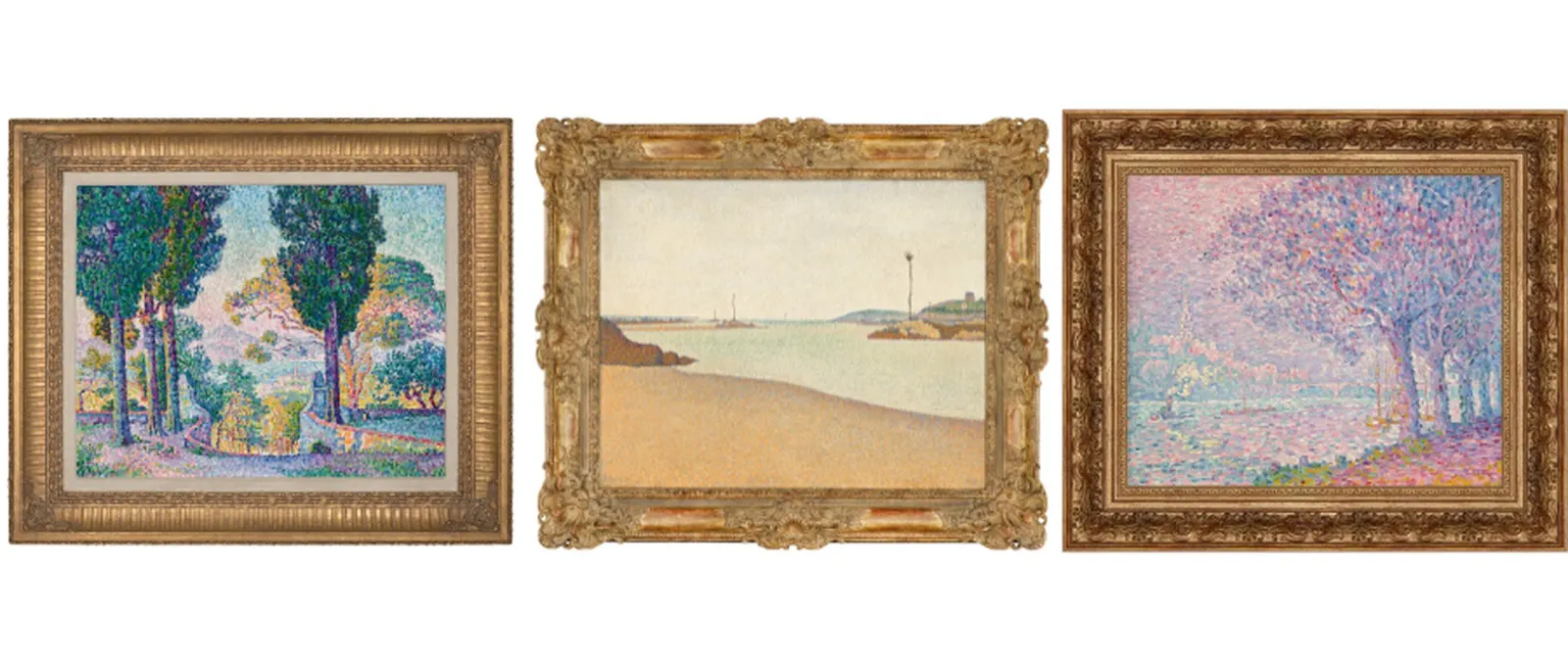
Christie’s will offer nearly 600 works from a private European collection titled Radiant Modernism across London, Paris and New York from October 2026 into 2027. The collection is estimated at approximately US$40 million to US$60 million and is built around long-term scholarly interest rather than one fashionable moment in the market.
Paul Signac, Josef Albers and Odilon Redon provide some of the strongest anchors, but the collection also includes Lyonel Feininger, Henri de Toulouse-Lautrec, Félix Vallotton, Maurice Denis and other artists. Its breadth gives buyers a view across several movements while maintaining a clear interest in colour and formal experimentation.
Pointillism forms one of the central threads
Signac appears across paintings, works on paper and prints, allowing collectors to see his research through several media rather than through isolated examples. Major oils include Sainte-Anne (Saint-Tropez), estimated at £4.5 million to £6.5 million, and other works that trace his development of divisionist colour.
A collection with this level of depth can be especially useful for connoisseurship. Repeated exposure to one artist across periods and media makes differences in technique, condition and ambition easier to recognise than when works appear one at a time.
Symbolism and expressionism broaden the visual language
Odilon Redon represents the collection’s Symbolist strand, while Lyonel Feininger and others introduce expressionist approaches. These movements differ historically, but they share an interest in moving beyond straightforward naturalism toward more subjective or constructed visual worlds.
Seen together, the works create a conversation around colour, perception and emotional atmosphere. That intellectual coherence is one reason the collection feels more deliberate than a general survey of late nineteenth- and twentieth-century art.
Albers extends the collection into post-war abstraction
Josef Albers provides a later bridge through his rigorous investigations of colour relationships. His work demonstrates how questions first explored by earlier modernists continued into post-war abstraction in a more systematic and geometric form.
For collectors, this creates continuity across generations. Signac’s optical experiments and Albers’s colour studies emerge from very different contexts, yet both treat colour as something active that changes according to its neighbours and the viewer’s perception.
Three cities divide a collection too large for one sale
Christie’s will begin in London during Frieze Week, continue in Paris around Art Basel and then move into New York’s November marquee auctions. Further works are scheduled for 2027, allowing the collection to be dispersed gradually rather than compressed into a single event.
This structure lets specialists place works in the market where they are likely to receive the strongest attention. It also keeps the Radiant Modernism identity visible over a longer period, giving collectors repeated opportunities to engage with the collection.
Forty years of collecting gives the group unusual depth
The collection was assembled over four decades with an emphasis on research, rarity and condition. That long formation matters because it means many acquisitions were made before later market trends clarified which artists or periods would become most fashionable.
For buyers, the sale offers access to works selected through sustained study rather than short-term speculation. As the nearly 600 pieces disperse, the catalogue will remain as a record of one collector’s attempt to understand modern art through colour, structure and the evolution of visual perception.