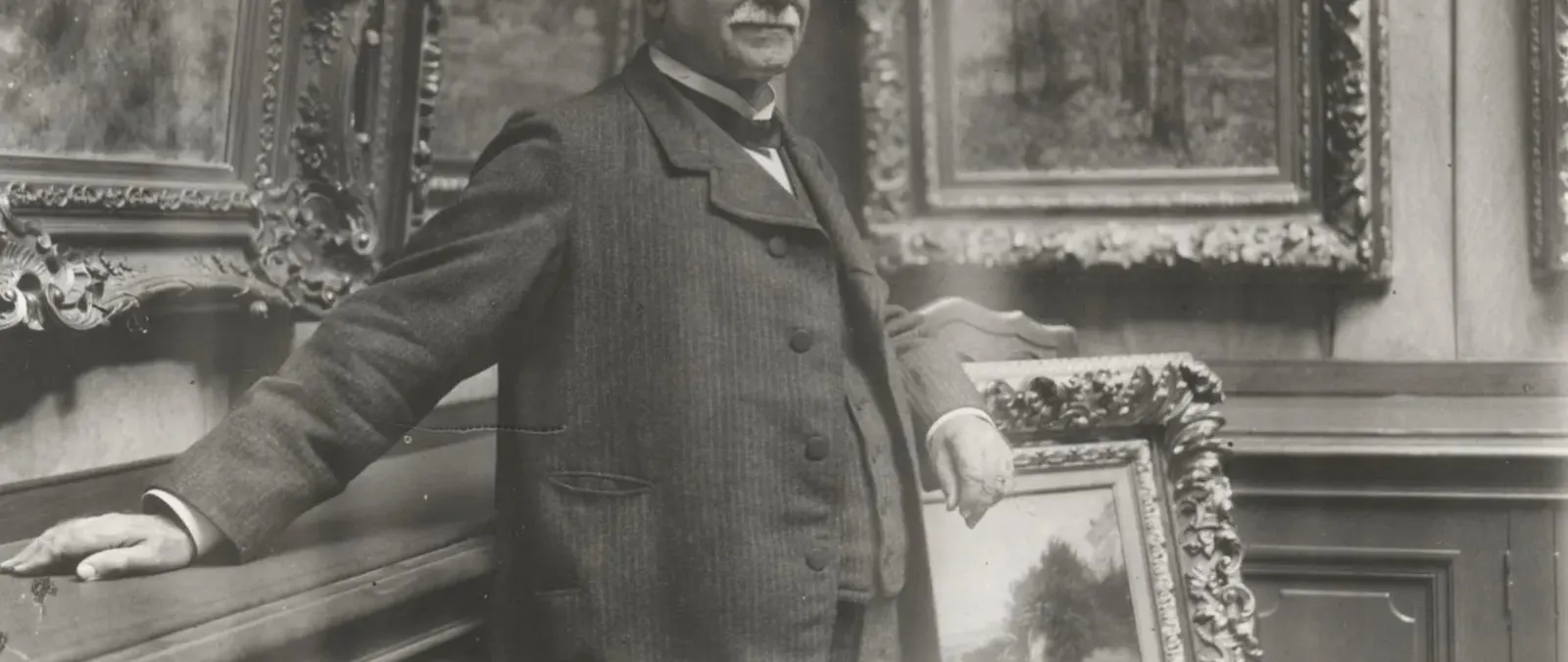
Christie’s will present 62 works from the Durand-Ruel family during Paris Art Week, bringing a group of Impressionist and modern paintings to market after generations of private ownership. The collection is estimated at €30 million to €43 million and includes works by Claude Monet, Pierre-Auguste Renoir, Camille Pissarro, Eugène Boudin and Alfred Sisley.
Paul Durand-Ruel remains one of the central figures in the history of Impressionism because he supported artists before broad public and institutional acceptance had formed. The sale therefore carries a provenance that is unusually closely connected with the movement itself rather than with later collecting fashion.
Monet leads a collection with deep family provenance
Among the major works is Monet’s Bord des falaises à Pourville, a painting that remained within the Durand-Ruel family for more than 140 years. Its estimate of €11 million to €15 million reflects both quality and the rarity of a work with such a long, direct ownership history.
Freshness to market often matters at this level because important Impressionist pictures have frequently circulated through auctions and private transactions. A painting kept in one family can attract collectors who value continuity as strongly as the artist’s name.
Renoir and Pissarro broaden the historical picture
Renoir’s Jeunes filles au bord de la mer is estimated at €4 million to €6 million, while Pissarro’s Le Louvre, soleil d’hiver, matin is guided at €2 million to €3 million. These works help show how Durand-Ruel supported several artists whose reputations developed in parallel but whose visual languages remained distinct.
For collectors, viewing them together is a reminder that Impressionism was never one uniform style. Urban observation, landscape, portraiture and changing light were explored in different ways, often by artists who exhibited and worked alongside one another.
The sale tells the story of a dealer as much as the artists
Durand-Ruel’s importance came from taking financial and reputational risks on artists who were not yet universally accepted. He bought deeply, organised exhibitions and introduced Impressionism to international audiences, helping create markets where little had existed before.
That history gives the sale an additional layer. Buyers are not only acquiring individual paintings but objects tied to the story of how modern art moved from controversy into museum canon and international collecting.
Paris Art Week provides the natural setting
The dedicated sale will take place on October 22, with other works offered the following day in Christie’s Art Moderne auction. The full group will be on public view from October 16 to 22, giving visitors a chance to see the collection before it disperses.
Holding the sale during Paris Art Week and Art Basel Paris brings an international audience already focused on modern and contemporary art. It also places the collection close to the institutions and galleries that continue to shape the city’s relationship with Impressionism.
A family collection becomes part of the public market
Once these works sell, the Durand-Ruel group will cease to exist in its current form. Individual paintings may enter museums, private collections or remain in France, but the family relationship that kept them together will be replaced by new ownership histories.
For collectors, that moment of transition is part of the appeal. The sale offers access to works that were preserved through generations by descendants of the dealer who helped build the artists’ original market, giving provenance unusual historical depth.