Christie’s opened its New York fall auction season with a $28 million Post-War to Present sale that combined established twentieth-century names with contemporary artists and produced three new artist records. The result gives an early indication of collector appetite ahead of the larger marquee auctions later in the autumn.
The sale was 81 per cent sold by value and achieved 86 per cent of its aggregate low estimate. Wayne Thiebaud’s Coastal Farms led the auction at $1.856 million, more than double its $800,000 low estimate, while works by Donald Judd, Gerhard Richter and Sam Gilliam also crossed the million-dollar mark.
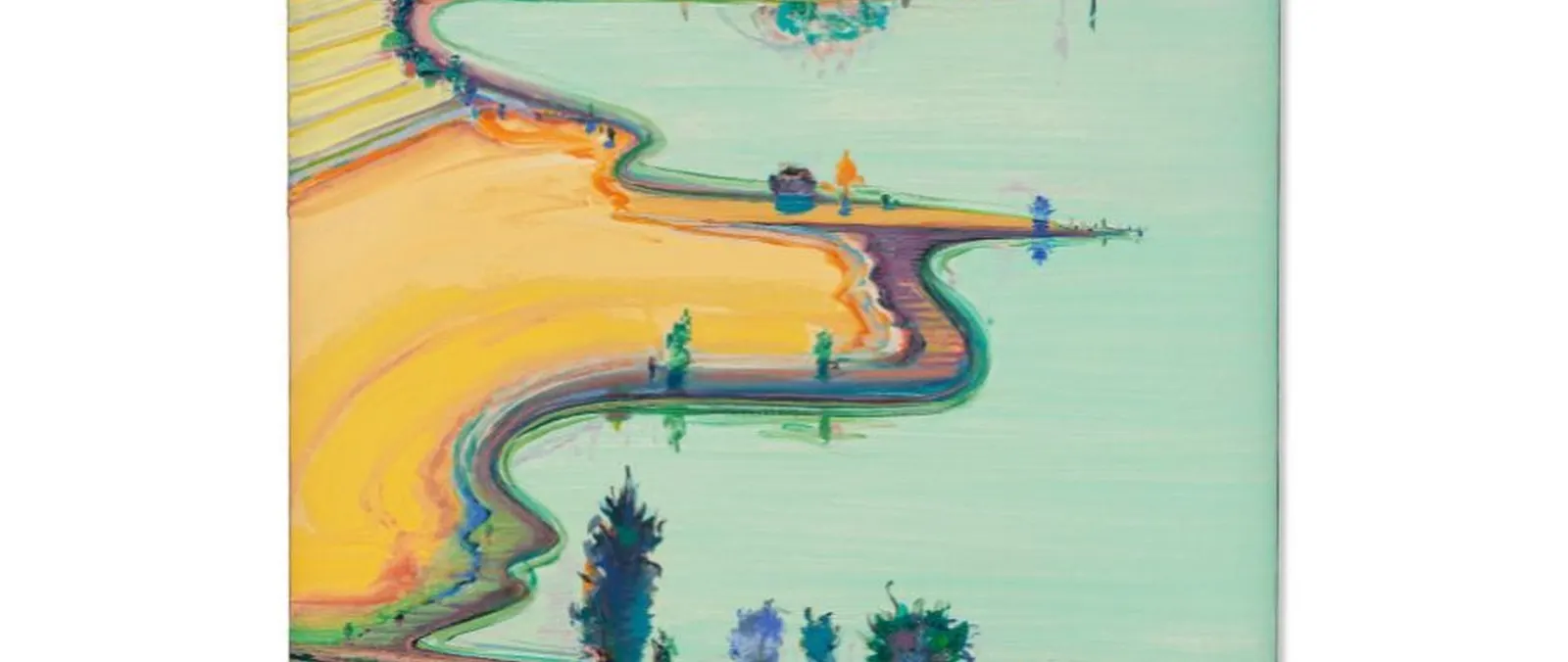
Wayne Thiebaud led the sale with a California landscape
Coastal Farms, painted in 1997, belongs to Thiebaud’s celebrated group of heightened California landscapes. The work transforms agricultural terrain into a compressed arrangement of colour and geometry, showing the same fascination with form and surface that characterised his better-known paintings of cakes and consumer objects.
Its $1.856 million result demonstrates that collectors continue to look beyond the most familiar subjects within established artists’ careers. A work with strong quality and provenance can create competition even when it sits outside the image most immediately associated with the artist.
Three women artists set new auction benchmarks
Judy Chicago’s Pasadena Lifesavers Blue Series #5 sold for $486,400, establishing a new auction record for the artist. Anni Albers’ Study for B reached $166,400, while Anicka Yi’s Counterfactual Imagination sold for $83,200 and also set a new market high.
These records matter because auction prices can influence museum attention, estate strategy and future consignor confidence. They do not define artistic significance, but they can help correct long-standing market imbalances when major work by historically under-recognised artists begins attracting sustained competitive bidding.
Richter and Judd showed depth in established post-war names
Gerhard Richter’s Fuji realised $1.152 million and set a record for the series, while a red galvanised Donald Judd sculpture from the collection of Barbara Jakobson achieved $1.3056 million. Sam Gilliam’s large-scale Region and Mind sold for $1.024 million.
Josef Albers’ Homage to the Square reached $960,000, more than twice its $400,000 low estimate. Together, these results show that the sale was not dependent on one top lot; several different schools of post-war abstraction and conceptual practice attracted substantial bidding.
Mid-season auctions can reveal collector selectivity
Post-War to Present sits below the theatre of the major evening sales, but that can make it useful as a market indicator. Buyers are often more willing to compare quality, estimate and provenance closely when they are not competing for a small number of globally famous trophy works.
The 81 per cent sold-by-value figure also shows that the market remains selective. Strong material exceeded expectations, while the unsold portion demonstrates that collector demand is not indiscriminate simply because an artist has an established name.
New York’s autumn market is now moving toward marquee week
The $28 million total begins a season that will bring larger private collections, evening auctions and international consignments into New York. The early records for Chicago, Albers and Yi give the opening sale significance beyond its aggregate value.
For collectors, the lesson is familiar but useful: quality, rarity and a credible estimate continue to matter more than broad market narratives. The strongest results came from works with a clear reason to compete, whether that reason was rarity, provenance, historical importance or an opportunity to reset an artist’s auction record.