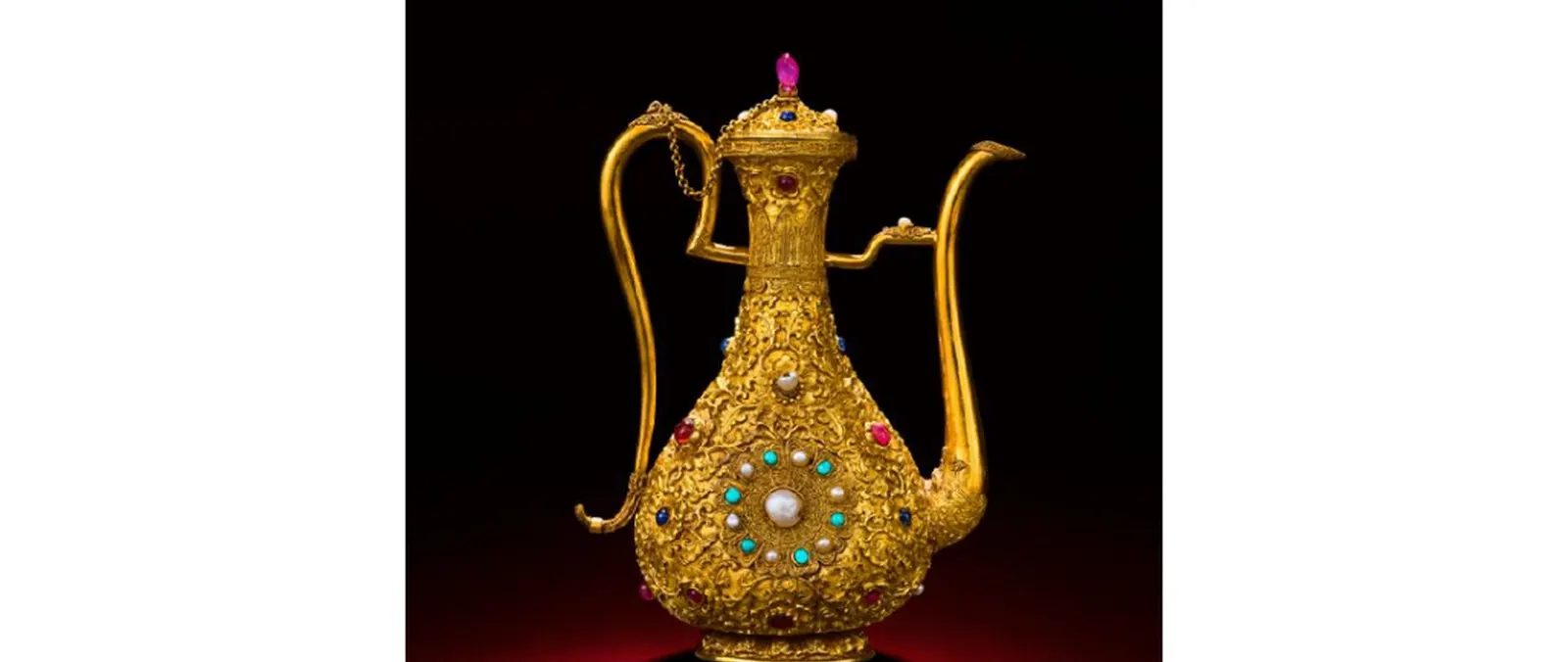
Christie’s Hong Kong will stage a dedicated single-lot auction on October 29 for an exceptionally rare imperial gold ewer from the Qianlong period. Made from solid gold and enriched with pearls, rubies, sapphires and turquoise, the vessel represents a level of court craftsmanship associated with the most ambitious productions of the Qing imperial workshops.
The sale is titled For the Son of Heaven: The Imperial Qianlong Gold Ewer and will take place during Hong Kong Asian Art Week. By presenting the object alone rather than inside a broader decorative-arts auction, Christie’s is signalling that the vessel is intended to be considered as a major historical work in its own right.
The object combines goldsmithing with jewel setting
The ewer’s form is built in solid gold and finished with intricate filigree and gemstone decoration. Pearls, rubies, sapphires and turquoise create a richly coloured surface that reflects the Qianlong court’s appetite for materials, techniques and visual references drawn from several different artistic traditions.
Such objects demanded collaboration between specialist workshops rather than a single maker. Goldsmithing, stone setting, design and court supervision all had to align, which helps explain why surviving examples of this scale and complexity are so rare outside institutional collections.
Imperial workshop records may connect it directly to the emperor
Christie’s points to archival records describing a jewel-embellished gold ewer commissioned in 1740 and completed for the Qianlong Emperor in 1741. The recorded object closely corresponds to the present vessel in scale and decoration, adding a potentially important documentary layer to its provenance.
That type of archival connection can transform how collectors evaluate an imperial object. The physical craftsmanship remains central, but written evidence linking a piece to a specific commission, workshop and reign strengthens its historical importance far beyond decorative appeal alone.
The Kempe provenance adds another collecting history
The ewer was formerly part of the collection of Dr Carl Kempe, one of the leading twentieth-century European collectors of Chinese art. His collection became known for the seriousness of its scholarship and the quality of its holdings across Chinese decorative arts.
Long-established provenance is especially valuable in the market for imperial Chinese works because collectors want to understand both authenticity and ownership history. A documented path through an important scholarly collection can also show how an object was appreciated before today’s auction values developed.
The design echoes one of the Qing court’s most famous gold vessels
Christie’s compares aspects of the ewer with the Jin’ou Yonggu cup, the celebrated gold vessel used by Qing emperors during New Year ceremonies. Both combine floral ornament, elaborate metalwork and gemstone embellishment in a language associated with imperial ceremony and authority.
The comparison does not make the two objects identical in function, but it helps place the ewer within the visual world of the Qianlong court. The emperor used luxury objects not simply as possessions but as expressions of order, taste, patronage and the reach of imperial workshops.
A single-lot sale turns attention entirely onto one object
The ewer will be previewed in Taipei before moving to Hong Kong for exhibition from October 22 to 28. Christie’s will then offer it alone on October 29 at its Asia Pacific headquarters in The Henderson.
For collectors, that structure creates an unusually focused auction event. Instead of competing for attention with dozens or hundreds of lots, the ewer becomes the sole narrative, allowing craftsmanship, provenance and historical context to be examined in the depth normally reserved for a museum exhibition.