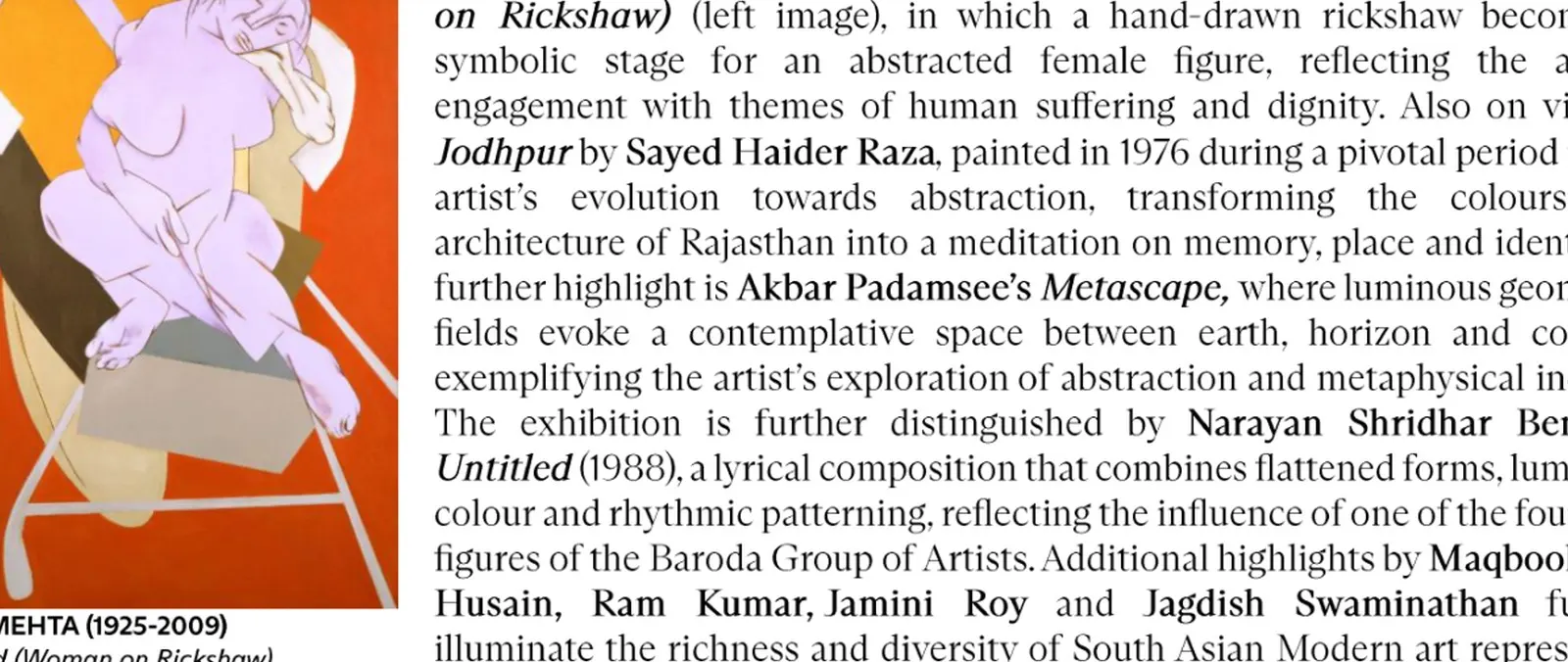
Christie’s will stage its first exhibition in Asia dedicated entirely to modern South Asian art, presenting more than 20 works from the Dabriwala Collection at The Henderson in Hong Kong from November 18 to 29. The exhibition also marks one of the first public presentations of a collection built across multiple generations of the Dabriwala family.
Titled Masterpieces of Modern South Asian Art: Highlights from the Dabriwala Collection, the show is designed as an introduction to the major movements and ideas that shaped twentieth-century modernism across the region. Its timing alongside India by the Bay gives the exhibition a wider cultural context beyond the auction market.
A private collection becomes a public survey
The Dabriwala Collection was developed over more than four decades and has expanded under collector Surbhit Dabriwala while retaining the original vision established by his father. The holdings bring together artists working across different generations, countries and approaches to modernism.
For collectors, that continuity matters because a multigenerational collection can reveal how taste evolves without losing an underlying point of view. The exhibition therefore presents more than isolated masterpieces; it shows how private collecting can create its own intellectual history over time.
South Asian modernism is presented as a broad field
The collection includes artists associated with India as well as figures from the wider South and Southeast Asian region. Christie’s highlights names including Cheong Soo Pieng, Hendra Gunawan, Affandi, Arpita Singh and Salman Toor, placing established modernists beside later and diasporic voices.
This wider frame helps challenge the idea that South Asian modern art can be understood through one national school or a small group of market-leading names. The exhibition instead treats the region as a network of overlapping histories shaped by independence, migration, tradition and international modernism.
Hong Kong provides access to a growing collector base
The Henderson has become Christie’s Asia Pacific headquarters and gives the exhibition a prominent setting in one of the region’s most important art-market centres. Presenting the works there brings them into direct contact with collectors who may already be active in Chinese, Southeast Asian, contemporary or international modern art.
That cross-category audience is important for the long-term development of South Asian art in Asia. New collecting categories often grow when buyers encounter them beside areas they already understand, reducing the distance between an unfamiliar field and an established collecting practice.
Education is built into the programme
The exhibition will be accompanied by a panel discussion on November 29 exploring the formation and legacy of the Dabriwala Collection. Collector Surbhit Dabriwala and Christie’s specialists are expected to discuss collecting, connoisseurship and the wider cultural significance of the works.
This educational component gives the project more depth than a standard viewing. It allows visitors to understand why the works were collected and how the field has developed, information that is especially useful for potential new collectors considering their first acquisitions in the category.
Christie’s is using its 40th year in Asia to broaden the conversation
The exhibition forms part of Christie’s wider 2026 programme marking 40 years in Asia. Rather than focusing only on headline auctions, the house is using exhibitions and public programming to expand access to categories that may still be underrepresented in regional private collections.
For collectors travelling through Hong Kong in November, the Dabriwala exhibition offers a rare chance to see a coherent private collection outside the context of a sale. That distinction matters because it shifts attention from immediate prices toward artistic relationships, collecting history and the long-term formation of taste.