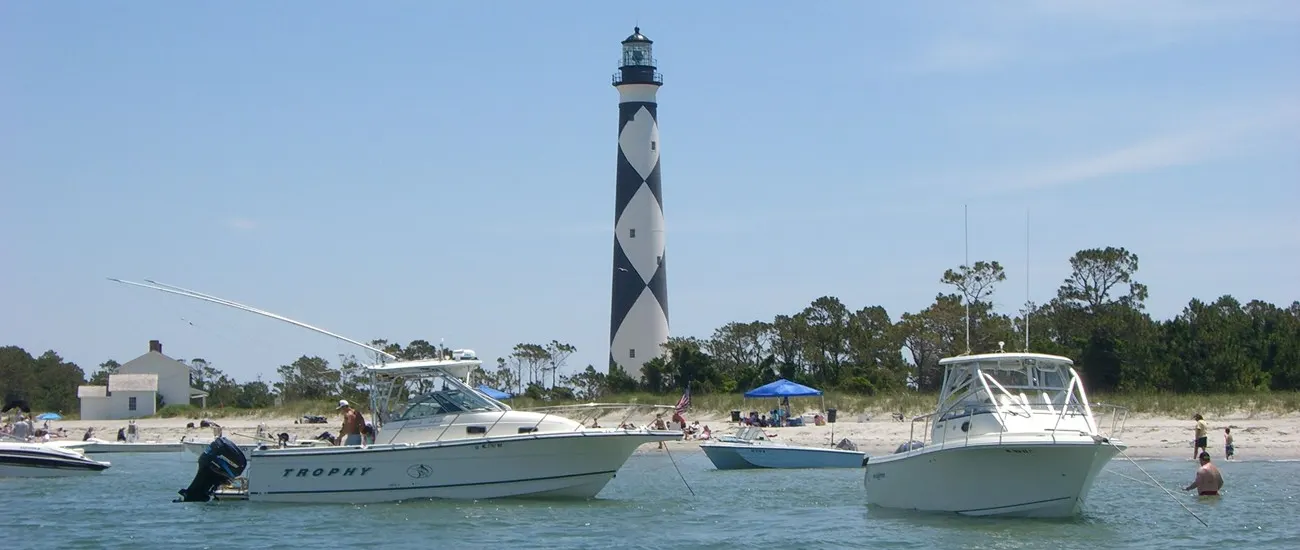
The rare luxury of an accessible wild shore
Cape Lookout National Seashore offers a striking change of pace from the resort-marina circuit. Beyond Beaufort on North Carolina’s Crystal Coast, barrier islands, a black-and-white diamond-patterned lighthouse and broad stretches of undeveloped beach form a cruising ground where the principal attraction is space. For crews aboard a 12–24-metre yacht, the reward is not a tightly packed itinerary but the chance to spend an unhurried afternoon watching the light move across the dunes, exploring by tender and returning to a quiet anchorage for sunset. The seashore’s isolation is real: the National Park Service explains that its islands are reached by boat, so shore access must be planned as carefully as the passage itself.
This is a destination in which seamanship shapes the experience rather than merely transporting guests between attractions. A family motor yacht with a capable tender may use the deeper water of Cape Lookout Bight as its operating base and explore selected landing points separately, always subject to conditions and current rules. A sailing yacht can make a similarly memorable stop, provided the skipper assesses swell, depth, approach channels, anchoring room and the latest forecasts. The open Atlantic coastline and the protected sound are quite different environments; a sheltered view on a map should never replace a fresh weather and tide assessment.
Why Cape Lookout Bight matters to a deeper-draft yacht
The National Park Service identifies Cape Lookout Bight, behind the spit, as an anchorage suitable for sailboats and deeper-draft vessels, noting that deep water approaches close to the spit in parts of the bight. That distinction is important in a coastline known for moving sand and unexpectedly shallow water. The bight offers a useful starting point for a longer coastal visit, but it is not a promise of uniform depth or unrestricted space. Skippers should select an anchoring position using current charts, depth soundings, weather exposure, swing clearance and the positions of other craft, then confirm that the anchor is holding before the crew leaves by tender.
The surrounding sounds demand much greater caution. The park’s own boating guidance describes channels averaging about five feet deep and adjoining water often less than three feet, with shoals and tides making some passages impassable. Those figures are a warning, not navigational data to steer by: a yacht that can comfortably lie in Cape Lookout Bight may still be wholly unsuitable for nearby sound-side shortcuts or docks. The park points mariners towards NOAA charts 11545 and 11550, but those references should be checked against the current official chart catalogue, corrections and local notices before departure. There is no substitute for a conservative under-keel-clearance calculation.
A good captain will resist the temptation to press closer to a scenic beach simply because smaller runabouts are doing so. Tender operations allow guests to enjoy an island landing while keeping the mother yacht in suitable water, if conditions and local restrictions allow. This can also reduce propeller disturbance and make it easier to avoid shallow flats that support coastal wildlife. The most elegant approach is often the least conspicuous one: anchor well, travel ashore lightly, and treat the shoreline as a fragile place rather than an extension of the swim platform.
Beaches, lighthouse and island life
The Cape Lookout lighthouse is an instantly recognizable landmark and a rewarding subject for photography from offshore or from permitted viewpoints ashore. Visitors should not assume that climbing is available: the park’s April 2026 operating notice lists the tower as closed while stabilization work and safety concerns are addressed. The landscape nevertheless offers compelling reasons to visit, including the light station setting, dunes, shell-strewn shores and views over Barden Inlet. Any beach excursion should begin by confirming where a tender can legally and safely land, as well as whether seasonal nesting areas or other temporary closures are in force.
Shackleford Banks adds a different atmosphere, with low sandy terrain, wildlife and a sense of distance from the developed coast. It is best appreciated slowly and at a respectful distance from the island’s horses and other animals. Visitors should keep food secured, give wildlife room to move, remove rubbish and avoid treating an encounter as an invitation to approach for a photograph. The same principle applies to shorebirds, nesting turtles and sensitive dune vegetation; a yacht holiday should leave the beach looking undisturbed when the tender departs.
Further north, the Core Banks and Portsmouth area reflect another layer of maritime history. These islands do not offer the predictable services or easy all-weather transfers of a purpose-built marina, and a longer exploration is more realistic when timed around daylight, tides, visibility and a generous weather window. A private crew can design a flexible day around one landing rather than forcing several distant stops. If the wind rises or an inlet becomes uncomfortable, guests can still enjoy the seascape from aboard without sacrificing safety for a timetable.
Landing rights and the fifteen-minute dock rule
One of the most consequential details for visiting yacht crews is the National Park Service’s distinction between loading and mooring. Its boating guide generally limits private motorboats at public docks to 15 minutes while actively loading or unloading passengers and gear, and it lists additional no-anchoring or no-mooring areas around marked waters near the lighthouse and Shackleford docks. The former US Coast Guard dock is closed to public entry and mooring. A tender driver should receive a briefing on the exact landing point and have a fallback plan if a dock is occupied or temporarily restricted.
The park’s docks-and-anchorages guidance says that docking for a long stay is not permitted at the specified passenger-transfer docks. Boats planning to remain should anchor away from the dock and outside the way of other traffic, subject to site conditions and rules. In the bight, the park describes anchoring for deeper-draft sailboats as distinct from shallower-draft areas along parts of Shackleford Banks. It also cites a total limit of 14 days at anchor in water within park boundaries. None of these rules removes the need to verify any updated restrictions through the park before arrival.
Treat the tender as a working vessel with its own passage plan, rather than simply a convenient shuttle. Loading should take place only where allowed, with a lookout for swimmers, ferry movements, currents and shallow patches; the driver should never leave a vessel unattended at a transfer dock in contravention of park rules. A simple radio check and agreed return time keep the mother yacht informed, while lifejackets, adequate fuel, communication equipment and an accessible boarding arrangement make the trip comfortable for guests of different ages.
A practical two-day luxury-yacht itinerary
An unhurried first day might begin in Beaufort with fuel, provisioning and confirmation of the coastal forecast before the yacht proceeds toward the Cape Lookout cruising area. The exact route depends on vessel dimensions, draft, current charted depths, tide and the captain’s local knowledge; this is not an approach to improvise from a travel article. Once safely anchored in an appropriate part of the bight, guests can enjoy lunch aboard and a first look at the lighthouse across the water. If conditions cooperate and the landing rules are clear, a short tender excursion gives the beach its full sense of scale.
On the second day, a dawn watch over the dunes can be followed by a carefully chosen shore outing, photography session or relaxed swim in a suitable area. The highlight may be nothing more elaborate than fresh air, deserted-looking sand and an uninterrupted horizon. For guests who prefer activity, a guided natural-history visit or a walk along a permitted beach can provide a richer understanding of the island ecosystem. The itinerary should retain an early return option if afternoon wind, thunderstorms or inlet conditions worsen, particularly where tender operations are concerned.
Rather than trying to combine every island into a compressed cruise, a yacht owner can frame this as a small expedition: one good anchorage, one meaningful shoreline visit and plenty of time aboard. That makes the destination as relevant to a comfortable 15-metre flybridge yacht as to a larger cruiser at the top of the luxury-yacht category. The vessel’s quiet-water comfort and safe tender arrangement will often matter more to the enjoyment of the trip than the length of its guest-amenity list.
Weather, ecology and responsible departure
Cape Lookout is exposed to Atlantic weather and shifting coastal conditions, so route planning should be reviewed repeatedly rather than only at the berth. A fresh offshore forecast, tide information, local notices, inlet conditions and a realistic forecast for the tender journey all belong in the departure briefing. Wind direction may alter the comfort of the chosen anchorage, and swell can complicate a seemingly easy beach landing. A cautious skipper will identify where to go if the wind shifts, preserve enough daylight to reposition and never rely on last season’s shoal patterns.
Good environmental practice is part of the destination’s appeal. Keep a generous distance from animals, avoid anchoring where the bottom could be damaged, secure loose items against wind and bring every piece of waste back aboard. Guests should use designated access points and avoid wildlife nesting zones, even when a stretch of beach appears empty. The crew can explain these expectations positively: the privilege of visiting such a lightly developed coast carries a responsibility to leave it in the same condition for the next arriving boat.
Finally, check operating conditions immediately before sailing. The National Park Service’s current-conditions page has identified closures and limited services, including the closed lighthouse, and facilities can change because of weather, restoration work or season. Public dock access and island visitor services should not be confused with guaranteed yacht berths or shore power; this is a self-sufficient anchorage-led experience. With suitable draft management, careful tender use and respect for the park’s rules, Cape Lookout can be an exceptional North Carolina stop precisely because it remains more wilderness than waterfront resort.