San Diego's finest view begins on the headland
For a private-yacht guest arriving in San Diego, Point Loma offers a different perspective on the harbour: not from a cockpit or waterfront terrace, but from the historic ridge that guards its ocean entrance. Cabrillo National Monument occupies the southern tip of the peninsula, looking over San Diego Bay on one side and the open Pacific on the other. The contrast makes it a memorable shore excursion for travellers interested in navigation, coastal architecture and the natural landscape.
A yacht should remain at its properly authorised berth or anchorage while guests make the visit by road. The monument is a land-based national park, not a marina, tender dock or independent waterfront boarding point. Arrange a vehicle from the San Diego waterfront and treat the headland as the centrepiece of a measured half-day rather than as an informal tender destination.
A lighthouse that explains the coastline
The Old Point Loma Lighthouse first entered service on 15 November 1855, as the United States began to establish navigation lights on the Pacific coast. Its commanding location seemed ideal because a beacon high above the water would be visible from both ocean and bay. The restored lightkeeper's residence now tells a more intimate story, from the upkeep of the lamp to the domestic isolation faced by its keepers.
Height proved to be the lighthouse's weakness. According to the National Park Service, fog and low cloud too often hid the light, and a new station opened closer to sea level in March 1891. That practical problem gives a visiting yacht owner a rewarding way to think about maritime design: technology succeeds only when it works in the actual conditions of the place.
Look inside, and keep the tower in perspective
The lighthouse offers a self-guided look at period rooms and furnishings reflecting nineteenth-century lightkeeping life. The modest scale is part of its appeal, especially for visitors accustomed to the engineered comfort of contemporary yachts. It is worth slowing down to notice how household routines and navigation duties were combined in a remote building above the harbour.
Do not plan the visit on the assumption that guests can routinely climb to the lantern. The National Park Service opens the lighthouse tower only on designated special occasions, and its narrow staircase is not accessible to everyone. Confirm any special-access day directly with the park before promising it to guests.
From European exploration to coastal defence
The monument commemorates Juan Rodríguez Cabrillo's arrival in the region in 1542 and also interprets the area's later military history. The same headland that gave early navigators a landmark became strategically valuable to those charged with protecting approaches to San Diego Bay. A good visit links these stories instead of treating the lighthouse as an isolated photographic stop.
The military-history exhibits and coastal outlooks add useful layers to the shore day. For a yacht captain, they also make the approach to a modern commercial and naval harbour easier to appreciate in historical context. Guests should respect any restricted defence facilities, remain on designated public paths and follow the park's on-site signs rather than seeking informal access to the surrounding peninsula.
The Pacific shore has its own timetable
On the ocean side, Cabrillo's rocky intertidal zone reveals small pools, algae and marine animals when the sea withdraws. The park identifies fall and winter as particularly rewarding seasons because daytime low tides more often coincide with visitor hours. It recommends aiming for a favourable falling or rising tide around low water rather than expecting tidepools to be available at any arbitrary hour.
Conditions vary from one day to the next, and a low tide is not a guarantee that waves and slippery rocks will be safe. The park publishes monthly tide predictions and says a predicted tide of 0.7 feet or lower generally offers the best opportunity to explore its pools. Guests should use those predictions alongside the day's surf conditions and ranger advice, and should not remove shells, animals or plants.
A practical note about tidepool access
The intertidal area has a separate road and parking area from the hilltop visitor facilities. That makes transport arrangements important: a driver who drops guests at the lighthouse should not assume they can easily reach the tidepools on foot without considering distance, gradients and time. The National Park Service also warns that mobile reception is absent around parts of the tidepool area.
One sensible arrangement is to use a pre-booked driver who can move the group between the upper monument and the coastal access point. Agree a precise collection time before setting off, particularly if the group has children or guests with limited mobility. Wear shoes suited to uneven wet rock, and leave the marine environment exactly as found.
Plan around the park's real opening hours
Cabrillo National Monument generally opens from 9 a.m. to 5 p.m., except on Thanksgiving Day and Christmas Day, according to its current operating-hours page. The Bayside and Oceanside trails close earlier, at 4 p.m., while the coastal and tidepool areas normally close at 4:30 p.m. These differences matter because the most dramatic coastal light can arrive just as sections are preparing to close.
For a guest itinerary, the timetable should begin with park access and the day's tides, not with an idealised sunset photograph. There is no general after-hours public admission, and the entrance gate closes at 5 p.m. Verify operating notices immediately before departure because extreme weather, crowding and park management can affect access.
A refined four-part shore itinerary
Begin with a relaxed road transfer from a San Diego berth to the peninsula, using the approach to introduce the harbour's geography. Continue to the visitor centre and the Cabrillo outlook, then spend time exploring the old lighthouse and its domestic interpretation. A brief walk to a permitted viewpoint gives the party space to appreciate the separation between busy harbour water and exposed Pacific coast.
If the tide, sea state and guest mobility are favourable, ask the driver to take the group to the intertidal area before its afternoon closure. If not, use the remaining time for coastal history, a guided discussion of navigation lights or the park's exhibits. Return to the waterfront for a leisurely onboard meal instead of rushing between unrelated attractions; the day is richer when its maritime theme stays coherent.
The small details that distinguish a good visit
The park entrance is at 1800 Cabrillo Memorial Drive, San Diego. Private vehicles and individuals have different entrance-fee categories, so the concierge should check current charges and the treatment of commercial vehicles before confirming transport. The San Diego Metropolitan Transit System's Route 84 also reaches the visitor centre on scheduled services, although a dedicated vehicle will be more flexible for a group dividing time between the upper park and the coastal area.
Photography works best when the monuments and views are treated as subjects in their own right, rather than requiring access to prohibited areas. The historic lighthouse and surrounding water offer a pleasing dialogue between old navigation methods and modern seafaring. Visitors may find that the most striking memory of the visit is the realisation that the harbour's familiar skyline changes completely once seen from the headland.
Official information, sources and image credit
This guide draws on the National Park Service's official descriptions of the Old Point Loma Lighthouse, lighthouse history, intertidal-zone visitor advice and access arrangements. The park's current operating-hours information should take precedence over any printed itinerary when arranging a visit.
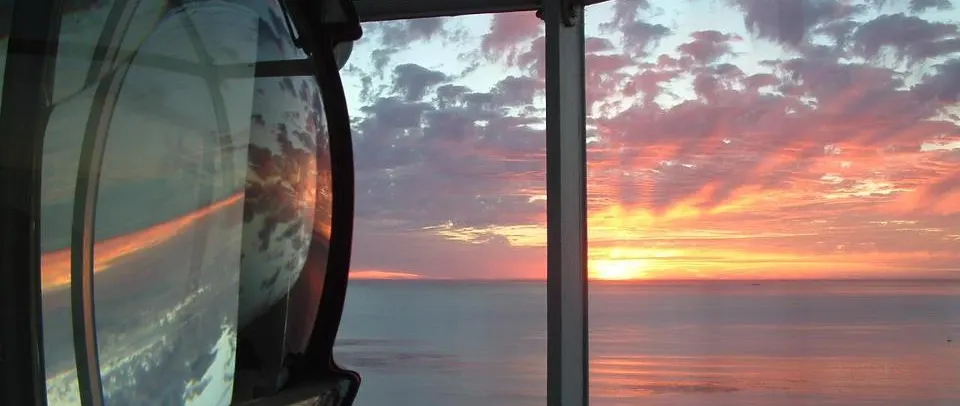
The hero photograph shows the lighthouse at Cabrillo National Monument at sunset. It is an official United States National Park Service photograph, dated 2012 and listed as public domain in the NPS asset catalogue. As with any national park visit, entry, open areas and safety conditions should be confirmed close to the planned date.