A restaurant conceived around the coastal journey
For many travellers, a Mediterranean holiday is remembered through its meals as much as its architecture or landscapes. The smells of a harbour market, the selection of a freshly prepared fish and a long conversation over a shared table can become lasting associations with a destination. The challenge of recreating that character aboard a larger vessel is to establish a meaningful relationship between the cuisine served on board and the places actually visited.
On 17 November 2026, Holland America Line announced plans for Azul, a new speciality restaurant intended to open aboard Oosterdam in autumn 2027. Its concept brings together Mediterranean cooking, a display of fresh ingredients, demonstrations and a dining room developed with London-based SMC Design. It will accommodate seventy guests and is planned for the aft section of Deck 2.
The restaurant is one part of a wider programme of changes to the ship. It is not currently operational, and prospective travellers should distinguish the announcement of its concept from the eventual availability of reservations. The complete menu and the restaurant's pricing arrangements have yet to be released.
For Luxury Yacht Guide readers, the project offers an interesting example of how premium hospitality can draw upon the culinary culture of coastal regions. The setting is a commercial passenger ship rather than a privately chartered yacht, but the emphasis on sourcing, shared meals and the connection with destinations has a broader maritime relevance.
Fish and the enjoyment of a shared table
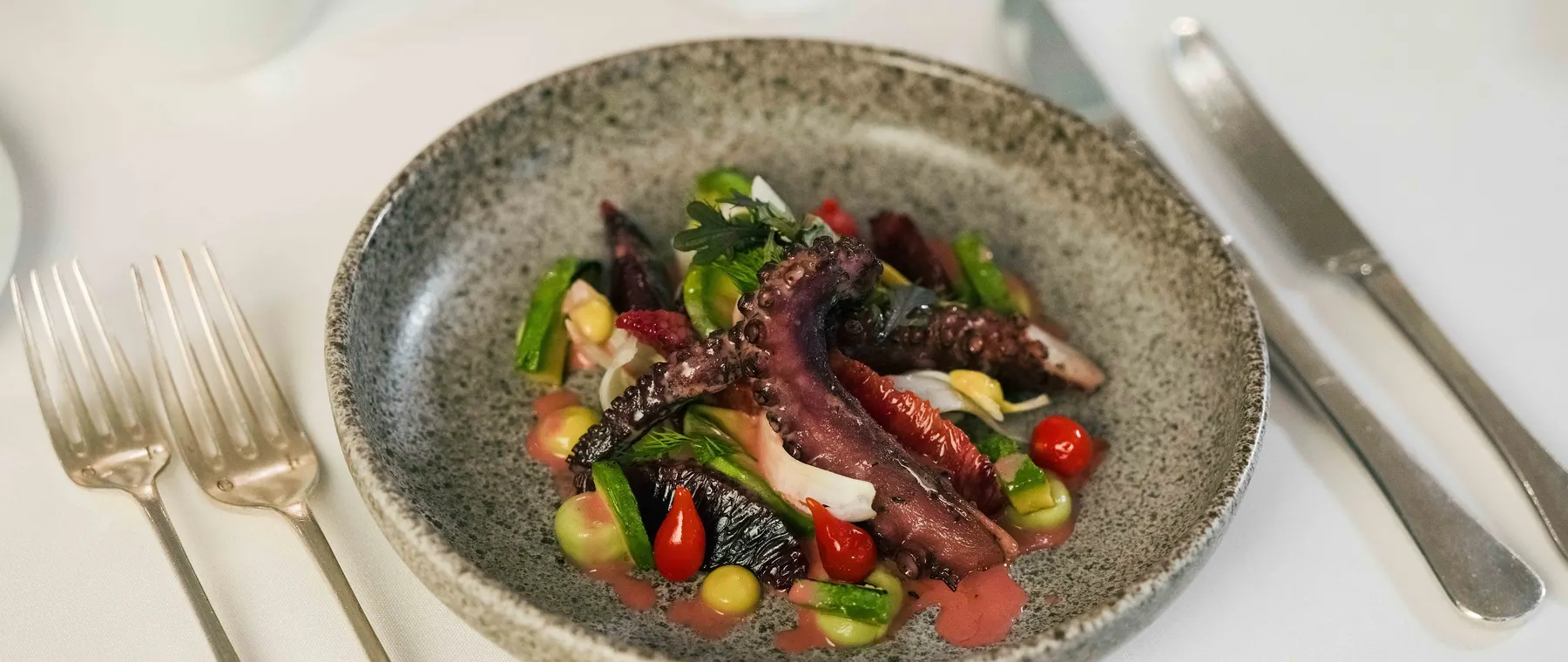
Among the dishes being developed for Azul is whole sea bass intended to be presented at the table. The official photograph released with the announcement depicts another proposed dish based on octopus. The company also plans a bread service accompanied by olive oil, introducing guests to the meal through an ingredient with a longstanding association with many Mediterranean food traditions.
Whole fish can make a particularly sociable centrepiece for a meal because its presentation creates a moment of shared attention. Depending on the service, the fish may be portioned for the diners at the table. Such a meal invites a different rhythm from a succession of individually plated courses, although the complete experience will depend on the actual menu and service arrangements.
Octopus offers another connection with the coastal cuisines of the region. Its treatment varies considerably between different islands and coastal communities, and the version conceived for Azul should be understood as the restaurant's own interpretation. The photograph illustrates how the dish has been styled for the announcement; it does not establish the exact form in which it will be offered once the restaurant opens.
The importance of olive oil extends beyond the simple provision of a condiment. An oil's taste can influence the experience of eating bread, vegetables and fish. The ability to compare different preparations and ingredients is one of the pleasures of travelling through Mediterranean destinations. Holland America has not yet identified individual producers or the origins of every ingredient in its planned menu, so it is too early to assess the restaurant's sourcing at that level of detail.
Bringing the market into the dining room
One of the proposed features is a changing display of fish and other ingredients near the entrance. The company intends this presentation to reflect the produce obtained during the vessel's itinerary. It forms part of the connection with Holland America Line's established Global Fresh Fish Program, which aims to incorporate locally sourced fish into its dining operations.
A harbour market can provide a particularly clear impression of the seasonal character of a destination. The appearance of fish and other produce can also influence the expectations of a diner before a meal begins. A display aboard a ship cannot reproduce every aspect of a working market ashore, but it may help establish a more visible relationship between ingredients and the food eventually prepared from them.
For travellers who enjoy understanding what they eat, the concept could complement visits to restaurants during a voyage. A meal aboard might introduce a preparation that encourages further exploration when the ship reaches another destination. Conversely, a visit to a market ashore could provide some context for a dish offered later in the restaurant.
The precise availability of fresh fish depends on the supply arrangements, season and operating circumstances. The announced programme should not be interpreted as a guarantee that a particular species will be available on every sailing or that every ingredient will originate in the most recent port of call. Guests with dietary requirements should discuss those requirements directly with the restaurant or the operator when the detailed arrangements become available.
A chef's counter and the role of culinary demonstrations
The planned chef's counter is intended to bring diners closer to the preparation and finishing of food. Outside conventional dinner service, Holland America expects the area to accommodate demonstrations, tastings and programmes relating to the regions being visited. Screens will supplement the counter to help visitors observe the activities taking place.
This approach is interesting for guests whose interest in food extends beyond consuming a finished dish. The opportunity to follow the work involved in its preparation can help explain why different ingredients or techniques produce particular textures and flavours. It can also encourage a more attentive appreciation of a relatively simple meal.
A culinary demonstration should offer a different experience from watching the routine service of a busy restaurant. Its value may lie in the opportunity to concentrate on a particular preparation, understand the decisions made by the chef and ask questions where the format permits. Holland America has not yet published a complete programme of sessions or established whether they will require separate reservations or payment.
The concept has potential appeal for couples or small groups with different interests. One person may enjoy the formal restaurant experience while another is more curious about cooking techniques and the relationship between regional ingredients. Bringing those activities into the same setting may offer flexibility, provided the eventual schedules and admission arrangements accommodate them.
For private yacht owners, the underlying idea is also familiar: a meal can become an important part of the day's itinerary when the preparation is connected with the places visited. That does not require an elaborate performance. The quality of the ingredients and the suitability of the experience for the people sharing it remain central.
Design inspired by coastal villages
SMC Design's proposed interior draws on the colours and materials associated with Mediterranean coastal settlements. A light-filled approach leads towards an ingredient display set on a sculpted stone platform. The entrance is planned to incorporate rattan lighting and decorative tiles, while the dining room will include planting, ceramics and contemporary artwork.
The choice of materials suggests an effort to distinguish the restaurant through its atmosphere rather than rely solely on a name or colour scheme. A textured surface can have a visual character that changes under artificial light, while a ceramic object may evoke the handcraft associated with a particular region without requiring the reproduction of a complete historical interior.
Views towards the sea are part of the planned dining experience. The relationship between the interior and the moving landscape outside can be particularly important aboard a passenger vessel. A restrained arrangement of materials and furniture may allow that view to remain a point of interest without competing excessively with the decoration.
The announcement also describes a dedicated bar, adding another social area to the restaurant. It may provide a useful transition between arrival and the meal, although the operational details have not yet been made public.
Readers interested in applying similar ideas to a private vessel should distinguish inspiration from specification. Materials suitable for a residential dining room are not automatically appropriate aboard a yacht. Fixing methods, exposure, cleaning requirements and applicable marine safety standards all need consideration. The proposed Azul interior nevertheless illustrates how architectural detail and a coherent culinary theme can work together to establish a sense of place.
The planned debut and its Mediterranean context
Oosterdam is intended to become the first vessel to complete the initial stage of Holland America Evolution, the company's planned transformation programme for its Vista and Signature Class ships. The first voyage following the changes is scheduled to depart Civitavecchia on 31 October 2027, travelling to Trieste over ten days. The operator identifies destinations in Italy, Greece, Montenegro and Croatia among its planned calls.
That itinerary gives the new restaurant a particularly relevant geographical setting. The cuisines encountered around the Adriatic, the Greek islands and Italy offer differing expressions of coastal cooking rather than one uniform Mediterranean style. Travellers who enjoy discovering those distinctions may find that time ashore contributes as much to their understanding of the restaurant's concept as the meals served aboard.
The cruise schedule will determine the time available for exploring individual ports. Guests should examine the detailed itinerary rather than assume that a particular market or restaurant can be visited during every call. The arrangements for embarkation at Civitavecchia also need consideration when planning additional accommodation or flights involving Rome.
At present, Azul's full menu, speciality dining charges and reservation conditions remain to be announced. The November release confirms the proposed size, design and culinary direction of the venue, not a final operational programme. The official food photograph accompanying this report depicts a planned octopus preparation rather than documenting service at an already opened restaurant.
For travellers who value a connection between gastronomy and the character of a coastline, the development is worth following as the 2027 refit progresses. Its most interesting proposition is the opportunity to bring the food culture of the places visited into the ordinary rhythm of life aboard a ship.
Sources and lead image
Source documentation: https://www.prnewswire.com/news-releases/holland-america-line-reveals-azul-a-new-mediterranean-restaurant-and-culinary-experience-for-oosterdam-302941608.html. Lead image: Mediterranean-inspired octopus dish developed for the planned Azul restaurant — Holland America Line, official food photograph accompanying its 17 November 2026 announcement; the restaurant is scheduled to open in 2027.. Official issuer-supplied press photograph, reproduced for editorial coverage of the specific announcement and resized for web display.