A design exhibition built around two ways of inhabiting the world
ABITO/HK opens a conversation between fashion and interior design at DesignInspire in the Hong Kong Convention and Exhibition Centre. Running from 18 to 21 November 2026, the exhibition forms part of the international programme of Salone del Mobile.Milano. It follows the presentation of ABITO at the Milan furniture fair in April and brings the original curatorial concept into dialogue with designers working in Hong Kong.
The project is organised and promoted by Italy's Ministry of Foreign Affairs and International Cooperation, working with Salone del Mobile.Milano and local partners. Curators Ludovica Serafini and Roberto Palomba of Palomba Serafini Associati have assembled historic clothing from the Quinto Tinarelli Collection alongside Italian furniture that remains in production. Selected works by Hong Kong designers occupy a separate but connected position within the installation.
The particular interest of the exhibition lies in this comparison between objects made for the body and objects made for the spaces in which people live. For Luxury Yacht Guide readers who take an interest in the development of interiors and fashion, the exhibition provides a way to explore how those disciplines reflect different aspects of the same social history.
Bringing the Milan concept to Hong Kong
The international tour extends the work of the Milan exhibition beyond its original setting. The Hong Kong edition is not simply a reconstruction of the installation presented in April. It introduces local creative work into the wider historical account, encouraging visitors to consider the connections and distinctions between Italian and Hong Kong design.
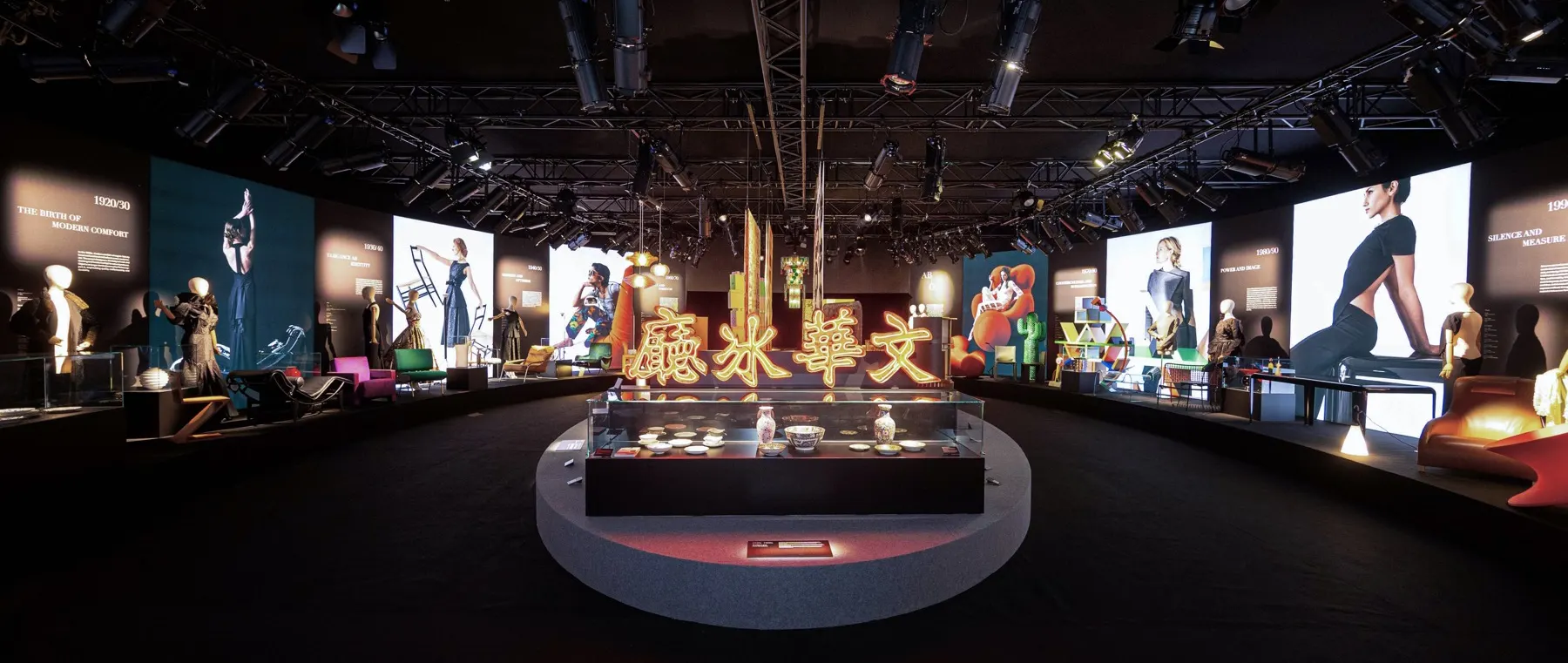
The official photographs show an oval installation with exhibits distributed around its perimeter and a central area devoted to the dialogue with local creative practices. The dark surrounding space directs attention towards the individual objects and their illuminated settings. This arrangement allows the designers to present distinct groups of pieces within a larger continuous experience.
The layout is important because an exhibition that incorporates historic garments and furniture can be encountered in several ways. A visitor may concentrate on the chronological development of the clothing, compare the construction of individual objects or consider the ways in which the two categories have acquired different cultural meanings. Locating them together provides opportunities that would not necessarily arise from displaying them in separate institutions.
From historic dress to contemporary furniture
The garments selected from the Quinto Tinarelli Collection span more than a century of fashion history. Their arrangement alongside Italian furniture and design objects establishes a particular contrast: the clothes are historic objects, whereas the furniture includes designs that can still be produced today.
That difference is central to the curators' approach. A garment can preserve evidence of the way it was made and used during a specific period. Its silhouette, construction and decorative treatment may reflect the activities and expectations of the society in which its wearer lived. Furniture can carry similar information, but a design that remains in production also continues to enter contemporary homes.
The continued production of an object does not necessarily mean it has been unchanged in every respect. Materials, manufacturing techniques and the requirements of contemporary customers can evolve. A piece that appears familiar may therefore embody a relationship between an original design and the decisions made by the people who continue to manufacture it.
An informed visitor can consider how those qualities influence the value of historic and contemporary pieces. The rarity of a particular historic garment depends on the object and its history, while the interest of a current furniture design may lie in its enduring usefulness or visual character. Both can carry cultural significance without having the same relationship to age or rarity.
Clothing and the evolution of everyday life
The exhibition's historical narrative pays particular attention to changing opportunities for women to participate in public life and move through different environments. Clothing can provide tangible evidence of those developments, although individual garments must be understood within the context of their wearer and period.
The construction of clothing influences movement, comfort and appearance. Changes to the form of a garment can reflect different expectations about the way a person spends the day, whether at work, at a social engagement or travelling between locations. Interior design faces related questions. A home arranged around formal entertaining may differ from one in which rooms need to support several activities during the day.
Putting these objects in conversation does not require every furniture design to have a direct connection with the garment beside it. Rather, the juxtaposition offers a way to consider how people have inhabited their bodies and surroundings at different times.
For those interested in yacht interiors, this is a particularly relevant aspect of the exhibition. A yacht's accommodation must often fulfil several functions within a limited volume. Furniture arrangements, materials and the movement of occupants through the interior can be fundamental to the experience of the vessel. Historical design can provide inspiration, but the suitability of any object for a marine environment needs to be established separately.
Between artisanal work and wider manufacture
Palomba Serafini Associati has also used the exhibition to explore two important shifts: from artisanal furniture production towards industrial manufacture, and from individually constructed couture towards ready-to-wear fashion. Neither development eliminates the importance of craftsmanship. Instead, they alter the circumstances in which creative ideas can reach a larger number of people.
In furniture design, the possibility of producing a consistent object repeatedly can influence how its components are arranged and assembled. It may also encourage the designer to consider the resources, tools and knowledge necessary to maintain the quality of the finished piece. Fashion designers face related decisions about sizing, materials and the translation of an original concept into garments intended for different wearers.
The continued relevance of older objects suggests that innovation cannot be measured by novelty alone. A design may remain useful and attractive because its proportions, construction or relationship with everyday activity continue to make sense. Its appeal should be considered in light of those qualities rather than simply the date in which it was first developed.
For a collector or interior designer choosing contemporary pieces, the question is how those objects will contribute to a living space over time. A design's ability to operate within different settings may be more significant than its popularity during a particular season.
Hong Kong's contribution
The addition of works by local creative practitioners provides another perspective on the curatorial theme. The Hong Kong component occupies the central area of the installation, establishing a deliberate point of exchange with the Italian objects in the surrounding space. It gives the exhibition relevance to the creative community that is hosting it, rather than presenting international design as a one-way transfer of ideas.
The programme includes conversations about the relationship between design, cultural identity and commercial opportunities. The organising institutions have also scheduled the presentation of the next Salone del Mobile.Milano, due to take place from 13 to 18 April 2027 at Fiera Milano in Rho. The forthcoming Milan edition is intended to include the return of Euroluce and the introduction of Salone Contract, a platform addressing major interior projects across several sectors, including marine interiors.
The latter is especially relevant to yacht designers, because it provides a context in which suppliers can discuss the requirements of projects with architects and commissioning clients. The announced platform is a future event and individual participation or product availability should be confirmed when the detailed programme is published.
Visiting the exhibition
ABITO/HK is being presented at DesignInspire in Wan Chai. The opening session on 18 November was designated for trade visitors, while the remaining days from 19 to 21 November admit trade and general visitors under the organiser's arrangements. Anyone considering a visit should consult DesignInspire for admission procedures and the current programme.
The interest of the exhibition extends beyond the individual objects on display. Its structure invites visitors to consider the relationship between craftsmanship, industrial production, social history and the possibilities of contemporary design. The setting in Hong Kong gives the original Italian concept another context in which to be interpreted. For readers interested in the objects that shape everyday life on land and aboard yachts, it offers an opportunity to examine how familiar design forms emerge, persist and acquire new meanings.
Sources and lead image
Source documentation: https://areapress.salonemilano.it/26_18_november_en/Press_Release_SalonedelMobile.Milano_International_Tour_ABITO_HongKong.pdf. Lead image: ABITO/HK at DesignInspire, Hong Kong Convention and Exhibition Centre — ABITO/HK, curation and installation by Palomba Serafini Associati, produced and promoted by the Italian Ministry of Foreign Affairs and International Cooperation in collaboration with Salone del Mobile.Milano. Official press photograph supplied in Images and captions package, editorial use expressly permitted.. Official issuer-supplied press photograph, reproduced for editorial coverage of the specific announcement and resized for web display.