A Hudson River redevelopment plan takes shape
Suntex Marinas has announced plans to redevelop Lincoln Harbor Marina in Weehawken, New Jersey, proposing a facility with 248 wet slips for vessels ranging from approximately 36 to 110 feet. The company released details in November 2026, placing the project within a wider programme of marina improvements and waterfront investment. The proposed average berth length is around 45 feet, meaning many slips would suit the 12–24-metre cruising-yacht market that Luxury Yacht Guide covers. The plans include a marina office and customer facilities such as restrooms and showers. They do not establish that 248 new slips are already open, that every proposed berth is available for reservation or that construction has been completed. Suntex's illustrations are explicitly conceptual and may change as the project develops. For owners contemplating a base near New York City, the news is relevant because suitable marina infrastructure can influence where a yacht is kept, how it is serviced and how frequently it is used. The practical questions extend beyond the number of berths on a drawing.
Why the location matters to yacht owners
Weehawken sits across the Hudson River from Manhattan, in a busy waterfront area with a mixture of commercial traffic, ferries, recreational vessels and working harbour facilities. A berth there may appeal to owners who want access to New York City and the region's coastal cruising destinations. But proximity to a major city is only one part of berth suitability. Skippers must understand traffic routes, local rules, currents and the practical limitations of a particular marina entrance. A short distance on a map can represent a more demanding manoeuvre than the same distance in a quiet sheltered bay. Owners should consider how often they expect to move the yacht and at what times of day they will arrive or depart. Weekend traffic, commercial movements and changes in weather can affect the experience. A desirable city view does not eliminate the need for safe navigation and a berth that suits the vessel's actual dimensions.
What Suntex has publicly proposed
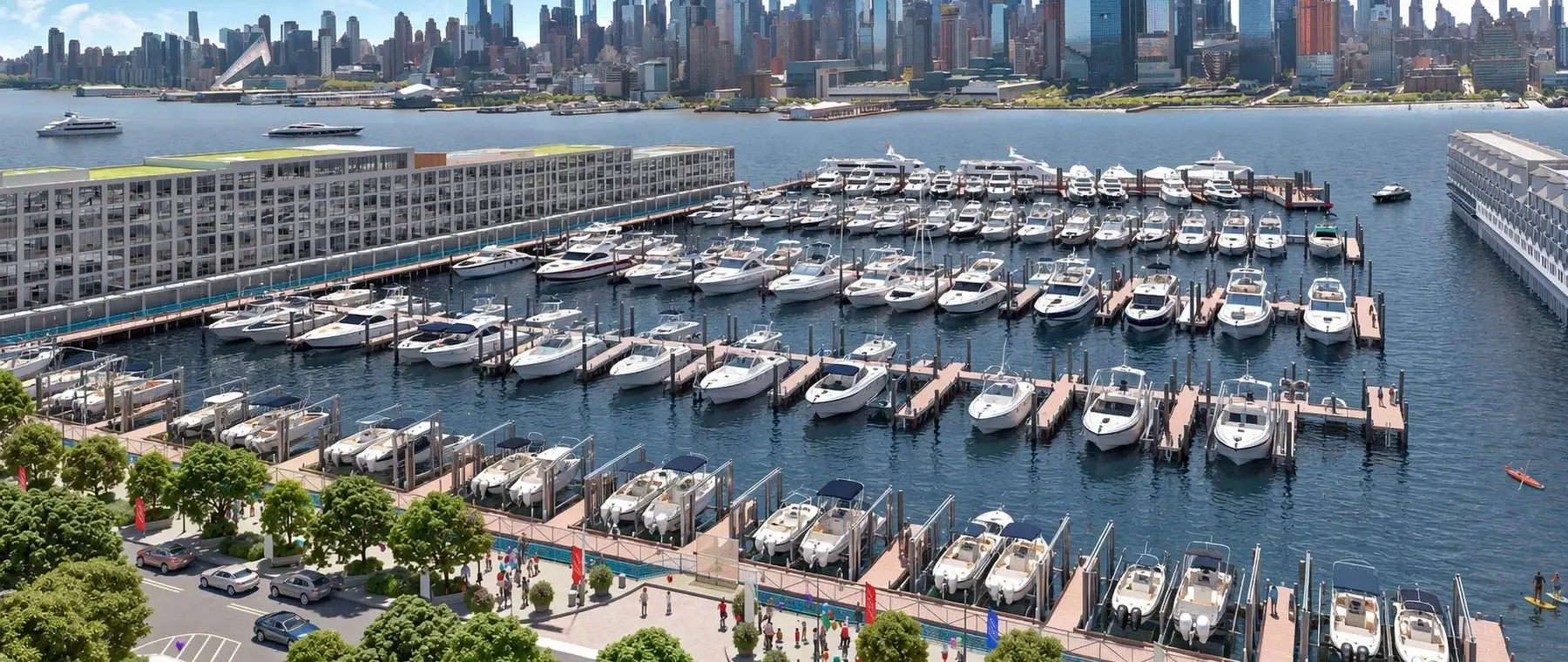
The November announcement identifies 248 wet slips accommodating boats between 36 and 110 feet, with an average length of about 45 feet. It also describes a marina office and customer facilities, including showers and restrooms, as elements of the intended redevelopment. These are planning details, not independently inspected completed amenities. The company has released a conceptual rendering to illustrate the intended direction. That image should not be used as proof of the final layout, construction materials or exact location of individual slips. The public announcement does not by itself provide a complete price list, guaranteed completion date or berth allocation policy. Owners should seek written information from the marina operator before making decisions about relocating a yacht. In particular, a slip described by its nominal length may not accommodate every vessel with that overall dimension. Width, draft, overhangs, dock geometry and utility connections can be equally important.
The difference between overall length and berth fit
Marina planners and owners often refer to a boat's length as though it were a single unambiguous measurement. In reality, overall length may include fixed swim platforms, outboard engines, bow fittings or other projections beyond the hull. The beam can also govern slip suitability, especially for catamarans or wide-beam motor yachts. A 45-foot average berth length says relatively little about the number of slips suitable for a particular sixteen-metre vessel. Prospective customers should provide the marina with a current measurement of the actual boat, including appendages, and request confirmation of allowable beam and draft. Shore-power needs should be discussed in the same conversation. A yacht with substantial domestic electrical loads may require a connection that not every pedestal provides. If the redevelopment moves forward, precise slip specifications and utility ratings will matter more to the owner than the overall project capacity.
Hudson River currents and manoeuvring
A berth on the Hudson calls for practical attention to the local current regime. A vessel can behave differently when approaching a fairway with current across the stern or moving toward a pontoon in a gusty crosswind. The skipper should study the local navigation publications and obtain guidance from experienced marina staff. A powerful bow thruster can assist, but it cannot replace an understanding of the forces acting on the vessel. Boats with high topsides or large flybridges may be particularly sensitive to wind. It is sensible to practise manoeuvres in the actual operating area with appropriate supervision, especially after moving from a more sheltered home marina. Line-handling arrangements should suit the direction of the usual current and the expected tidal movement. A planned redevelopment can improve dock infrastructure, but its eventual effectiveness for a given yacht will depend on the marina's real layout and the safety arrangements implemented.
Access to New York's wider cruising waters
The Hudson River location can be attractive as a starting point for journeys within the New York metropolitan waterways and toward the Atlantic coast. Owners may consider seasonal trips along nearby coastal areas or an itinerary involving multiple marinas. Those ambitions require an understanding of navigation restrictions, bridge clearances where relevant, weather conditions and available fuel or service stops. A yacht that is ideal for short harbour excursions may need additional equipment or crew preparation before heading offshore. Owners should not regard a city-centre berth as proof that every regional destination is convenient in all seasons. A realistic operating plan should include estimated passage durations, appropriate weather windows and alternate ports in case conditions change. The practical merit of the proposed facility will depend partly on how well it connects owners to dependable services and safe routes, not only on the quality of the docks themselves.
Services can determine the real value of a berth
A modern marina is more than a place to secure mooring lines. Owners may need routine cleaning, mechanical service, waste handling, reliable water, communications and competent assistance when problems arise. Suntex's announcement names customer facilities and a marina office but does not specify every future service or price. Buyers should therefore avoid assuming that an illustrated waterfront includes fuel supply, lifting equipment or dedicated technical workshops unless the operator confirms them. A marina can provide valuable convenience even when major maintenance must be arranged elsewhere, provided the routes to those service providers are clear. For a yacht used regularly by a family, predictable access, helpful staff and reliable utilities can matter more than decorative landscaping. Operators should also explain emergency arrangements, storm preparedness and how berth holders will be contacted if urgent action is required.
Marina redevelopment and construction disruption
Redeveloping a working waterfront can involve phases during which access or services change. The published concept does not establish a construction schedule, so owners should not assume that a particular dock or entrance will remain unaffected at all times. Anyone currently using the area should obtain direct information from the operator about planned works and arrangements for vessels during construction. Temporary slips, utility interruptions or restricted access can be manageable if communicated early. They can also cause serious inconvenience when a yacht is being prepared for a holiday or requires service. A prospective long-term berth holder should ask whether written contracts will address construction-related disruption and what notice the marina will provide. Such questions are not criticism of the project; they reflect normal due diligence whenever a facility is being extensively changed. The final benefit of redevelopment depends on the transition being managed as well as the eventual infrastructure.
Environmental and waterfront considerations
Marinas operate where land-based infrastructure meets a sensitive aquatic environment. Redevelopment proposals can create opportunities to improve waste systems, dock materials, stormwater management and the way vessels connect to shore utilities. The exact environmental measures for Lincoln Harbor should be judged against the operator's published plans and applicable permits, not inferred from general sustainability language. Owners can nevertheless ask useful questions about waste reception, fuel-spill response, water quality and storm resilience. A shore-power connection may reduce the need to run onboard generators while berthed, but the actual benefit depends on the electrical system and the source of supplied energy. Responsible boating also requires individual habits, including correct sewage handling and avoiding inappropriate discharge. An attractive waterfront design should be accompanied by dependable procedures. The long-term quality of a marina is determined by its maintenance and operating standards after construction is complete.
The commercial value of a New York-area marina
A waterfront berth near a major metropolitan centre can carry a different commercial proposition from a marina in a less densely populated cruising area. Owners may value access to restaurants, cultural venues or transport connections, while marina operators must balance demand, staffing and infrastructure costs. The Suntex proposal does not include a verified public rate schedule for the completed slips, and it would be misleading to invent one. A prospective customer should obtain a written quotation covering annual or seasonal rent, deposits, electricity, water, parking, security arrangements and any other charges. Contract conditions relating to early departure, transfer or vessel changes should also be examined. For boat owners considering occasional charter use, commercial permissions and insurance must be addressed separately from ordinary private berthing. The presence of 248 planned slips does not imply unrestricted commercial operations or a guaranteed berth for every interested operator.
What the proposed slip range suggests
The span from 36 to 110 feet indicates that the planned marina is intended for more than one kind of boat. The lower end includes larger dayboats and smaller cruisers, while the upper end reaches substantial private yachts. This variety can be useful in attracting a broad boating community, but it may also create operational needs related to different power supplies, manoeuvring space and service expectations. A marina that serves both relatively compact boats and larger motor yachts needs clear procedures for arrivals, departures and dock assistance. Owners should ask how fairways and turning basins will be arranged for the final slip configuration. Because the public image is conceptual, these dimensions should not be inferred from visual appearance alone. A technically detailed marina plan and a berth allocation schedule will be more useful once the operator publishes them. The development's relevance to the luxury-yacht market is therefore substantial, but its exact capacity for each vessel size remains to be confirmed.
How to assess the project before committing
Owners considering Lincoln Harbor should begin with the official Suntex announcement and contact the operator for current details. Provide the yacht's overall length, beam, draft, power requirements and intended period of use. Ask which aspects of the proposed design are approved, what amenities are expected to be available at the intended occupancy date and whether any construction-stage restrictions apply. It is also sensible to visit the existing waterfront in person, observe the navigation environment and speak to marina staff about local conditions. A berth decision should consider insurance requirements and the location of the nearest suitable repair and lifting facilities. If a long-term contract is offered before all redevelopment details are finalised, its provisions should be reviewed carefully. The goal is to understand what the marina can guarantee, not merely what a concept illustration suggests.
What this November announcement establishes
Suntex's November 2026 release confirms a proposal to modernise Lincoln Harbor Marina with 248 planned wet slips, a broad boat-length range and customer facilities. It is a meaningful development for owners who need berthing in the Hudson River area, but the distinction between future capacity and currently available services must remain clear. The company's conceptual drawing is useful for showing ambition and overall direction, not as an as-built survey. As additional permits, construction milestones and opening information are announced, the project can be assessed against increasingly concrete evidence. For Luxury Yacht Guide readers, the central lesson is that location, slip fit, utilities and operational support should be evaluated together. A marina is a long-term part of yacht ownership, and its practical value is created by reliable daily service rather than by an impressive rendering alone.
Official source and conceptual illustration
Project dimensions, location and the planned facilities are stated in Suntex Marinas' November 2026 Lincoln Harbor redevelopment announcement. The lead image is the company's official **conceptual rendering of the proposed redeveloped marina**, issued with the announcement. It is not a photograph of a completed project and does not guarantee final features, dimensions or finishes. Credit: Suntex Marinas, official Lincoln Harbor redevelopment concept visual. Copyright and any promotional-use rights remain with Suntex or the original design firm. It is reproduced solely for independent editorial reporting of the planning announcement.