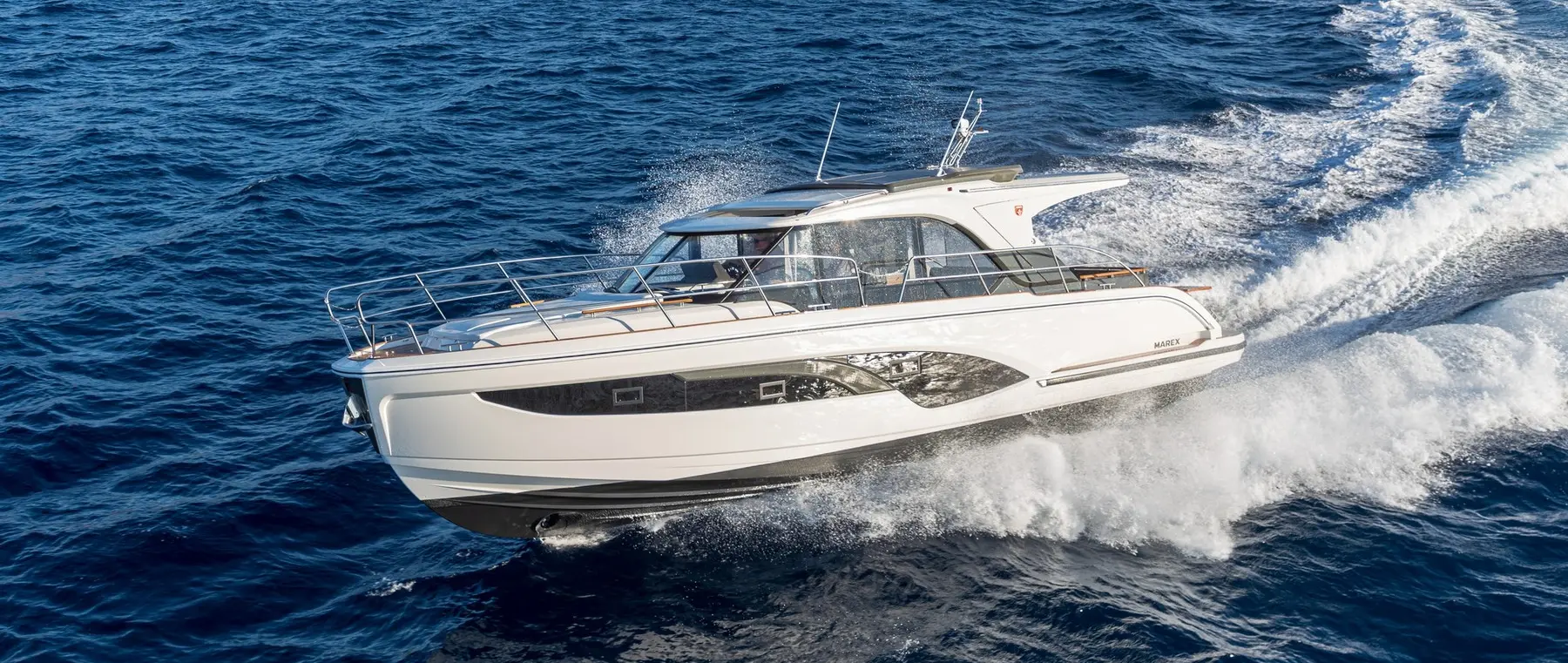
A family cruiser enters a useful size category
Marex's 390 gives the Scandinavian builder a new twelve-metre cruising platform between its smaller family boats and the larger 440 series. The model is presented as the fourth generation of an established concept, with owner feedback helping determine the proportions, storage and movement around the boat. Rather than pursuing novelty through dramatic styling alone, the design concentrates on a sheltered family cruiser that can alternate between an open, sociable summer layout and more protected travelling conditions.
The specification published by Marex lists an overall length of 12.00 metres, a beam of 3.72 metres and a draught of approximately 1.03 metres. Those dimensions put it at the entry to the Luxury Yacht Guide's core 12-to-24-metre range, where buyers frequently seek genuine cruising accommodation without committing to a much larger crewed yacht. Size alone does not answer whether it suits a family, but it establishes the physical envelope of the onboard design.
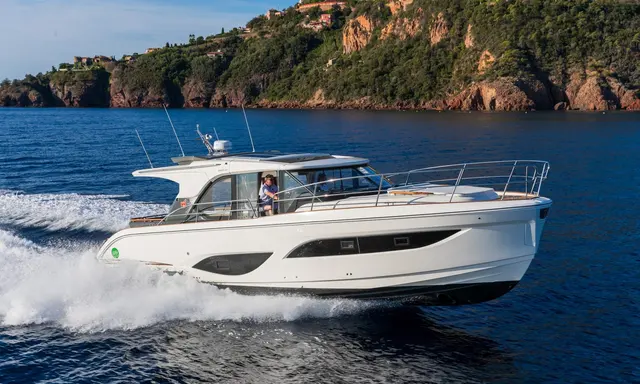
Marex says the concept was developed with VOM Creations and Alpha Engineering, with a variable-V hull form intended to balance performance and efficiency. A wide band of glazing along the hull brightens the accommodation, while the superstructure aims to connect the salon and cockpit. These are specific design choices that can be assessed during a viewing: how much daylight reaches the cabins, how readily people move between decks and where belongings can be stored securely.
The company's own account of the model's development emphasises practical feedback from existing owners. That is relevant because family cruisers often succeed or disappoint in minor tasks rather than the headline sea trial. A sensible buyer should examine locker openings, places to stow fenders, access to service items and the ergonomics of the helm before treating the published living-area drawings as the full story.
Cockpit and salon work together
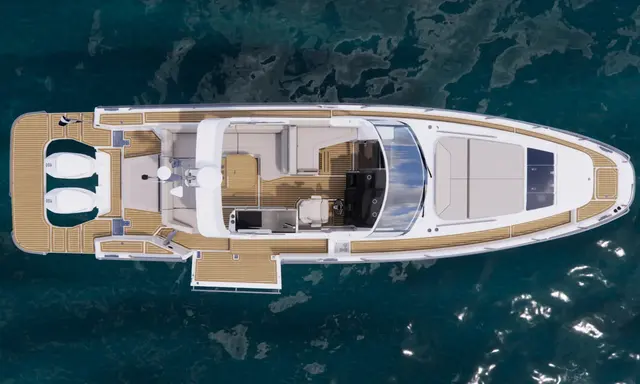
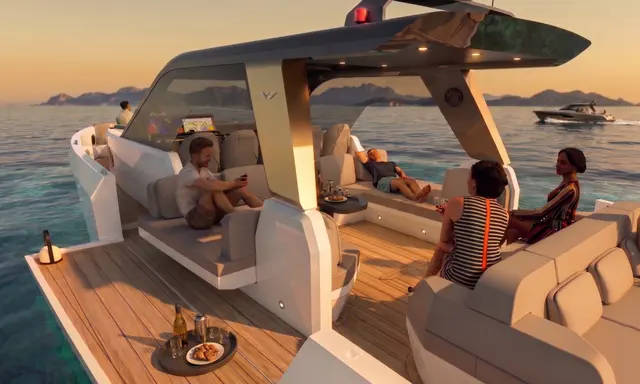
One of the 390's central ideas is a cockpit arranged for shared meals and time with family or friends. Wraparound seating and an extendable table form the core, while a sliding door and an electrically operated window connect the outside area with the salon. This arrangement allows people preparing food, steering or relaxing to remain part of the same conversation without placing everyone in one crowded compartment.
The transition between spaces matters on a cool or windy passage. It should be possible to close the salon quickly, maintain clear sightlines and keep guests sheltered without dismantling the entire living arrangement. For summer use, the same openings may turn the boat into a flowing indoor-outdoor platform, particularly when travelling between short coastal stops.
Inside, the manufacturer describes a reversible sofa backrest and extendable table that can create a U-shaped dining space. A pull-out stool offers an additional flexible seat or footrest, reflecting the sort of small design detail that can make a twelve-metre cruiser pleasant during long afternoons aboard. Buyers should verify how circulation works with every seat occupied and the table fully extended, as showroom flexibility can sometimes disguise a narrow passage.
The vessel is also designed for cruising rather than entertainment alone. Side access around the helm, secure movement between deck areas and adequate places for wet clothing are part of the practical assessment. A family spending several weekends aboard may find such considerations more valuable than adding another decorative finish that requires careful protection.
Accommodation for four, with flexibility
The factory specification gives two principal cabins with four normal berths and the possibility of accommodating two more people depending on the layout. A midship cabin arrangement incorporates additional practical storage, while the forward cabin provides a private sleeping area. The useful question for families is not only how many people can technically sleep aboard but whether those people can maintain privacy and reach the bathroom without repeatedly disturbing others.
Interior headroom and the amount of natural light need to be tested in person. Marex has made enlarged glazing part of the design story, but the experience will vary between the forward cabin, midship room and seating area. Prospective owners should also check ventilation, access to the berths and whether mattresses can be serviced or replaced without dismantling surrounding furniture.
According to the yard, freshwater capacity is approximately 590 litres, with a 380-litre black-water tank and a 60-litre hot-water system in the published technical description. These volumes support a practical touring brief, though effective endurance also depends on showers, cooking habits, marina facilities and the number of guests. A yacht with ample freshwater still requires thoughtful waste handling and familiarity with local discharge rules.
The published design category is CE B, indicating the intended certification category of the yacht rather than a blanket promise about comfort in every forecast. A skipper should still consider crew experience, alternate shelter and the limits of passengers when planning a longer coastwise trip. Comfort depends heavily on route and conditions, even aboard a capable cruiser of this size.
Propulsion choices and the operating brief
Marex lists several Volvo Penta twin-engine alternatives, including D4-320 sterndrives and D6-440 configurations, as well as V-drive choices. The best solution will depend on intended speed, local maintenance support, fuel economy, steering characteristics and berth arrangements. Different engines and drives may have a meaningful effect on installation layout and long-term costs, so a buyer should compare like-for-like specifications.
A fuel capacity of approximately 1,000 litres provides the basis for longer runs, but useful range must be calculated from the actual propulsion package and reliable consumption figures. The boat's approximate dry and full-load displacements are substantially different, at about 11.8 and 14.8 tonnes respectively. That gap illustrates why performance claims measured on a lightly loaded demonstration vessel may not match a holiday cruise with supplies and several people aboard.
Before an order is finalised, owners should assess engine-room access, electrical systems, heating arrangements and how easily the aft cockpit can be enclosed during cooler months. The 390's concept lends itself to year-round use in northern climates as well as Mediterranean summer boating, but the ideal equipment package is unlikely to be identical for both. Ventilation and weather protection deserve serious attention alongside speed.
The Marex 390 ultimately makes an argument for spending the extra length on everyday usability. It seeks to keep dining, helm, deck circulation and accommodation connected in a layout that works during ordinary family life rather than a formal yacht showcase. With a measured sea trial and a carefully specified propulsion system, it can be assessed on the practical criteria that matter most for twelve-metre ownership.