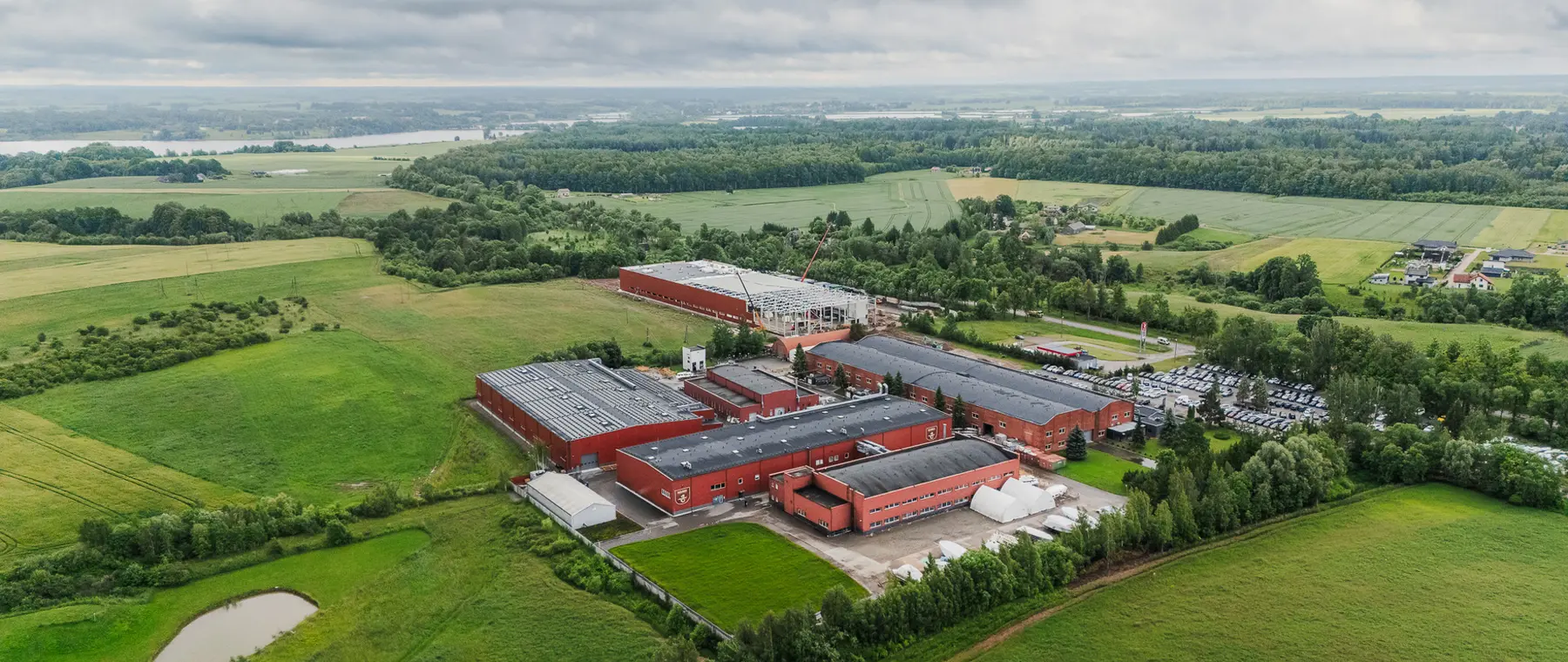
Marex Boats is investing €20 million in a new 11,000-square-metre production facility in Kaunas, Lithuania, expanding the Norwegian brand’s manufacturing base as it prepares for larger and more complex yacht models. The factory is scheduled to open in winter 2027 beside Marex’s existing 28,000-square-metre operation.
The project combines additional assembly space with automated warehousing, renewable-energy systems and a 50-metre testing pool. Marex says the new site will be able to handle three-deck yachts approaching 55 feet while creating capacity for future growth without abandoning its existing Kaunas production infrastructure.
Production space is designed around larger yachts
The new factory is being planned to support boats approaching 55 feet and three decks, a step up in physical scale from much of Marex’s established range. Larger yachts require more assembly height, heavier handling equipment and wider access around hulls, so factory design becomes part of product strategy rather than just a question of floor area.
Building that capability next to the existing plant should allow Marex to share staff, suppliers and technical knowledge between the two sites. It also gives the company room to grow without trying to force larger products through production spaces designed for smaller boats.
Automated storage shortens material movement
Marex plans to install Compact Twin automated warehouse systems, reducing the floor area needed for component storage and bringing parts to production teams more efficiently. On a boatbuilding line, time lost searching for or moving components can accumulate quickly across hundreds of fittings and subassemblies.
Automation does not remove the craft element of yacht building, but it can make the surrounding logistics more predictable. Better parts control may also improve traceability, which becomes increasingly important as electrical, plumbing and interior systems grow more complex.
Energy systems are built into the expansion
The facility will use a 350kW solar installation and a 222kW Viessmann geothermal system as part of its energy strategy. Marex is also including a 50-metre test pool, allowing completed boats and onboard systems to be checked on site before delivery or further sea trials.
Integrating energy and testing infrastructure at the construction stage is generally more effective than adding it later. The test pool in particular can reduce the number of basic commissioning issues that need to be discovered after a yacht has left the production environment.
The investment points toward the next Marex range
Marex says the expansion could create up to 100 jobs and includes a dedicated showroom alongside the manufacturing areas. The scale of the investment suggests the company is preparing not simply for higher volume, but for a broader product mix that includes larger yachts.
For buyers, the significance will become clearer when the next models reach production. A modernised factory can improve consistency and capacity, but the important measure remains whether those gains translate into better-finished boats, reliable delivery schedules and strong after-sales support.