Leopard Catamarans has placed owner conversations rather than an announced fleet of boats at the centre of its Paris Nautic Show programme, which runs at Paris-Le Bourget from 25 to 29 November 2026. The builder's official event information invites prospective purchasers to meet its specialists, discuss the present sailing and power-catamaran ranges, explore availability and arrange possible private viewings or sea trials in the South of France after the show. That is a useful distinction for anyone planning to purchase a cruising yacht: a consultation at an exhibition is not the same as stepping aboard a confirmed display vessel. The Paris announcement does not name a specific Leopard model as physically on show. Buyers should not infer a marina display, immediate delivery or a fixed purchase price from the event notice. For the 12-to-23.99-metre owner who is still weighing layouts and cruising programmes, however, a focused meeting can establish the questions that really need answering before a survey, sea trial or contract.
What Leopard is actually offering in Paris
The company's published event page identifies the Paris-Le Bourget Exhibition Centre and the five days from 25 to 29 November, while inviting visitors to make appointments with its team. It frames the meeting as a chance to ask about sailing and motor catamarans, current model availability, ownership possibilities and intended cruising patterns. The page also refers to arranging a separate viewing or sea trial at one of its South of France locations after the exhibition. What it does not do is verify which, if any, full-size yachts are on display in the hall. That absence matters. A purchaser who travels specifically to inspect machinery access, cabin dimensions or a flybridge should seek written confirmation of the particular hull available for inspection. A discussion with a sales specialist can narrow choices, but meaningful purchasing diligence still requires actual boats, actual specifications and comparable written quotations.
Start with the cruising mission, not the badge
The first question in a yacht-buying consultation should be how the vessel will be used. The owner who wants short Mediterranean passages, large shaded entertaining areas and frequent marina visits has a different operating profile from a family intending to cross seas or spend long periods at anchor. Sailing and power catamarans offer different patterns of speed, fuel consumption, rigging, service and crew workload. Even within one category, layout options influence privacy, ventilation, stowage and the ability to carry additional guests without sacrificing access to machinery. Leopard's Paris programme explicitly covers its sailing and power ranges, so a useful appointment should compare the owner’s own passage distances, typical berth restrictions, preferred destinations and desired time underway. A marketing phrase such as long-range cruising means little until the owner asks for the actual conditions and assumptions behind the projected range or daily energy balance.
What the Leopard 46 reveals about configuration choices
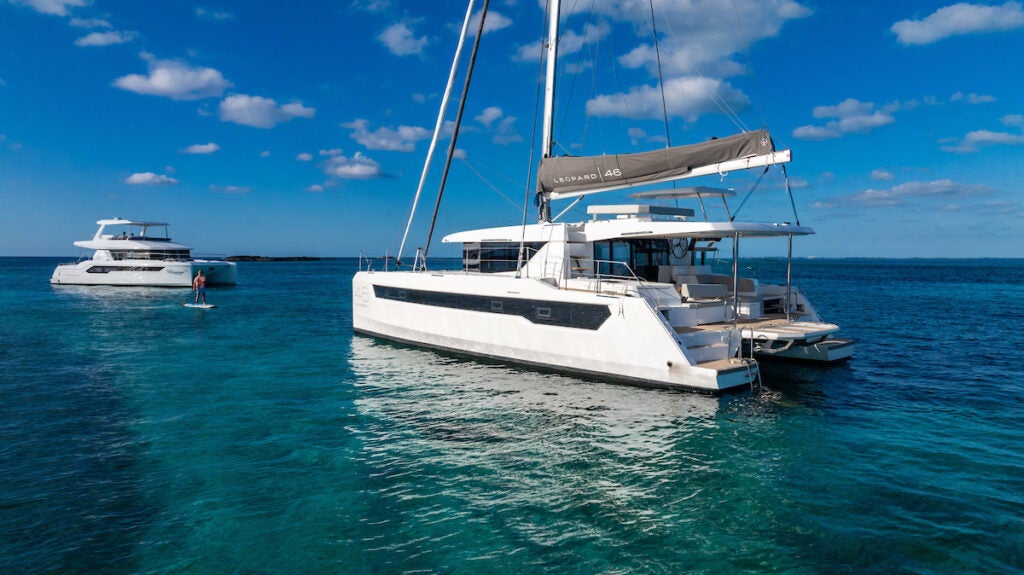
Leopard's official technical description of its 46 sailing catamaran illustrates the way decisions become interconnected. The builder describes refinements to the connection between aft cockpit and saloon and multiple accommodation arrangements, including three-cabin, four-cabin and five-cabin variants. It also lists standard twin Yanmar diesel engines, more powerful alternatives and an optional hybrid-electric drive system. Those published options show why an owner cannot simply request a generic price for a '46'. The best cabin plan for a private family may be a poor fit for charter-style occupancy, while storage that is adequate for coastal weekends might be inadequate for extended offshore cruising. Electrical storage, propulsion architecture and equipment specifications can change cost, weight and maintenance needs. Prospective buyers should request a dimensioned general arrangement plan and a clearly dated specification for the exact build slot under consideration.
Sail or power: different decisions after the sale
The sailing-versus-power decision is not merely a matter of personal taste. Sailing owners should assess sail-handling arrangements, protected helm positions, rigging maintenance, deck movement and how the yacht behaves when the apparent wind changes. Power-catamaran buyers need detailed information on propulsion access, generator operation, fuel capacity, reserve policy and service support. Both groups should review bridge-deck clearance, noise at sea, motion at anchor and the practicality of docking a wide-beam vessel in a crowded harbour. It is useful to compare a typical day's passage rather than a brochure’s best-case performance figure. How many hours will actually be spent motoring? Where will people sit underway? Can one person safely handle anchoring or lines while another remains at the helm? Good owner planning turns an abstract choice between product ranges into a set of operational requirements.
The sea trial should answer difficult questions
Leopard indicates that its team can help arrange private viewings or sea trials at South of France locations following the Paris exhibition. Those appointments deserve a proper written plan. A buyer should seek a vessel representative of the proposed configuration and make clear which areas must be inspected, from bilge access and engine rooms to accommodation at night. During a sea trial, note wind, sea state, displacement, fuel carried and engine settings before drawing conclusions about speed or noise. Test visibility from the chosen helm and check whether people can move safely around the boat while under way. Verify the handling of lines, controls and anchoring systems rather than watching only a salesperson demonstrate them. Where a sea trial cannot include all intended conditions, ask for documentary test evidence and a further inspection rather than filling the gaps with assumptions.
Hybrid propulsion requires a systems conversation
Optional electrical or hybrid equipment deserves more scrutiny than an attractive badge on a specification sheet. An owner considering such a configuration needs to know what powers propulsion, how batteries are charged, what equipment is supported at anchor and how the system behaves after a component fault. Useful questions include the manufacturer and warranty of critical electrical assemblies, battery chemistry, cooling and isolation, control software, shore-power requirements and service competence in the owner's proposed cruising area. Do not assume an optional hybrid arrangement makes the yacht silent, emission-free or capable of any particular distance under electric power. Those claims depend on measurable power demand, installed capacity, charging inputs and real operating conditions. Likewise, conventional diesel systems still require careful assessment of maintenance intervals, exhaust, vibration and spare-parts availability. A properly scoped consultation will document both alternatives before a final selection.
Berthing a wide catamaran is a commercial decision
For many prospective owners, the most expensive surprise comes after the yacht is delivered rather than during the showroom visit. A catamaran's beam can limit marina options and affect berthing charges, availability and manoeuvring space. Owners should check actual marina dimensions, tidal and seasonal conditions, electricity arrangements and whether suitable lifting facilities exist for the vessel's dimensions and weight. A berth described as available in principle may not have the width, draft, shore-power capability or long-term contract terms required. Cruising plans also interact with insurance, registration and local operating rules. If a boat is expected to spend summers in the western Mediterranean and winters elsewhere, the buyer needs evidence for support logistics in both regions. Request written local berth quotes for the exact vessel configuration, not a generic estimate for a boat of similar length.
Build slots, payment terms and warranties deserve attention
A conversation about current model availability should lead to a formal written explanation of production status, delivery window, specification cutoff dates and what counts as a completed vessel. The buyer needs to understand who is the contracting party, which options are included, how deposits are held, and what happens if a requested system is changed or supply delays occur. A delivery estimate is not a guaranteed handover date unless the contract provides for that. Technical surveys, factory inspections, sea-trial acceptance and independent professional advice should be planned early enough to influence contractual obligations. After delivery, attention turns to warranty scope, authorised technicians, parts supply, the availability of documentation and responsibility for correcting defects away from the original sales location. These provisions have a lasting effect on the cost and convenience of ownership.
The family layout test goes beyond cabin counts
Accommodation figures can conceal more than they reveal. Buyers should compare bed access, headroom, privacy, ventilation, storage for personal possessions and the location of crew or utility spaces. They should also assess how life flows between galley, cockpit, saloon and deck when the vessel is used by children, older guests or people carrying supplies from a tender. On some boats, an additional cabin makes sense only if equipment and general stowage can be accommodated elsewhere. A separate utility space might have greater long-term value than occasional extra guest berths. Ask the builder for drawings showing water tanks, service hatches, plumbing access and luggage storage, then inspect a comparable finished yacht. For frequent entertaining, investigate the practical movement of people and refreshments rather than relying only on the appearance of open-plan photographs.
A cost model should reflect how the yacht is used
It is sensible to build an annual operating estimate before choosing the model, even when an exact purchase quote is not available at the show. Include mooring, lift-outs, routine services, sail or propulsion maintenance, insurance, cleaning, utilities, communications, tender equipment and occasional professional assistance. For powered yachts, fuel planning must reflect the actual speeds, distances and conditions the owner expects. For sailing boats, replacing sails and maintaining rigging can become material long-term obligations. Reserve a contingency for travel, urgent repairs and unusual maintenance. If a purchaser intends to offset costs through charter, examine the additional obligations and seasonal availability independently rather than treating prospective income as certain. A budget with transparent assumptions can be adjusted after sea trials and quotations; an unexplained percentage of purchase price is a poor substitute.
How to make an exhibition appointment productive
The strongest use of Leopard's Paris presence is to arrive with a written brief and finish with documented next steps. Specify the intended home port, passages, usual guest number, privacy requirements, preferred power architecture, must-have equipment and acceptable cost range. Ask which models can meet those requirements without expensive redesign, which options are genuinely available, and when a suitable example can be inspected. Obtain official general arrangement plans, a dated specifications list and contact information for the relevant dealer or service representative. If a viewing or trial is offered for a later date in the South of France, confirm the vessel, location and conditions in writing. There is no need to commit at the exhibition to make the meeting valuable: clarity about the next decision is a meaningful outcome in itself.
Why this matters for the 12-to-24-metre sector
The Paris programme shows a sales process shaped around consultation as much as physical display. For the luxury catamaran segment below 24 metres, that approach can work well if it links the initial conversation to verifiable technical information and actual boats. Buyers often compare vessels with similar nominal length but radically different beam, handling, systems and accommodation priorities. A specialist can help expose those distinctions; only the documentation, independent inspections and sea trials can resolve them. Leopard's announcement should therefore be read for what it confirms: attendance at Paris Nautic from 25 to 29 November and access to conversations about ownership, model availability and further demonstrations. It is not an announcement that a specific catamaran has launched, nor proof that a particular vessel will be physically exhibited in Paris.
Sources and image credits
Reporting based on Leopard Catamarans: official 25–29 November Paris Nautic Show 2026 appointment announcement, Leopard Catamarans: official Leopard 46 model configurations, propulsion options, and archive photography.
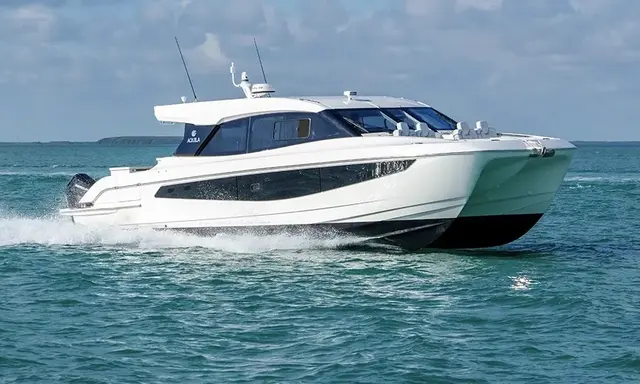
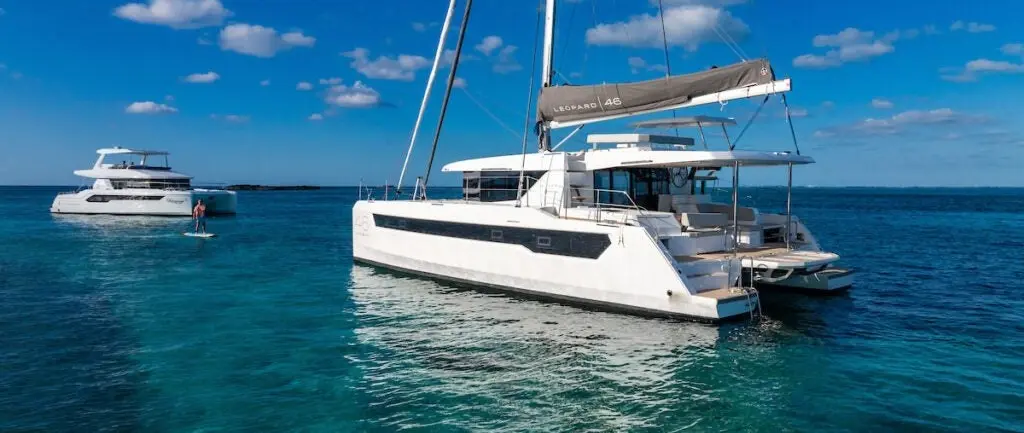
Lead photograph: Leopard 46 official manufacturer's model-gallery photograph; representative archive image, no unverified Paris on-site yacht display implied. © Leopard Catamarans and original photographer. Official builder model-gallery photograph; original rights remain with the creator. Original official image source.