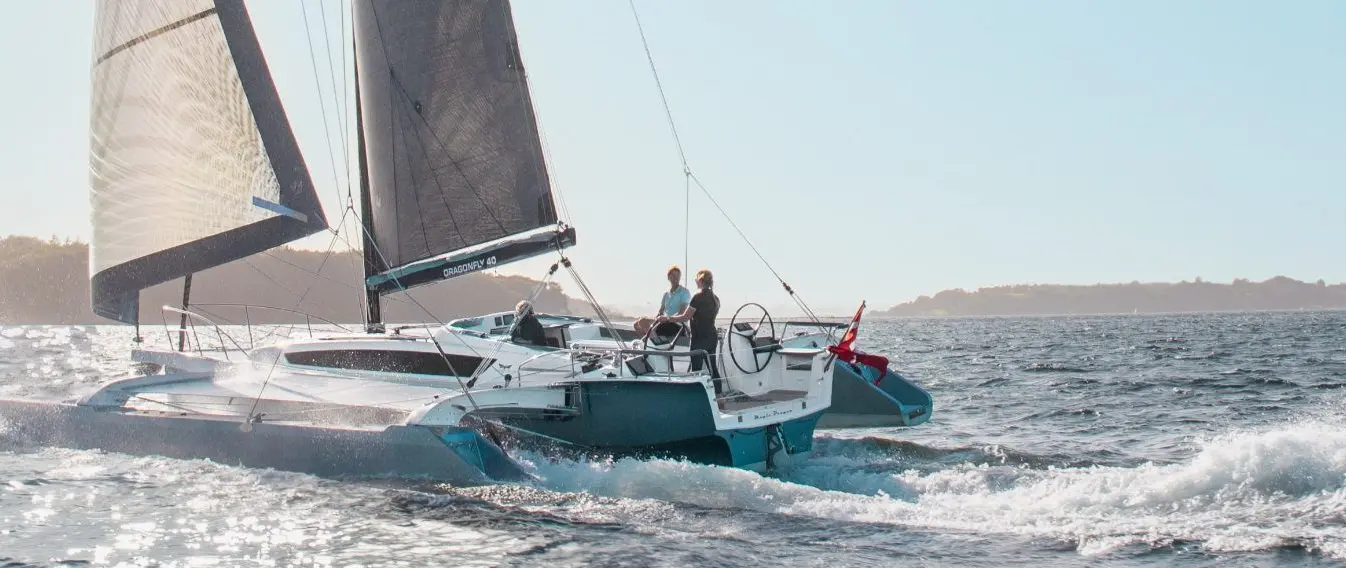
The Dragonfly 40 Carbon is set to make its UK debut at the 2026 Southampton International Boat Show, presenting a lighter high-performance version of the Danish yard's folding 40-foot trimaran. The Carbon specification uses pre-preg carbon construction to reduce the weight of the standard boat by more than 15 per cent, with the aim of improving acceleration and agility without abandoning the cruising systems of the established Dragonfly 40.
The model sits inside Luxury Yacht Guide's size range with a 12.40-metre centre-hull length. It also illustrates a very different route to performance cruising from a conventional monohull, combining a wide sailing platform with a folding system that reduces the boat's marina beam.
Carbon construction targets lower mass
Southampton's official model presentation says the Carbon version uses pre-preg carbon construction to cut standard-boat weight by more than 15 per cent. Reducing structural mass can improve acceleration and responsiveness because less energy is needed to drive the boat through changes in wind strength and sea state.
The advantage is not only maximum speed, since a lighter platform can also respond more quickly in marginal conditions. The practical trade-off is that carbon construction demands tighter manufacturing control and usually carries a higher purchase cost than conventional composite construction.
Folding reduces an 8.40m beam to 4.00m
The Dragonfly 40 has a sailing beam of 8.40 metres, giving the trimaran a large, stable platform underway and at anchor. Dragonfly's folding system reduces that beam to 4.00 metres for marina use, allowing the yacht to fit into a berth much closer to the dimensions expected for a conventional cruising boat.
The centre hull measures 12.40 metres overall, while the boat extends to 14.17 metres in its folded configuration because of the geometry of the amas and folding structure. That combination means berth planning should consider both reduced beam and folded length rather than treating the yacht as a simple 40-footer.
Shallow-water access remains part of the concept
With the centreboard and rudder raised, published draught is approximately 0.70 metres, opening anchorages that deeper-keel yachts cannot reach. The centreboard can be lowered for sailing performance, while the trimaran's wide platform provides stability without relying on a conventional deep ballast keel.
Dragonfly lists the model for CE Category A operation with up to six people, and the standard inboard diesel is rated at 40hp with a 57hp option available. Fuel capacity is 150 litres and freshwater capacity 220 litres, supporting the yacht's role as more than a short-distance performance demonstrator.
Southampton gives the Carbon version its UK debut
The Dragonfly 40 Carbon is due at Southampton on berth M131, where visitors will be able to inspect the folding mechanism, cockpit and accommodation rather than judging the concept only from performance figures. The show also gives buyers a direct way to assess how much interior and deck practicality has been retained after the weight-saving programme.
Luxury Yacht Guide already lists the Dragonfly 40 in its production-yacht database, so this article records the Carbon variant's UK market debut rather than creating a second model entry. We will follow owner and test data as the lighter specification moves into wider service.