Cape Town working marina gains repeat recognition
The V&A Waterfront Marina in Cape Town has been awarded Blue Flag status for the eighth consecutive season, a recognition of the marina's efforts to maintain high environmental and operational standards. Its renewal was announced on 8 October 2026 at a ceremony at Hermanus's Grotto Beach as the Blue Flag programme marked 25 years in South Africa.
The award matters because the V&A is not an isolated leisure harbour: it operates within a busy 123-hectare precinct used by fishing boats, commercial vessels, tourism operators and private yachts. Keeping waterways safe and attractive in such a setting requires regular attention beyond the visible facilities used by visiting boat owners.
Blue Flag is coordinated globally by the Foundation for Environmental Education and administered locally by the Wildlife and Environment Society of South Africa. It assesses matters including environmental management, accessible information, safety and education, rather than simply the number of luxury berths available.
Marine wildlife receives practical protection
The marina works with the Two Oceans Aquarium Foundation through a Marine Wildlife Management Programme, helping staff respond to animals moving through the working harbour. That cooperation gives an environmental role to everyday waterfront operations, where vessel movements and human activity can bring people into close proximity with marine species.
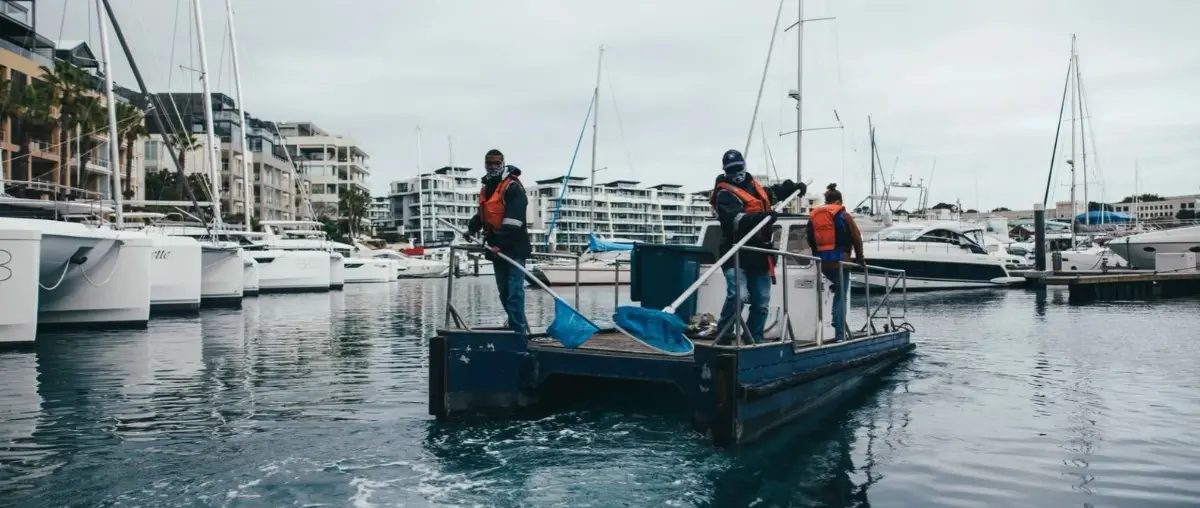
Daily marina patrols collect floating litter and debris, while strategically placed netting intercepts additional waste before it spreads towards the wider harbour or the open ocean. Those measures are particularly useful in a complex commercial waterfront, where material can enter the water from several sources.
The V&A Waterfront also plans future initiatives including a marine bay suitable for swimming and a turtle conservation centre at Granger Bay. These are announced ambitions, not completed facilities or services visitors can necessarily use today.
What boat owners can take from Blue Flag standards
For a yacht visiting Cape Town, the most important consequence of active marina management is practical rather than symbolic. Clear safety procedures, functioning collection services, reliable communications and disciplined waste handling help make harbour stops easier for owners and crews.
Responsible boaters still need to follow local pump-out arrangements and keep plastics, cleaning chemicals and other contaminants out of the water. A marina award does not replace a captain's obligations, nor does it provide an independent technical rating of any individual yacht's environmental footprint.
Visitors choosing among destinations may reasonably include environmental management alongside berth dimensions, shore power, security and transport access. The presence of a formal certification gives them another question to ask, but availability and actual services should be confirmed directly.
A milestone year for South African coastal tourism
The 2026 national awards recognised 50 beaches, seven tourism boats and five marinas with full Blue Flag status. An additional 20 beaches received pilot recognition, while 19 coastal sites were acknowledged under WESSA's Green Coast initiative.
South Africa was the first country outside Europe to adopt Blue Flag, and the ceremony coincided with WESSA's centenary. These milestones help explain the programme's prominence in local coastal tourism without implying that every participating location offers the same boating facilities.
The photograph accompanying this report was distributed with coverage of the real V&A Waterfront Marina. It illustrates the existing destination, while the October award confirms continued work by marina staff and conservation partners rather than the opening of a new yacht marina.