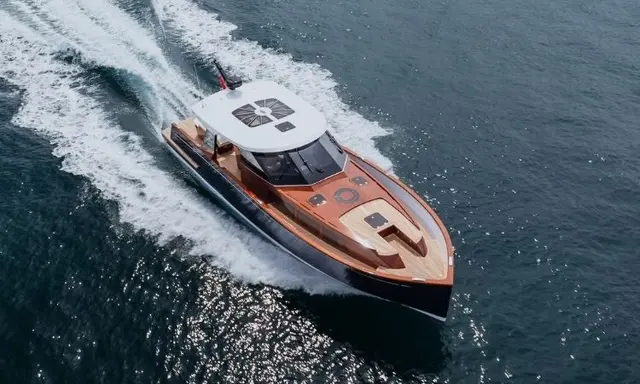
Callegari has chosen Cannes for the world premiere of the Callegari 48, a new 14.94-metre flagship intended to re-establish the Italian name at the top end of the maxi-RIB market. The project combines a carbon structure, a hydrodynamically developed hull and luxury-yacht-style interior treatment in a format aimed at both performance and extended days aboard.
The builder is making technology a central part of the launch rather than relying only on styling. Callegari says the 48 uses composite processes derived from aerospace practice, with engineering led by Antonello Guidi and exterior design by Lorenzo Guadagnucci, while the yard’s own technical team under architect Francesca Rubbi developed the interior.
A full-carbon structure
The Callegari 48 is built around a monobloc full-carbon structure produced with infusion techniques. The yard says controlled post-curing and software monitoring during construction are used to manage the process, with the goal of achieving the stiffness and low weight needed for a high-performance boat of this size.
Official model data lists an overall length of 14.94 metres and a beam of 4.80 metres. Callegari recommends around 1,200 hp of installed power, placing the new flagship firmly in the high-output maxi-RIB class while leaving the final propulsion specification to be matched to each owner’s brief.
CFD shapes the running surface
The hull has been developed with computational fluid dynamics to refine running attitude, resistance and stability before full-scale testing. Callegari is presenting that work as a direct link between its engineering programme and the experience at the helm rather than as a purely theoretical design exercise.
A lightweight structure only delivers useful efficiency if the hull and propulsion work with it, so the design team has treated weight, balance and hydrodynamics as one system. The result is intended to preserve the fast, direct character expected from a maxi-RIB while improving refinement and structural control.
Exterior design keeps the brand recognisable
Lorenzo Guadagnucci’s exterior styling uses sculpted surfaces and a relatively clean profile rather than covering the boat with decorative detailing. Callegari says the design is intended to reinterpret the brand’s heritage in a modern way, giving the 48 a recognisable silhouette without making the project dependent on nostalgia.
The large open deck remains central to the concept, because the 48 is still designed around direct contact with the sea. At this size, however, the deck plan also has to support dining, shade, circulation and longer periods aboard in a way that smaller performance RIBs are not expected to manage.
Interiors move beyond day-boat expectations
The interior brief is deliberately more ambitious than a conventional support boat. Callegari’s technical department has used materials, lighting and continuous design themes to make the lower-deck spaces feel part of the same luxury product as the exterior rather than an afterthought used only for occasional overnight stays.
That shift is important because the premium RIB sector increasingly overlaps with compact motor yachts. Buyers now expect a boat around 15 metres to provide genuine privacy, good headroom and carefully finished accommodation while still preserving the open-deck character that attracted them to the category in the first place.
Cannes tests Callegari’s international ambitions
Chief executive Jacopo Recchia has linked the new flagship to international expansion, identifying the United States, Middle East and Asia alongside the European market. The Cannes debut gives the yard access to dealers, owners and media from all of those regions in one event.
The Callegari 48 therefore represents more than a single new model. It is a statement that the company wants to compete again in the global premium sector using Italian design and carbon engineering as its principal differentiators, with Cannes serving as the first major public measure of that strategy.
Carbon engineering has to deliver more than a headline
Callegari is making full-carbon construction a central part of the 48 story, but owners will ultimately judge the benefit through ride, noise, efficiency and long-term structural quality rather than the material label alone. The combination of infused composites, controlled post-curing and CFD-developed hull geometry is intended to make the engineering visible in how the boat behaves, not just in a technical specification sheet.
The Cannes premiere therefore gives the yard an important credibility test. A returning premium name can attract attention with design and heritage, but dealers and experienced owners will also want evidence of repeatable build quality and service support. If the 48 can translate aerospace-influenced production methods into a refined everyday yacht, Callegari will have a stronger argument for international growth than performance figures by themselves.