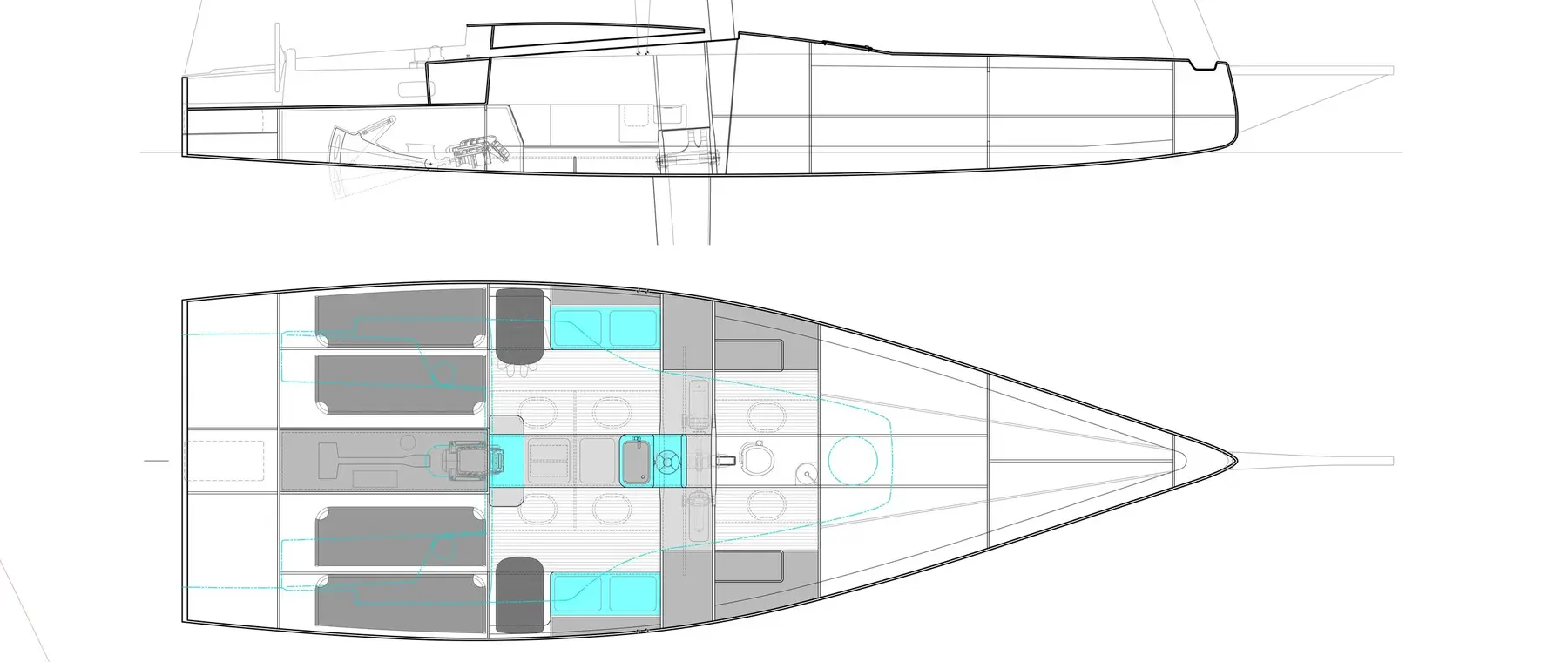
The 40OF design team is continuing development of a 40-foot offshore monohull intended to achieve full foiling in open-ocean racing. At approximately 12.2 metres overall, the project sits just inside Luxury Yacht Guide's size range while pursuing performance usually associated with far more specialised racing platforms.
The concept is being developed by designers Wilson/Marquinez with Sailing Architect and a network of build and technical partners. The team is seeking buyers and investors to move from design development toward a prototype and eventually a one-design class.
Four sailing modes are built into the concept
The yacht is designed to move between displacement, foil-assisted, semi-foiling and full-foiling modes rather than relying on flight in every condition. Retractable C-foils, rudder foils, water ballast and a canting keel are used together to alter lift and righting moment as wind and sea state change.
That flexibility is important offshore because full flight is not always the fastest or safest option in large waves. The design team specifically expects the boat to back away from maximum lift when conditions would make repeated take-offs and landings too violent.
The project draws on America's Cup experience
Designers Nahuel Wilson and Laureano Marquinez previously worked on AC75 development and on high-performance ocean-racing projects. Their more recent foiling work also includes the Persico 69F, giving the 40OF programme a technical foundation in fully foiling monohulls.
The challenge is transferring that experience into a yacht expected to survive long offshore races rather than short-course competition. Structure, control systems and foil geometry therefore have to balance outright lift with reliability and manageable crew workload.
Performance targets reach 19 to 30 knots
Sailing Architect publishes target foiling speeds of roughly 19 to 30 knots across the normal wind range, with reaching and downwind flight possible from around 12 knots of true wind. Upwind foiling is envisaged in stronger conditions, while lighter airs would use the foils mainly to increase righting moment.
Those are design predictions rather than verified sea-trial figures because no production prototype has yet completed an offshore campaign. The project team has instead modelled performance against real race conditions, including the 2026 Newport to Bermuda weather profile.
Two yards have already priced possible builds
Evolution Marine in South Africa and Moore Brothers in the United States have both produced build proposals using different carbon-composite methods. The team is also exploring additional yards in Europe and Asia as part of a longer-term plan for regional fleet support.
The next decisive step is construction of a first full-size yacht. Until then, the 40OF remains an ambitious development project, but one that shows how America's Cup-style foiling technology is continuing to move toward offshore yachts around the 12-metre mark.